
NEET Choice Filling Tips 2026: How to Order Preferences Smartly
The best NEET choice-filling strategy is to arrange colleges and courses in your genuine order of preference, beginning with the option you would most like to join. Do not place a less-preferred college above a dream college simply because its previous cutoff appears safer. The counselling system considers your rank, eligibility, category, available seats and submitted preference order to identify the highest available choice for you.
A strong preference list should include ambitious, competitive, realistic and safer options. However, every listed college must be acceptable in terms of course, fees, location, clinical exposure, hostel facilities, service obligations and personal priorities.
Candidates should also understand that NEET examination and counselling are handled by different authorities. NTA conducts NEET UG as the common entrance examination for undergraduate medical admission, while MCC and state counselling authorities manage different groups of seats. The official NEET UG portal currently carries the 2026 Information Bulletin and related notices.
These NEET Choice Filling Tips 2026 explain eligibility, expected Round 1 dates, registration, documents, choice filling, seat allotment, reporting and the mistakes candidates should avoid before locking their medical-college preferences.
Last Updated – July 10, 2026

➡️ Explore our College Predictor: /college-predictor
Official disclaimer: This article provides general admission guidance and is not an official notification from NTA, MCC, NMC or any state counselling authority. Dates, fees, seat matrices, eligibility rules, reservation policies and reporting instructions may change. Candidates must verify all details through the relevant official portals before registration, choice locking or admission.
Who Conducts NEET Counselling 2026?
NEET counselling is not completed through one portal for every medical seat. Candidates may need to participate separately in MCC counselling and one or more state counselling processes.
MCC manages counselling for the 15% All India Quota and specified seats in participating central universities, institutions and other categories covered by its counselling framework. State authorities separately manage eligible state-quota and applicable private-college seats according to their own rules.
| Counselling route | Main responsibility |
|---|---|
| MCC counselling | All India Quota and other specified participating seats |
| State counselling | State-quota and applicable private or institutional seats |
| Institutional requirements | Additional admission formalities prescribed by the allotted institution |
Registering with MCC does not automatically register a candidate for state counselling. Each process may have separate fees, schedules, eligibility conditions and preference lists.
Expected NEET Counselling Round 1 Schedule 2026
As of July 10, 2026, MCC’s main portal is still displaying counselling information for the 2025 admission session, while its current UG updates also include continuing 2025 counselling activities. A confirmed MCC NEET UG 2026 Round 1 schedule was not visible in the official pages reviewed for this article.
The following timeline is therefore an expected planning window, not an official schedule.
| Expected activity | Tentative period |
|---|---|
| MCC counselling notification | After completion of the NEET UG 2026 result process |
| Round 1 registration and payment | Expected after the official MCC notification |
| Choice filling and locking | During the notified Round 1 registration window |
| Seat-allotment processing | After choice locking closes |
| Round 1 result | On the date announced by MCC |
| Reporting at allotted college | Within the official post-allotment reporting period |
Candidates should not rely on dates from previous years or social-media posts. Monitor the official MCC portal and the relevant state counselling website regularly.
NEET Counselling 2026 Eligibility
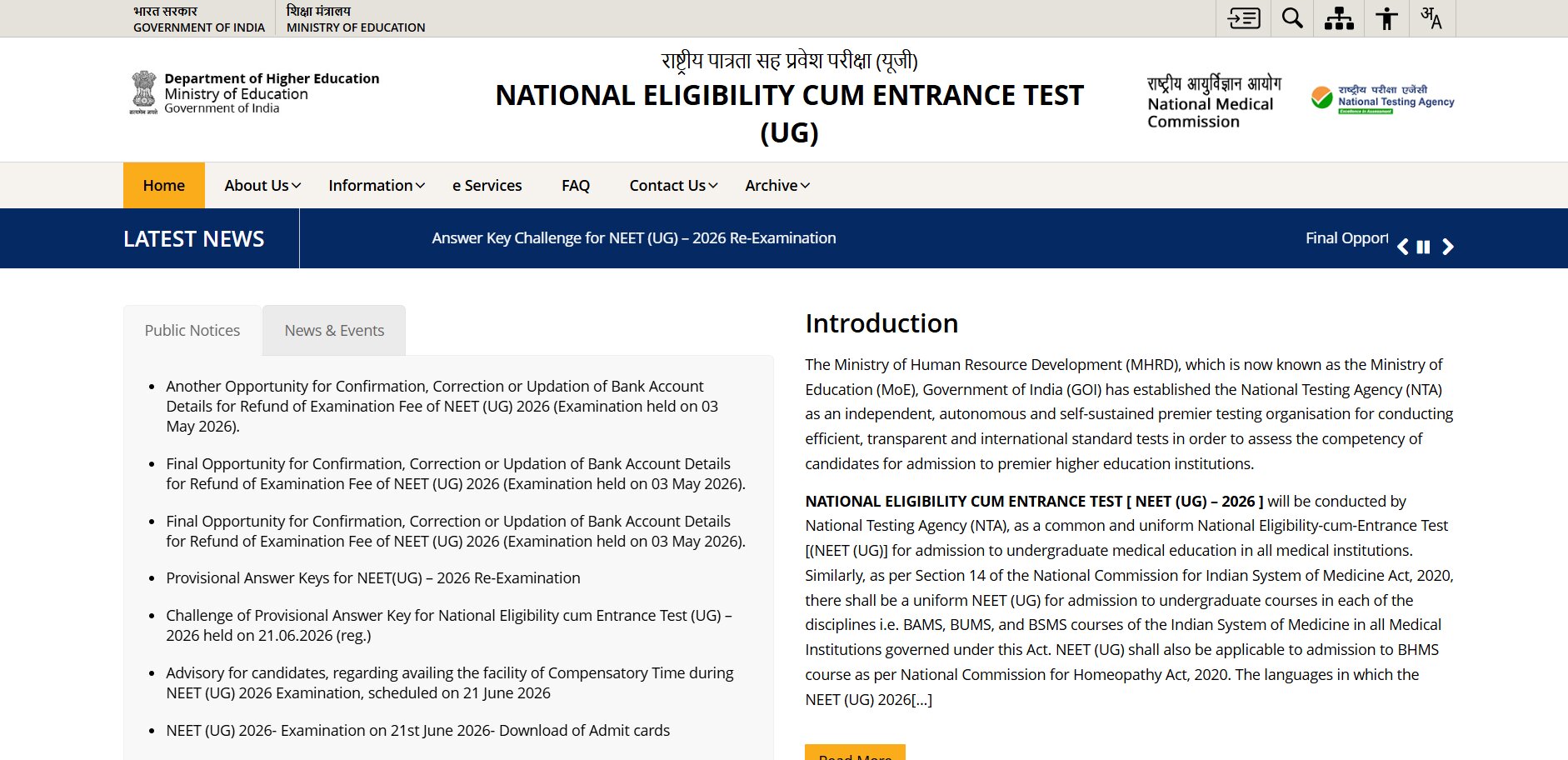
Visit Official Website : neet.nta.nic.in
Candidates must satisfy both NEET qualification requirements and the conditions imposed by the counselling authority for the relevant seat.
General eligibility considerations include:
- qualifying NEET UG 2026 under the applicable category;
- satisfying the age and educational conditions stated in the official bulletin;
- completing Class 12 or an equivalent examination with the prescribed subjects;
- possessing valid category, nationality and identity documents;
- meeting domicile requirements for applicable state-quota seats;
- satisfying NRI, minority, institutional or special-category rules where claimed;
- registering and paying the required counselling fees within the deadline.
NEET UG 2026 is the common entrance examination for undergraduate medical education and also applies to specified undergraduate AYUSH and homoeopathy programmes under the relevant legislation.
Qualifying NEET does not make a candidate eligible for every available seat. Quota-specific eligibility must be checked separately before choices are submitted.
| Eligibility area | What candidates should verify |
|---|---|
| NEET qualification | Valid 2026 score, rank and qualifying status |
| Academic eligibility | Required subjects, marks and qualifying examination |
| Quota eligibility | AIQ, domicile, category, NRI or institutional conditions |
| Documentary eligibility | Correct, valid and properly formatted certificates |
Documents Required for NEET Counselling 2026
The final document list can vary according to the counselling authority, category, course and allotted institution. Candidates should treat the current official MCC or state checklist as the final requirement.
| Document group | Commonly required documents |
|---|---|
| NEET documents | NEET UG admit card, scorecard and rank letter |
| Academic documents | Class 10 certificate, Class 12 marksheet and passing certificate |
| Identity documents | Aadhaar card or another permitted government identity proof |
| Category documents | SC, ST, OBC-NCL, EWS or PwBD certificate, where applicable |
| Residence documents | Domicile, residence or nationality certificate, where required |
| Counselling documents | Registration slip, payment receipt and provisional allotment letter |
| Reporting documents | Passport-size photographs, medical fitness certificate and undertakings |
| Special-category documents | NRI, minority or institutional eligibility proof, where applicable |
Candidates should confirm that names, dates of birth and category details match across all records. Certificates should comply with the prescribed format and validity period.
Keep both original documents and the required number of self-attested copies ready before reporting.
NEET Counselling Registration Process
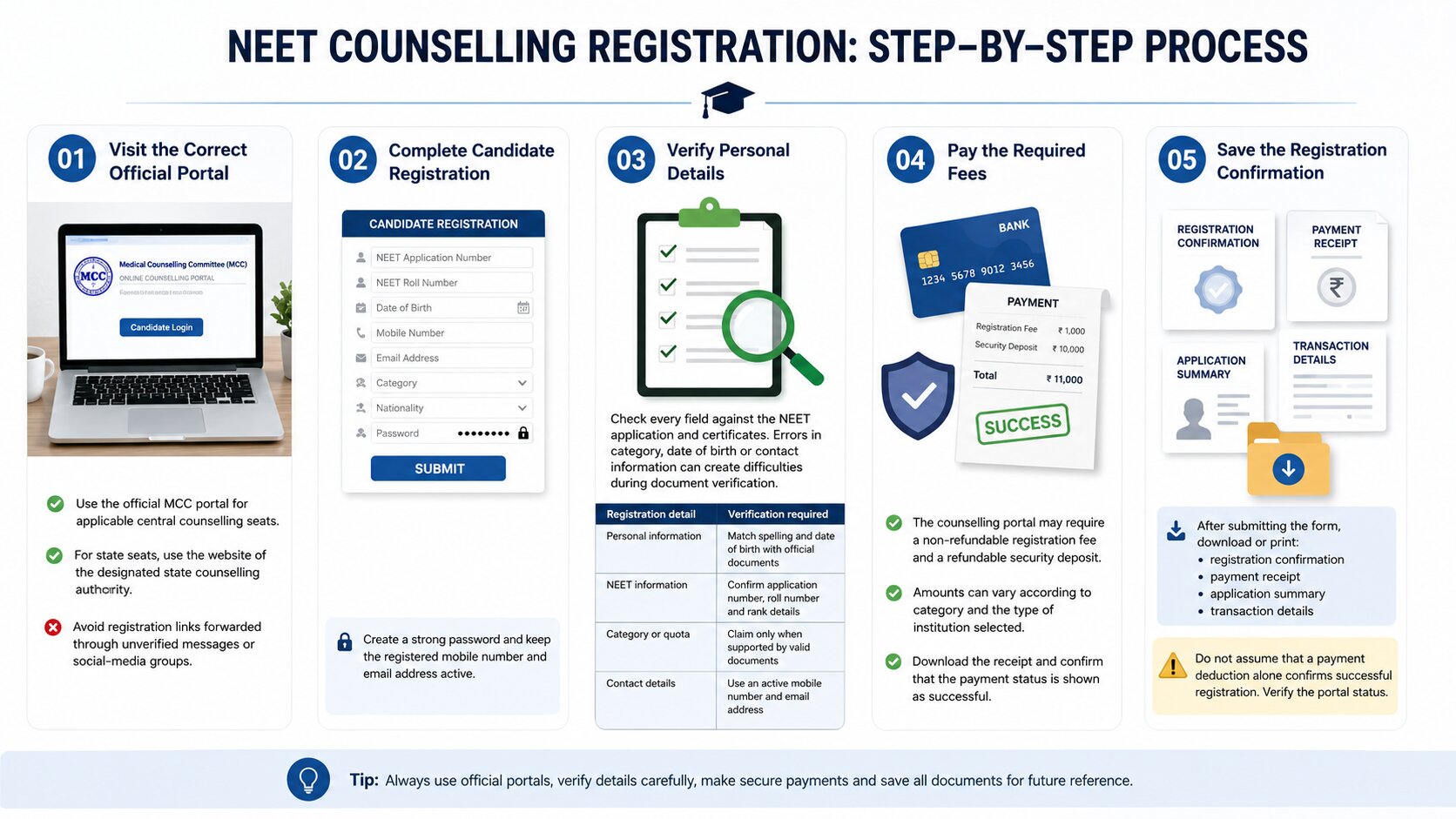
Step 1: Visit the Correct Official Portal
Use the official MCC portal for applicable central counselling seats. For state seats, use the website of the designated state counselling authority.
Avoid registration links forwarded through unverified messages or social-media groups.
Step 2: Complete Candidate Registration
Enter the requested details, which may include:
- NEET application number;
- roll number;
- date of birth;
- contact details;
- category;
- nationality;
- security information.
Create a strong password and keep the registered mobile number and email address active.
Step 3: Verify Personal Details
Check every field against the NEET application and certificates. Errors in category, date of birth or contact information can create difficulties during document verification.
| Registration detail | Verification required |
|---|---|
| Personal information | Match spelling and date of birth with official documents |
| NEET information | Confirm application number, roll number and rank details |
| Category or quota | Claim only when supported by valid documents |
| Contact details | Use an active mobile number and email address |
Step 4: Pay the Required Fees
The counselling portal may require a non-refundable registration fee and a refundable security deposit. Amounts can vary according to category and the type of institution selected.
Download the receipt and confirm that the payment status is shown as successful.
Step 5: Save the Registration Confirmation
After submitting the form, download or print:
- registration confirmation;
- payment receipt;
- application summary;
- transaction details.
Do not assume that a payment deduction alone confirms successful registration. Verify the portal status.
NEET Choice Filling Guide 2026
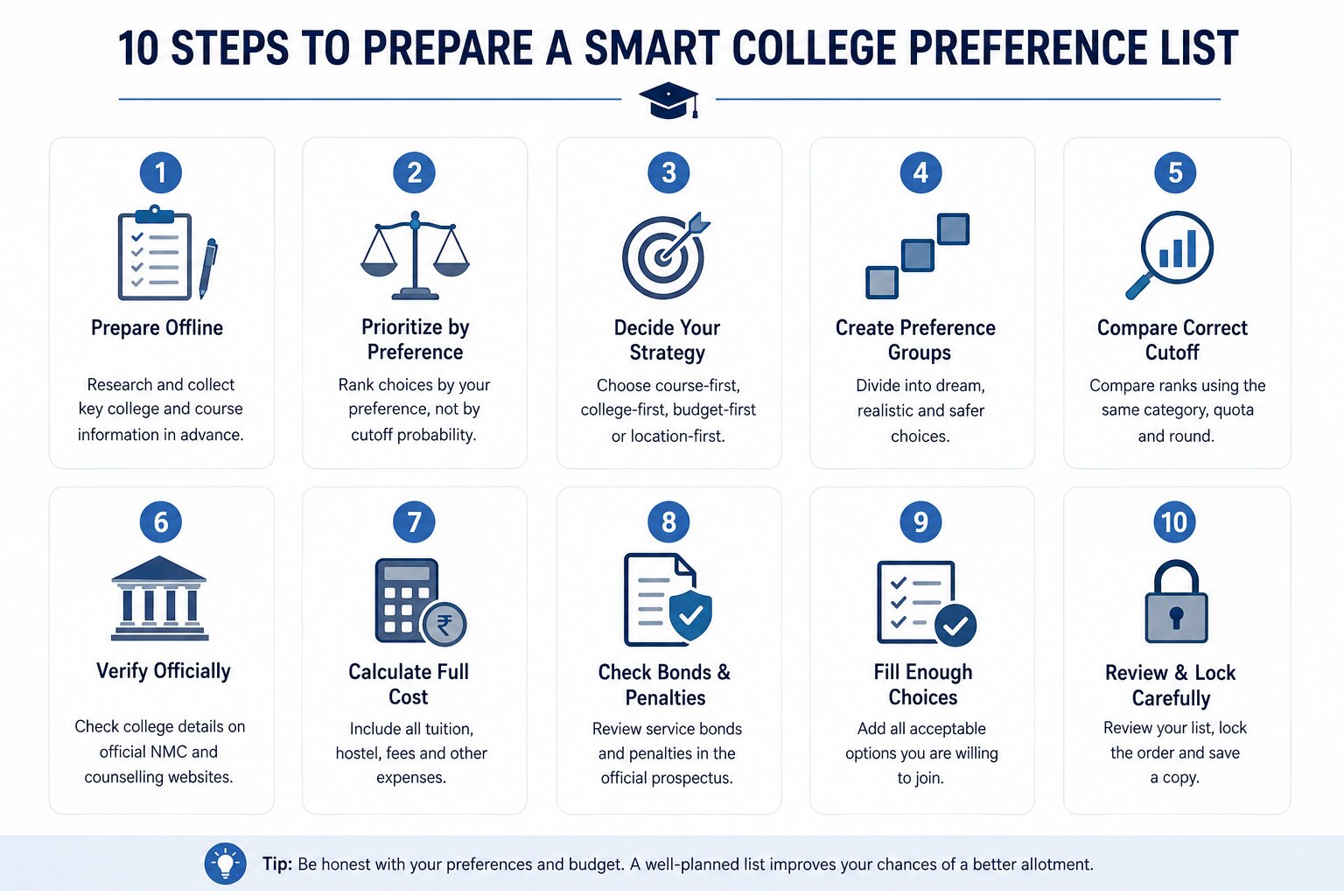
1. Prepare the Preference List Offline
Do not begin researching colleges only after the choice-filling window opens. Create a spreadsheet in advance.
| Information to collect | Why it matters |
|---|---|
| College and course | Identifies the exact preference combination |
| Quota and category | Ensures the cutoff comparison is relevant |
| Previous closing ranks | Helps assess historical competitiveness |
| Tuition and total cost | Shows whether the option is affordable |
| Bond conditions | Reveals service commitments and penalties |
| Location and hostel | Helps evaluate daily living conditions |
| Clinical exposure | Indicates likely practical-learning opportunities |
| Personal ranking | Records your genuine preference |
2. Arrange Choices by Preference, Not Cutoff Probability
Suppose you prefer College A over College B, but College A closed at a more competitive rank last year. College A should still appear above College B.
Your choice list should answer:
“Which option would I choose if both were available?”
It should not answer:
“Which option is easiest to obtain?”
Dream colleges can remain at the top. Realistic and safer choices should follow in genuine preference order.
3. Decide Your Course Priority
Candidates should decide whether they are following a course-first or college-first strategy.
| Strategy | How preferences are arranged |
|---|---|
| Course-first | All acceptable MBBS options are placed before BDS or other courses |
| College-first | A preferred institution or location may be prioritised across courses |
| Budget-first | Affordable options are placed above colleges exceeding the family budget |
| Location-first | Colleges near home or in preferred states receive greater priority |
Do not include BDS, nursing, AYUSH or another course simply as a backup unless you are genuinely prepared to study it.
4. Divide Choices Into Preference Groups
A practical list can be divided into three usable groups, with unacceptable options excluded completely.
| Preference group | Meaning |
|---|---|
| Dream choices | Highly preferred options with historically more competitive cutoffs |
| Realistic choices | Colleges where previous closing ranks are near your range |
| Safer choices | Acceptable colleges with historically less competitive closing ranks |
A “safe” choice is never guaranteed. Cutoffs can change because of seat availability, candidate behaviour, reservation, new colleges and round-wise movement.
5. Compare the Correct Cutoff
Never compare your rank with a cutoff from the wrong category or quota.
Check that the data matches:
- counselling authority;
- institution;
- course;
- category;
- quota;
- counselling round;
- seat type;
- applicable rank format.
An AIQ Open-category closing rank should not be treated as the likely cutoff for a reserved state-quota seat.
6. Verify the College Officially
The NMC maintains official information on colleges teaching MBBS, including institution, management, annual intake and recognition-related details. Candidates should cross-check the college with current counselling seat matrices and official regulatory information.
Do not depend entirely on advertisements, third-party college lists or unverified claims about recognition and seats.
7. Calculate the Full Course Cost
Private and deemed institutions may involve expenses beyond tuition.
Include:
- annual tuition fee;
- hostel and mess charges;
- deposits and security payments;
- university and examination charges;
- annual fee revisions;
- travel and living expenses;
- discontinuation penalties;
- service-bond consequences.
Do not list a college that your family cannot realistically afford.
8. Check Service Bonds and Penalties
Bond conditions may differ between states and institutions. Some colleges may require compulsory service, impose a penalty for non-service or prescribe separate discontinuation charges.
Verify these conditions through the latest official prospectus before placing the college in your list.
9. Fill Enough Acceptable Choices
Submitting only a few famous colleges can reduce your allotment possibilities.
Include every eligible college-course combination that you would genuinely accept. However, do not fill choices merely to increase the count.
Ask this before adding any option:
“Would I report and take admission here if this becomes my final allotment?”
10. Review and Lock Carefully
Before locking, verify the complete order at least twice.
| Final review area | Question to ask |
|---|---|
| Preference sequence | Is every higher choice genuinely preferred? |
| Course selection | Am I willing to study every listed course? |
| Affordability | Can my family manage the complete cost? |
| Eligibility | Do I qualify for the selected quota or seat type? |
| Reporting readiness | Can I complete admission within the deadline? |
Save and download the locked preference list according to the portal’s instructions.
How NEET Seat Allotment Works
Seat allotment broadly depends on:
- NEET rank;
- category and reservation;
- quota eligibility;
- submitted choice order;
- availability of seats;
- counselling rules for the relevant round.
The system checks the preferences in the submitted sequence and identifies the highest available option for which the candidate is eligible.
| Allotment factor | Candidate’s role |
|---|---|
| NEET rank | Already determined by examination performance |
| Category and quota | Must be claimed correctly with valid proof |
| Choice order | Controlled by the candidate before locking |
| Seat availability | Determined during allotment processing |
| Reporting compliance | Must be completed after receiving a seat |
A provisional allotment does not by itself complete admission. The candidate must follow the reporting and verification instructions.
Reporting Process After Seat Allotment
After a result is declared, candidates should immediately read the round-specific notice and allotment letter.
The reporting process may involve:
- downloading the provisional allotment letter;
- paying the prescribed admission fee;
- reporting online or at the allotted college;
- presenting original documents;
- completing document verification;
- undergoing a medical examination, where required;
- submitting declarations or undertakings;
- receiving admission confirmation;
- following the round’s upgrade, resignation or participation rules.
| Reporting requirement | Main precaution |
|---|---|
| Allotment letter | Verify the college, course, category and quota |
| Fee payment | Use the prescribed method and save proof |
| Document verification | Carry valid originals and required copies |
| College reporting | Reach within the stated date and time |
| Admission confirmation | Obtain written or portal-based acknowledgement |
Missing the reporting deadline or failing document verification may result in loss of the allotted seat, subject to the applicable counselling rules.
Common NEET Choice-Filling Mistakes

➡️ Get Personalized Guidance: College Predictor
Placing Safe Colleges First
A college should be ranked higher only when you prefer it more—not because it appears easier to obtain.
Filling Too Few Choices
A very short list may leave you without an allotment even when other acceptable seats are available.
Adding Unaffordable Colleges
An unaffordable private or deemed institution is not a practical backup.
Copying Someone Else’s Preference List
Ranks may be similar, but budget, domicile, course preference and family circumstances can be different.
Ignoring Bonds and Hidden Costs
A low tuition fee does not always mean the lowest total financial commitment.
Comparing Unrelated Cutoffs
AIQ, state quota, categories and counselling rounds should not be mixed.
Adding Unwanted Courses
Do not include a course unless you understand its career path and are prepared to join it.
Waiting Until the Last Hour
Technical problems, payment failures and heavy portal traffic can cause missed deadlines.
Failing to Download Proof
Keep copies of registration, payment, final choices, allotment and reporting confirmation.
Expert Counselling Tips
- Create separate preference lists for MCC and state counselling because available seats, quotas and fees differ.
- Use official closing ranks to estimate possibilities, but never use cutoff probability as the main ordering principle.
- Compare colleges through clinical exposure, academics, total cost, bond, location and personal comfort.
- Place every aspirational choice you genuinely prefer above realistic and safer choices.
- Remove any institution that is unaffordable, unacceptable or unsuitable for your long-term plans.
- Discuss the final budget with your family before locking private or deemed-university choices.
- Keep documents scanned and organised in clearly named folders.
- Check official notices daily during registration, allotment and reporting periods.
How Admittance Edutech Can Help
Preparing a NEET preference list requires careful analysis of rank, category, quota, budget, college quality and admission rules.
Admittance Edutech can assist candidates with:
- personalised NEET choice-filling strategy;
- MCC and state counselling guidance;
- MBBS and BDS college shortlisting;
- category-wise cutoff analysis;
- government, private and deemed-college comparison;
- fee and budget-based filtering;
- bond and location analysis;
- preference-list review;
- round-wise upgrade planning;
- reporting and document guidance.
The objective is to create a properly ordered list where every option is eligible, researched, affordable and genuinely acceptable.
Conclusion
NEET choice filling is a decisive part of medical counselling because the order of preferences can determine which available college and course are allotted. Candidates should place their most preferred eligible option first and arrange all remaining acceptable choices in descending order. Colleges should never be ranked merely according to cutoff probability, online popularity or another student’s list.
A well-designed preference list combines dream, realistic and safer choices while excluding institutions that are unaffordable or unsuitable. Before adding a college, candidates should examine the course, quota, category, fees, clinical exposure, hostel facilities, location, service bond and reporting requirements. Previous closing ranks can help estimate admission chances, but they cannot guarantee the 2026 outcome.
Candidates should also remember that MCC and state counselling are separate processes. Registration, fees, seat matrices, deadlines and eligibility conditions may differ. Every application, payment receipt, final preference list and allotment letter should be downloaded and preserved.
Before locking choices, review the sequence carefully with your family and confirm that you are prepared to join every listed option. A thoughtful preference order cannot guarantee a particular medical seat, but it can prevent avoidable mistakes and help you secure the best available option for your NEET rank, budget, eligibility and long-term career goals.

Related Post |Private MBBS Colleges in India Fees Structure 2026: Complete College-wise Comparison
Frequently Asked Questions
1. How should I arrange colleges during NEET choice filling 2026?
Arrange colleges in your genuine order of preference. Place the college-course combination you want most at the top, even if its previous closing rank was more competitive than your current rank.
2. Should I include dream colleges above my expected rank range?
Yes. Include aspirational choices first, followed by realistic and safer options. Previous cutoffs are only indicators and may change during NEET counselling 2026.
3. How many choices should I fill in NEET counselling?
Fill every eligible college-course combination that you would genuinely accept and can afford. Do not limit yourself to a few popular colleges, but avoid adding unacceptable options.
4. Is MCC registration enough for state-quota medical seats?
No. MCC and state counselling are separate processes. Candidates seeking state-quota seats generally need to register separately with the relevant state counselling authority.
5. Should I add a private medical college without checking its fees?
No. Verify tuition, hostel charges, deposits, other compulsory expenses, fee revisions and bond conditions before adding a private or deemed medical college.
ALSO,
-
JoSAA Round 3 Strategy 2026: When to Upgrade, Float, Slide or Freeze Your Seat
-
What is JoSAA Counselling 2026? Complete Beginner Guide for JEE Main and JEE Advanced Students
How should I arrange colleges during NEET choice filling 2026?
Arrange colleges in your genuine order of preference. Place the college-course combination you want most at the top, even if its previous closing rank was more competitive than your current rank.
Should I include dream colleges above my expected rank range?
Yes. Include aspirational choices first, followed by realistic and safer options. Previous cutoffs are only indicators and may change during NEET counselling 2026.
How many choices should I fill in NEET counselling?
Fill every eligible college-course combination that you would genuinely accept and can afford. Do not limit yourself to a few popular colleges, but avoid adding unacceptable options.
Is MCC registration enough for state-quota medical seats?
No. MCC and state counselling are separate processes. Candidates seeking state-quota seats generally need to register separately with the relevant state counselling authority.
Should I add a private medical college without checking its fees?
No. Verify tuition, hostel charges, deposits, other compulsory expenses, fee revisions and bond conditions before adding a private or deemed medical college. ALSO,