CLAT 2027 vs AILET 2027 represents the ultimate strategic dilemma for aspiring lawyers across India seeking entry into premier National Law Universities (NLUs). While the Common Law Admission Test (CLAT) serves as the centralized gateway for 24 prestigious NLUs—including NLSIU Bengaluru, NALSAR Hyderabad, and WBNUJS Kolkata—the All India Law Entrance Test (AILET) is conducted exclusively by National Law University, Delhi (NLU Delhi) for its boutique five-year integrated B.A. LL.B. (Hons.) program.
With both official examination notifications now active, registration portals open, and exam dates scheduled just seven days apart in December 2026, understanding the nuanced structural differences between CLAT 2027 and AILET 2027 is crucial for effective preparation. While both tests evaluate critical reading, logical reasoning, and current affairs, their section weightages, passage formats, mathematics requirements, and competition-to-seat ratios vary significantly. Law aspirants can explore comprehensive institution profiles and admission pathways in our specialized Law Admissions Category, assess national cutoff benchmarks via the All India College Predictor Hub, and review college infrastructure details in the Explore Colleges Directory.
CLAT 2027 vs AILET 2027: Core Comparison Matrix
To provide a clear high-level understanding of both national law examinations, the following matrix compares the essential parameters, conducting bodies, seat availability, and test structures for 2027 admissions:
| Comparison Feature | CLAT 2027 (Consortium of NLUs) | AILET 2027 (NLU Delhi) |
|---|---|---|
| Conducting Authority | Consortium of National Law Universities | National Law University, Delhi (Standalone) |
| Participating Institutions | 24 National Law Universities + 60+ Affiliate Law Schools | Exclusively National Law University, Delhi (NLU Delhi) |
| Total UG Seats Available | Approximately 3,300+ Seats across 24 NLUs | 123 Total Seats (110 Indian Merit + 13 Foreign/NRI/Supernumerary) |
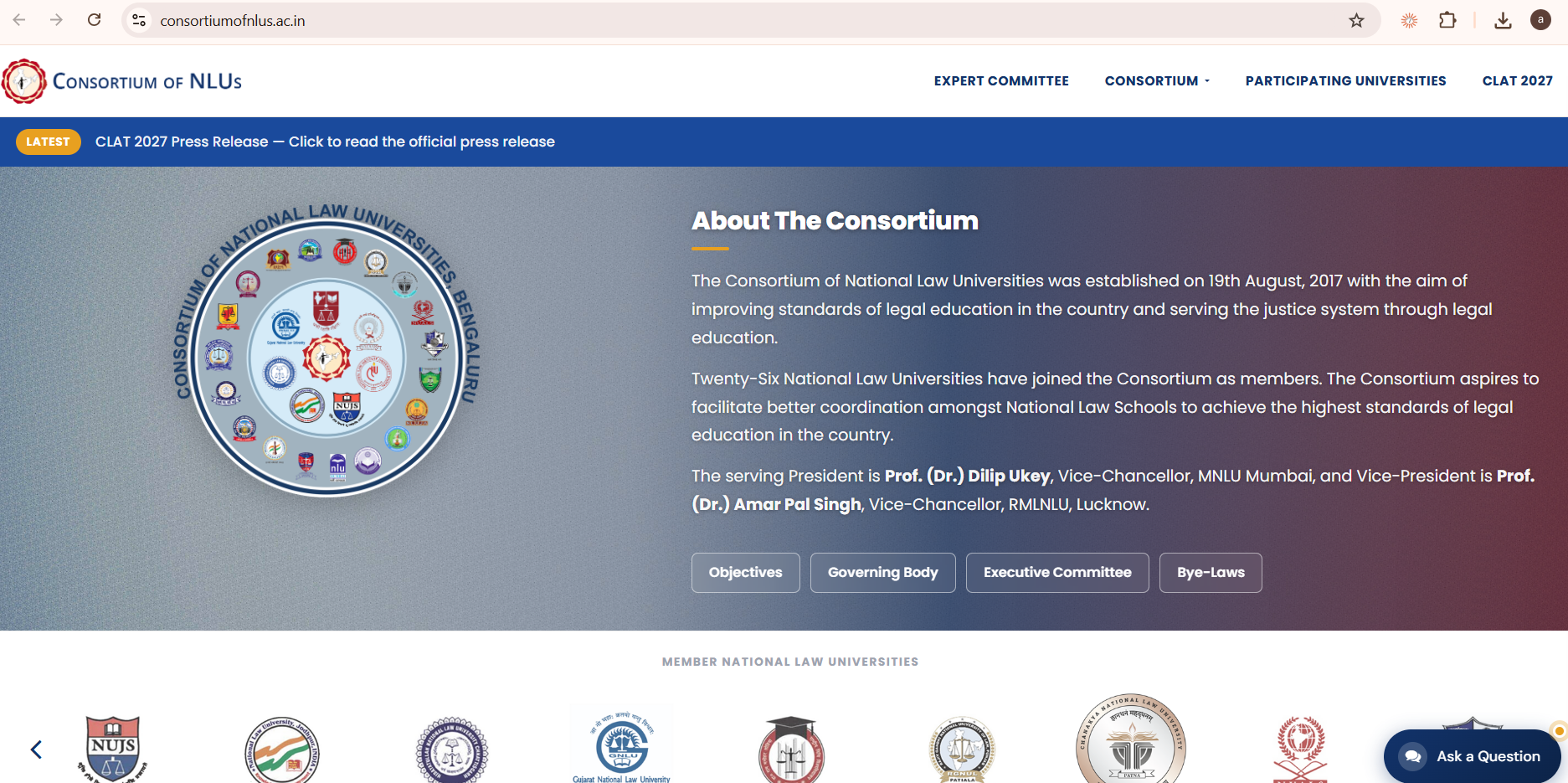
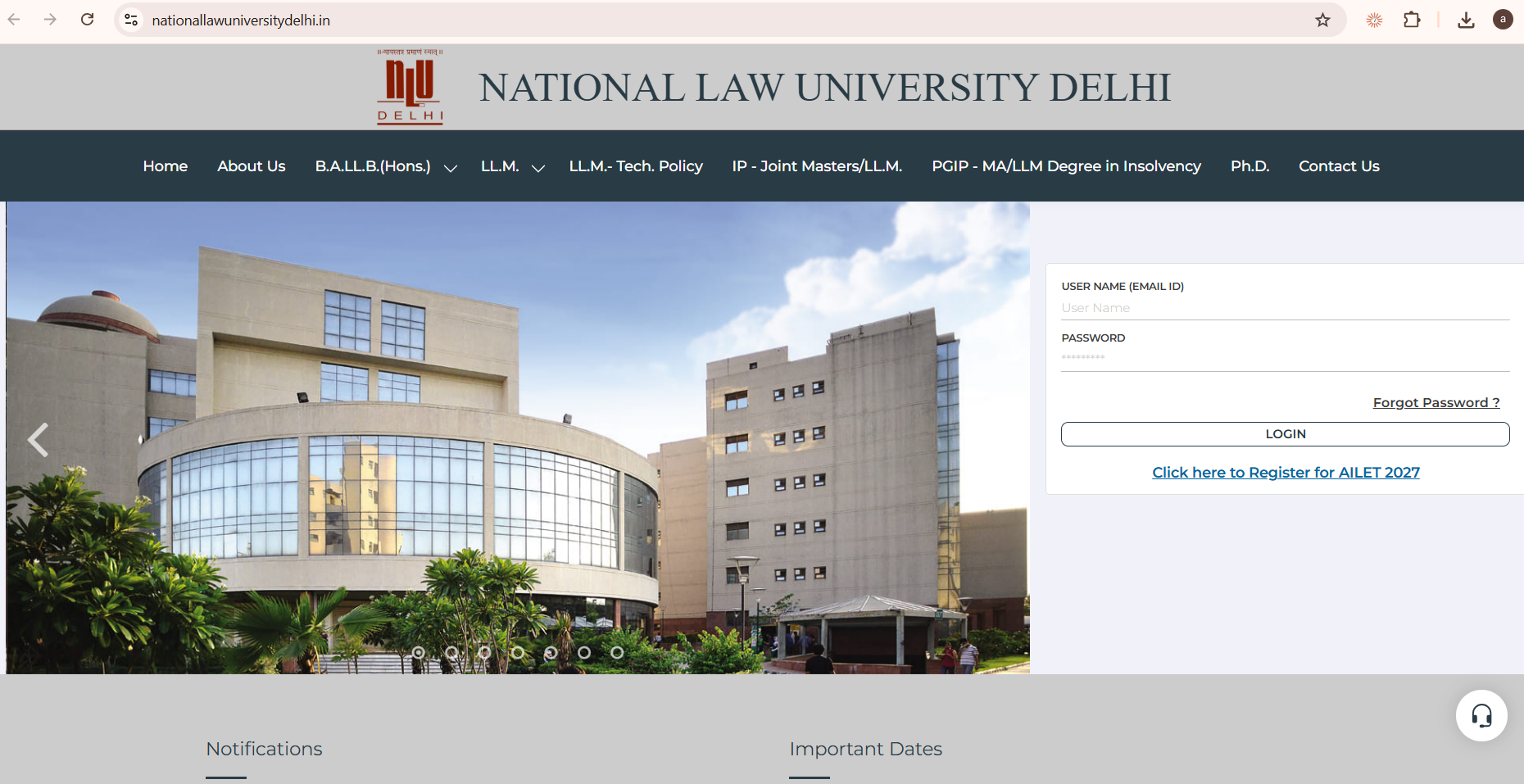
| Official Portal Link | consortiumofnlus.ac.in | nationallawuniversitydelhi.in |
| Exam Date and Time | December 6, 2026 (Sunday) | 2:00 PM – 4:00 PM | December 13, 2026 (Sunday) | 2:00 PM – 4:00 PM |
| Registration Window | August 3, 2026 – October 31, 2026 | August 7, 2026 – November 10, 2026 |
| Exam Mode | Offline (Pen-and-Paper OMR Format) | Offline (Pen-and-Paper OMR Format) |
| Duration of Examination | 120 Minutes (2 Hours) | 120 Minutes (2 Hours) |
| Total Number of Questions | 120 Objective MCQs | 150 Objective MCQs |
| Marking Scheme | +1 Mark for Correct Answer; -0.25 Mark for Incorrect Answer | +1 Mark for Correct Answer; -0.25 Mark for Incorrect Answer |
| Application Fee | General/OBC/NRI: ₹4,000 | SC/ST/BPL: ₹3,500 | General/OBC/EWS/NRI: ₹3,500 | SC/ST/PwD: ₹1,500 |
| Acceptance Ratio / Competitiveness | ~4.5% to 5.0% for Top 5 NLUs (~75,000 applicants) | ~0.4% Acceptance Rate (~25,000 applicants for 110 seats) |
Detailed Exam Pattern and Sectional Weightage Breakdown
The structural format of the question paper is the most significant operational difference between CLAT 2027 and AILET 2027. While CLAT tests five distinct disciplines strictly via passage-based comprehension, AILET tests three expanded sections with 150 questions in the same 120-minute timeframe.
| Subject / Section Name | CLAT 2027 Weightage (120 Questions) | AILET 2027 Weightage (150 Questions) | Structural & Testing Differences |
|---|---|---|---|
| English Language | 22 – 26 Questions (~20%) | 50 Questions (33.3%) | CLAT uses long contextual passages (450 words); AILET combines passage-based questions with vocabulary, grammar, idioms, and sentence correction. |
| Current Affairs and General Knowledge | 28 – 32 Questions (~25%) | 30 Questions (20.0%) | CLAT tests deep contextual understanding of contemporary events; AILET includes both static GK (history, constitution, geography) and national/international current affairs. |
| Logical Reasoning | 22 – 26 Questions (~20%) | 70 Questions (46.7%) | CLAT tests purely critical reasoning (arguments, assumptions, inferences from text); AILET covers critical reasoning, analytical puzzles, syllogisms, blood relations, and embedded legal reasoning scenarios. |
| Legal Reasoning / Legal Aptitude | 28 – 32 Questions (~25%) | Tested within Section C (Logical Reasoning) | CLAT tests legal principles, case analogies, and statutory interpretations directly in dedicated passages; AILET does not have a separate legal section but tests legal logic within Section C. |
| Quantitative Techniques (Mathematics) | 10 – 14 Questions (~10%) | Not Included (0 Questions) | CLAT features data interpretation passages, ratios, percentages, and basic algebra; AILET has eliminated quantitative techniques from its UG syllabus. |
Critical Takeaway on Time Management and Speed Pressures
In CLAT 2027, candidates have exactly 60 seconds per question (120 questions in 120 minutes), but must read approximately 15,000 to 18,000 words across 25 to 30 reading passages. In contrast, AILET 2027 demands lightning-fast decision making with only 48 seconds per question (150 questions in 120 minutes), making speed and instant analytical pattern recognition paramount for NLU Delhi aspirants.
Detailed Section-by-Section Syllabus and Topic Breakdown
To master both examinations, aspirants must dissect the exact syllabus components tested across English, Logical Reasoning, Current Affairs, Legal Reasoning, and Quantitative Techniques:
| Examination Section | CLAT 2027 Core Syllabus & Focus Areas | AILET 2027 Core Syllabus & Focus Areas |
|---|---|---|
| English Language | Comprehension passages from contemporary non-fiction, fiction, philosophical essays, and historical texts. Inference, central theme, tone of the author, contextual vocabulary, and comparative arguments. | Reading comprehension passages, grammar rules (tenses, prepositions, subject-verb agreement), vocabulary building, synonyms, antonyms, idioms, phrases, sentence improvement, cloze tests, and analogies. |
| Current Affairs & GK | Passage-based questions drawn from major national and international news, Supreme Court judgments, constitutional amendments, international treaties, economic policies, science, and cultural heritage. | Direct multiple-choice questions covering static General Knowledge (Indian Polity, Modern History, Geography, UN Bodies) alongside 12 months of dynamic national and global current events. |
| Legal Reasoning | Passages detailing legal philosophies, principles of Torts (negligence, nuisance, defamation), Contracts (offer, acceptance, consideration, breach), Criminal Law (IPC/BNS offences), and Constitutional Law (Fundamental Rights, DPSP). | Integrated inside Section C as legal logic puzzles. Testing candidate ability to apply given legal rules to specific factual situations without requiring external legal knowledge. |
| Logical Reasoning | Short passage-based critical reasoning evaluating premise-conclusion links, assumptions, strengthening/weakening arguments, parallel reasoning, paradoxes, and logical fallacies. | Comprehensive analytical and critical reasoning: seating arrangements, complex puzzles, coding-decoding, blood relations, directions, syllogisms, statements & assumptions, cause & effect, and course of action. |
| Quantitative Techniques | Caselets, graphical charts, tables, and passage-based Data Interpretation. 10th standard basic mathematical concepts including ratios, percentages, averages, profit & loss, time-speed-distance, and basic algebra. | Completely Excluded. No mathematical questions are included in the AILET undergraduate test. |
Participating National Law Universities and Seat Distribution
Understanding which universities accept which entrance exam is vital to prevent costly application mistakes. Candidates who aspire to study at NLU Delhi must register for AILET, as NLU Delhi does not accept CLAT scores. Similarly, candidates aiming for NLSIU Bangalore, NALSAR Hyderabad, or WBNUJS Kolkata must appear for CLAT.
| Tier / Classification | National Law University Name | Qualifying Entrance Test | Approximate UG Seat Intake | Flagship 5-Year Law Programs |
|---|---|---|---|---|
| Tier 1 Apex (South) | National Law School of India University (NLSIU), Bengaluru | CLAT 2027 | 300 Seats | B.A. LL.B. (Hons.) |
| Tier 1 Apex (National Capital) | National Law University, Delhi (NLU Delhi) | AILET 2027 Exclusively | 123 Seats | B.A. LL.B. (Hons.) |
| Tier 1 Apex (Telangana) | NALSAR University of Law, Hyderabad | CLAT 2027 | 180 Seats | B.A. LL.B. (Hons.) |
| Tier 1 Apex (West Bengal) | West Bengal National University of Juridical Sciences (WBNUJS), Kolkata | CLAT 2027 | 132 Seats | B.A. LL.B. (Hons.) / B.Sc. LL.B. (Hons.) |
| Tier 1 Premier (Rajasthan) | National Law University (NLUJ), Jodhpur | CLAT 2027 | 120 Seats | B.A. LL.B. (Hons.) / B.B.A. LL.B. (Hons.) |
| Tier 1 Premier (Gujarat) | Gujarat National Law University (GNLU), Gandhinagar & Silvassa | CLAT 2027 | 204 Seats + 66 Seats | B.A. / B.B.A. / B.Com. / B.Sc. LL.B. (Hons.) |
| Tier 2 Core NLUs (Madhya Pradesh) | National Law Institute University (NLIU), Bhopal | CLAT 2027 | 134 Seats | B.A. LL.B. (Hons.) / B.Sc. LL.B. (Cyber Security) |
| Tier 2 Core NLUs (Chhattisgarh) | Hidayatullah National Law University (HNLU), Raipur | CLAT 2027 | 180 Seats | B.A. LL.B. (Hons.) |
| Tier 2 Core NLUs (Maharashtra) | MNLU Mumbai, MNLU Nagpur, and MNLU Aurangabad | CLAT 2027 | 360+ Seats Total | B.A. LL.B. (Hons.) / B.B.A. LL.B. (Hons.) |
| Other Participating NLUs | 15 Additional State NLUs (Patna, Kochi, Cuttack, Ranchi, Shimla, etc.) | CLAT 2027 | 1,500+ Seats Total | Integrated LL.B. Specializations |
For personalized guidance on selecting university preference orders, calculating safe score percentiles, and building backup admission options, you can Book a Free Admission Counselling Session with our law education specialists.
Historical Cutoff Trends and Safe Score Analysis
Analyzing historical qualifying marks and closing ranks provides aspirants with realistic performance benchmarks for both examinations:
| Institution / Entrance Exam | General Merit (GM) Closing Rank | Estimated Raw Score (Out of Max Marks) | OBC / EWS Cutoff Range | SC / ST Cutoff Range |
|---|---|---|---|---|
| NLSIU Bengaluru (CLAT) | All India Rank 1 – 114 | 98.50 – 104.00 / 120 Marks | Rank 450 – 1,200 | Rank 2,800 – 7,500 |
| NLU Delhi (AILET) | All India Rank 1 – 72 | 102.00 – 108.50 / 150 Marks | Rank 210 – 480 | Rank 1,400 – 3,200 |
| NALSAR Hyderabad (CLAT) | All India Rank 115 – 210 | 94.00 – 98.00 / 120 Marks | Rank 950 – 1,600 | Rank 4,200 – 9,100 |
| WBNUJS Kolkata (CLAT) | All India Rank 211 – 340 | 91.50 – 94.50 / 120 Marks | Rank 1,400 – 2,200 | Rank 5,100 – 10,800 |
| NLUJ Jodhpur (CLAT) | All India Rank 341 – 470 | 88.00 – 92.00 / 120 Marks | Rank 1,800 – 2,800 | Rank 6,400 – 12,500 |
| GNLU Gandhinagar (CLAT) | All India Rank 471 – 650 | 85.00 – 89.50 / 120 Marks | Rank 2,200 – 3,500 | Rank 7,800 – 14,000 |
| Top 10 NLUs Safe Cutoff (CLAT) | All India Rank 651 – 1,400 | 78.00 – 84.50 / 120 Marks | Rank 3,800 – 6,000 | Rank 12,000 – 22,000 |
Tier-1 Law Firm Placements, Median CTC, and Career Trajectories
One of the primary drivers for cracking CLAT and AILET is the prestigious placement opportunities offered by top National Law Universities. Tier-1 law firms (known in India as the Seven Sisters—including Cyril Amarchand Mangaldas, Shardul Amarchand Mangaldas, Trilegal, AZB & Partners, Khaitan & Co, J. Sagar Associates, and Luthra and Luthra) recruit aggressively during Day Zero placement drives:
| National Law University | Highest International CTC | Highest Domestic CTC | Median Domestic CTC | Prominent Recruiters / Career Paths |
|---|---|---|---|---|
| NLSIU Bengaluru | £55,000 – £65,000 / annum (Magic Circle UK firms) | ₹20.00 – ₹24.00 Lakhs / annum | ₹18.00 – ₹19.50 Lakhs / annum | CAM, SAM, Trilegal, Linklaters, Allen & Overy, Supreme Court Clerkships. |
| NLU Delhi (AILET) | £50,000 – £60,000 / annum | ₹19.50 – ₹23.00 Lakhs / annum | ₹17.50 – ₹19.00 Lakhs / annum | AZB, Khaitan & Co, SAM, ICICI Bank In-House, Policy Think Tanks. |
| NALSAR Hyderabad | £45,000 – £55,000 / annum | ₹18.50 – ₹22.00 Lakhs / annum | ₹16.50 – ₹18.00 Lakhs / annum | JSA, Trilegal, CAM, Big 4 Consulting (Deloitte, EY, PwC). |
| WBNUJS Kolkata | £45,000 – £52,000 / annum | ₹18.00 – ₹21.00 Lakhs / annum | ₹16.00 – ₹17.50 Lakhs / annum | SAM, Khaitan & Co, Herbert Smith Freehills, Banking Financial Services. |
| NLUJ Jodhpur | ₹28.00 Lakhs (International/Domestic) | ₹17.50 – ₹20.00 Lakhs / annum | ₹15.00 – ₹16.50 Lakhs / annum | Corporate Law Boutiques, Litigation Chambers, PSU Legal Officers. |
| GNLU Gandhinagar | ₹25.00 Lakhs / annum | ₹16.50 – ₹19.00 Lakhs / annum | ₹14.50 – ₹15.50 Lakhs / annum | Energy Sector In-House Counsels, Corporate Law Firms, Civil Services. |
Category Reservation and State Domicile Policy Comparison
Seat reservations play an enormous role in final seat allocation. Both the Consortium of NLUs and NLU Delhi follow distinct reservation policies governed by Central and State legislations:
| Category / Quota | CLAT 2027 Reservation Framework (All NLUs) | AILET 2027 Reservation Framework (NLU Delhi) |
|---|---|---|
| Scheduled Castes (SC) | 15% Horizontal/Vertical Reservation across all participating NLUs. | 15% Dedicated Reservation (17 Seats in UG B.A. LL.B.). |
| Scheduled Tribes (ST) | 7.5% Central Reservation policy implemented at all NLUs. | 7.5% Dedicated Reservation (8 Seats in UG B.A. LL.B.). |
| Other Backward Classes (OBC-NCL) | Implemented at selected NLUs based on respective State Acts (20% – 27%). | 22% Non-Creamy Layer Reservation (24 Seats in UG B.A. LL.B.). |
| Economically Weaker Sections (EWS) | 10% Supernumerary/Institutional Reservation at eligible NLUs. | 10% Dedicated Reservation (11 Seats in UG B.A. LL.B.). |
| Persons with Disabilities (PwD) | 5% Horizontal Reservation across all categories. | 5% Horizontal Reservation across all categories. |
| State Domicile Quota | Varies from 25% (NLSIU Karnataka Domicile) to 50% (HNLU Raipur, MNLU Maharashtra, WBNUJS West Bengal). | No Delhi State Domicile Quota for general merit admissions (Entirely All India Merit). |
| Foreign Nationals / NRI Sponsored | Dedicated supernumerary quotas (typically 10% to 15% seats). | 10 Seats for Foreign Nationals + 1 Seat for Kashmiri Migrants + 2 Seats for Residents of Jammu & Kashmir. |
Comprehensive 90-Day Dual Preparation Strategy
Because CLAT 2027 (December 6) and AILET 2027 (December 13) are separated by just one week, smart candidates adopt an integrated dual-preparation model. Here is the phase-wise execution blueprint:
- Phase 1: Foundation and Synergistic Skills (Weeks 1 to 4)
- Reading Speed and Comprehension: Read editorials from national dailies (The Hindu, Indian Express) daily to maintain a reading speed of 300 to 350 words per minute. This directly benefits the passage-based format of CLAT and the 50-mark English section of AILET.
- Critical Reasoning Mastery: Practice identifying premise-conclusion links, assumptions, strengthening/weakening arguments, and paradoxes. Critical reasoning constitutes over 40% of both examinations combined.
- Current Affairs Consolidation: Review comprehensive monthly compilations covering international summits, Supreme Court constitutional bench judgments, legal amendments, economic developments, and national awards from January 2026 onwards.
- Phase 2: Exam-Specific Customization (Weeks 5 to 9)
- For CLAT Focus: Solve 2 to 3 sets of Data Interpretation (Quantitative Techniques) weekly to secure the critical 10 to 12 math marks that decide top 3 NLU ranks. Practice 450-word legal passages involving torts, contracts, criminal law, and constitutional law.
- For AILET Focus: Shift emphasis to high-speed analytical reasoning puzzles (seating arrangements, blood relations, syllogisms, input-output, coding-decoding). Practice standalone grammar, vocabulary, idioms, and contextual usage tests.
- Phase 3: High-Intensity Mock Testing and Error Log Analysis (Weeks 10 to 12)
- Attempt 2 full-length CLAT mocks and 2 full-length AILET mocks every week strictly between 2:00 PM and 4:00 PM to condition your biological clock.
- Maintain an Error Log Book detailing unforced errors, misread questions, over-extended time traps, and negative marking penalties. Eliminate negative mark bleed by establishing a strict question-skipping threshold.
Recommended Books and Section-Wise Resource Guide
To optimize study hours and avoid information overload, law aspirants should rely on trusted, standard resources for both examinations:
| Section / Subject | Recommended Books and Authors | Target Examination Utility |
|---|---|---|
| English Language & Vocabulary | Word Power Made Easy by Norman Lewis; High School English Grammar & Composition by Wren & Martin; Objective General English by SP Bakshi. | Essential for AILET grammar and vocabulary; foundational for CLAT reading speed. |
| Critical & Analytical Reasoning | A Modern Approach to Verbal & Non-Verbal Reasoning by RS Aggarwal; Analytical Reasoning by MK Pandey; GMAT Critical Reasoning Grail. | MK Pandey is crucial for AILET analytical puzzles; GMAT Grail is ideal for CLAT critical logic. |
| Legal Reasoning & Constitution | Legal Aptitude for CLAT and other Law Entrance Examinations by AP Bhardwaj; Official Law Commission of India reports; Supreme Court Observer case briefs. | Indispensable for CLAT passage-based legal comprehension and AILET legal logic. |
| Current Affairs & General Knowledge | Monthly Compendiums (Pratiyogita Darpan, GK Today); Manorama Yearbook (for Static GK); LiveLaw / Bar and Bench legal current affairs. | Static GK books for AILET; Law portals for CLAT contemporary judgment passages. |
| Quantitative Techniques (Maths) | Quantitative Aptitude for Competitive Examinations by RS Aggarwal; Fast Track Objective Arithmetic by Rajesh Verma. | Exclusively for CLAT Data Interpretation and Caselets. |
Frequently Asked Questions (FAQs) About CLAT 2027 and AILET 2027
Q1: Can I prepare for both CLAT 2027 and AILET 2027 simultaneously?
Answer: Yes. Over 80% of the core syllabus overlaps between both exams, particularly in English comprehension, critical reasoning, and current affairs. The main differences lie in AILET’s higher emphasis on analytical puzzles and grammar without mathematics, compared to CLAT’s dedicated Quantitative Techniques and passage-based legal sections.
Q2: Does NLU Delhi accept CLAT 2027 scores for admission?
Answer: No. National Law University, Delhi is not a member of the Consortium of NLUs and conducts its own independent admission test, AILET 2027. You must register separately for AILET to be eligible for NLU Delhi.
Q3: Which exam is tougher: CLAT or AILET?
Answer: In terms of acceptance ratio, AILET is significantly tougher because over 25,000 candidates compete for just 110 open merit seats (a 0.4% acceptance rate). In terms of reading stamina, CLAT is highly challenging due to 120 passage-based questions requiring the analysis of over 15,000 words in two hours.
Q4: Is mathematics (Quantitative Techniques) required for AILET 2027?
Answer: No. NLU Delhi removed the Mathematics section from the UG AILET syllabus. The exam consists exclusively of three sections: English Language (50 marks), Current Affairs & GK (30 marks), and Logical Reasoning (70 marks).
Q5: Does CLAT 2027 have a dedicated Legal Aptitude section?
Answer: Yes. CLAT 2027 features a dedicated Legal Reasoning section consisting of 28 to 32 questions based on legal passages, facts, and legal principles. Prior law knowledge is not mandatory, as questions test candidate reasoning ability based on the provided text.
Q6: What is the negative marking policy in CLAT and AILET 2027?
Answer: Both examinations follow an identical marking scheme: candidates receive +1 mark for each correct response and face a penalty of -0.25 marks for every incorrect answer.
Q7: What is the official exam date for CLAT 2027?
Answer: CLAT 2027 will be conducted on Sunday, December 6, 2026, from 2:00 PM to 4:00 PM across offline test centres throughout India.
Q8: What is the official exam date for AILET 2027?
Answer: AILET 2027 will be conducted on Sunday, December 13, 2026, from 2:00 PM to 4:00 PM in offline pen-and-paper mode.
Q9: How many seats are available in total through CLAT 2027?
Answer: CLAT 2027 offers admission to over 3,300 undergraduate five-year integrated law seats across 24 participating National Law Universities across India.
Q10: What is considered a safe score for getting into the Top 3 NLUs through CLAT?
Answer: A raw score of 95+ out of 120 marks (or an All India Rank within the top 350) is generally considered a competitive score for securing admission to NLSIU Bengaluru, NALSAR Hyderabad, or WBNUJS Kolkata.
Q11: Are private law universities accepting CLAT 2027 scores?
Answer: Yes. Over 60 leading private law schools and deemed universities (such as BITS Law School, UPES Dehradun, Nirma University, and Bennett University) accept CLAT scores for their integrated law admissions.
Q12: Where can candidates submit their official application forms for CLAT and AILET?
Answer: Candidates must apply for CLAT 2027 through the Consortium portal at consortiumofnlus.ac.in and for AILET 2027 through NLU Delhi’s official portal at nationallawuniversitydelhi.in before their respective closing deadlines.