209 BAMS Seats Cut in Gujarat ahead of the state AYUSH counselling has created significant ripples among thousands of NEET UG qualified aspirants eagerly awaiting the official admission notification. As the Admission Committee for Professional Under Graduate Medical Educational Courses (ACPUGMEC Gujarat Portal) prepares to notify the centralized counselling calendar for Ayurvedic and Homoeopathic degree courses, annual institutional assessments conducted by the National Commission for Indian System of Medicine (NCISM Official Portal) have resulted in a direct pre-counselling reduction of 209 Bachelor of Ayurvedic Medicine and Surgery (BAMS) seats across several private and self-financed Ayurvedic colleges in the state.
Crucially, the official Gujarat AYUSH Round 1 counselling has not commenced yet, and ACPUGMEC has not yet notified the formal Round 1 registration and choice-filling schedule. This reduction represents a pre-counselling regulatory assessment outcome, established during the annual inspection and approval cycle before colleges are formally integrated into the state’s centralized admission seat matrix. For students banking on BAMS as their primary medical career pathway, learning about a 209-seat deficit prior to schedule release is naturally alarming. However, understanding why these regulatory cuts happen—and how the upcoming counselling pipeline operates—is vital to planning an effective, calm, and successful admission campaign.
In this comprehensive, human-centered analysis, we examine the root causes behind the NCISM seat reductions, the pre-counselling institutional landscape across Gujarat, how the 209-seat deficit impacts Government Quota and Management Quota pools, what to expect once ACPUGMEC releases the Round 1 schedule, and practical steps you must take right now to prepare your college preference lists.
Pre-Counselling Context: Why 209 BAMS Seats Were Cut in Gujarat Before Schedule Release
Before any state admission committee—including ACPUGMEC in Gujarat or AACCC at the national level—can publish its official seat matrix and invite candidate option entry, every participating medical and AYUSH institution must possess a valid, annual Letter of Permission (LoP) from its apex national regulator. For Ayurveda, this authority is the National Commission for Indian System of Medicine (NCISM), functioning under the Union Ministry of AYUSH.
Under the Minimum Essential Standards, Assessment and Rating (MESAR) Regulations, the NCISM conducts exhaustive annual inspections or reviews digitized compliance filings from all Ayurvedic colleges across India. To receive unconditional approval for their full sanctioned intake (typically 60 or 100 seats per college), institutions must prove strict compliance across four foundational operational pillars:
- Hospital Infrastructure and Bed Occupancy (IPD): An Ayurvedic college must operate an attached, fully functional teaching hospital with a verified minimum bed occupancy (typically 40% to 50% year-round) and verifiable daily outpatient (OPD) records. When inspection teams find sparse inpatient occupancy or discrepancies between digital patient registers and physical ward occupancy, regulatory action is swift.
- Regular Teaching Faculty and Biometric Verification: Colleges must maintain prescribed teacher-to-student ratios across all 14 classical departments of Ayurveda (such as Rachana Sharir, Kriya Sharir, Dravyaguna, Rasa Shastra, Kayachikitsa, Shalya Tantra, and Prasuti Tantra). Colleges relying on temporary visiting faculty or showing biometric mismatches face immediate seat curtailment.
- Herbal Gardens and Practical Pharmacy Units: Institutions must maintain a certified Dravyaguna herbal garden with at least 200 to 250 authenticated medicinal plant species, alongside an operational, GMP-compliant Rasashala (classical pharmacy preparation unit) and modern quality-control testing laboratories.
- Clinical Diagnostic Suites and Panchakarma Facilities: The hospital must provide functional Panchakarma therapy suites (with separate setups for male and female patients) and standard diagnostic services including clinical pathology, biochemistry, X-Ray, and ECG.
During the regulatory assessment cycle for the current academic session, several self-financed Ayurvedic institutions in Gujarat were flagged for specific infrastructural or staffing deficiencies. As a result, the NCISM either issued conditional permissions with curtailed intake capacities (e.g., reducing a 100-seat college to 60 seats) or temporarily withheld batch clearances pending compliance rectification. When aggregated across the state, this regulatory enforcement resulted in an initial pre-counselling cut of 209 BAMS seats.
| Regulatory Assessment Pillar | Mandatory NCISM Standard | Deficiencies Observed in Affected Institutions | Direct Regulatory Impact |
|---|---|---|---|
| Teaching Hospital Bed Occupancy (IPD) | 40% to 50% regular inpatient bed occupancy | Inadequate patient intake records, low physical occupancy during audit | Sanctioned intake reduced (e.g., 100 to 60 seats) |
| Full-Time Qualified Faculty Roster | Prescribed MD/MS (Ayu) professors across 14 departments | Biometric attendance discrepancies, unfilled senior lecturer posts | Seats withheld pending physical compliance verification |
| Botanical Herbal Garden & Species | Minimum 200+ authenticated medicinal plant species | Incomplete herbarium documentation, neglected cultivation plots | Deficiency notice issued with intake pause |
| GMP Pharmacy & Quality Control Labs | Functional Rasashala producing classical formulations | Substandard laboratory equipment, lack of certified pharmacists | Provisional intake restriction applied |
| Panchakarma & Diagnostic Setup | Operational Panchakarma chambers, ECG, X-Ray, Labs | Incomplete therapy equipment, non-operational diagnostic units | Excluded from initial pre-counselling seat list |
Breakdown of Gujarat BAMS Colleges: Government vs. Private SFI Sector
A crucial fact that brings reassurance to high-scoring NEET candidates is that the 209-seat reduction is **confined entirely to select private Self-Financed Institutions (SFIs)**. Gujarat’s prestigious Government Ayurvedic Colleges have maintained exemplary compliance and zero seat reductions.
Government Ayurvedic Colleges in Gujarat—including Government Akhandanand Ayurved College (Ahmedabad), Government Ayurved College (Vadodara), Sheth J.P. Government Ayurved College (Bhavnagar), and Government Ayurved College (Junagadh)—remain 100% stable with their full sanctioned intake of over 419+ seats ready to be published in the upcoming ACPUGMEC Round 1 matrix.
| College Category / Sector in Gujarat | Number of Institutions | Standard Sanctioned Seat Capacity | Status of the 209 Seats Reduction | Upcoming Round 1 Matrix Outlook |
|---|---|---|---|---|
| Government Ayurvedic Colleges | 5 Colleges | Approx. 419+ Government Seats | Zero Seats Cut (100% Seats Fully Intact) | Included with full sanctioned intake in Round 1 |
| Grant-in-Aid Ayurvedic Colleges | Select Aided Institutions | Approx. 150+ State Quota Seats | Minimal or no disruption observed | Ready for immediate inclusion in Round 1 matrix |
| Self-Financed (SFI) Ayurvedic Colleges | Over 35+ Private Colleges | Approx. 2,400+ Total Seats | 209 Seats Cut across non-compliant SFIs | Affected colleges will reflect reduced/paused intake |
| All India Quota (AIQ – 15% Private Share) | Participating Private SFIs | 15% of Private Sanctioned Pool | Proportionately reduced in national AACCC pool | Updated through AACCC central AYUSH portal |
| Total Statewide BAMS Ecosystem | 46+ Institutions | Approx. 3,000+ Projected Seats | Net Deficit of 209 BAMS Seats | Awaiting Official ACPUGMEC Schedule |
Impact on Quota Distributions: Government Quota, Management Quota, and NRI Seats
In Gujarat, seats in self-financed Ayurvedic institutions are systematically partitioned into three statutory quotas governed by state admission regulations:
- Government Quota (GQ – 75%): Allocated strictly through ACPUGMEC state merit ranks to Gujarat domicile candidates with highly subsidized, state-regulated tuition fees.
- Management Quota (MQ – 15%): Allocated through state merit to eligible candidates at higher fee tiers determined by the state Fee Regulatory Committee (Medical).
- NRI Quota (10%): Designated for Non-Resident Indian candidates or genuine NRI-sponsored applicants.
When an Ayurvedic college loses 40 or 60 seats due to NCISM disapproval, the cut applies proportionately across all three quotas. Mathematically, a statewide reduction of 209 private BAMS seats eliminates approximately 156 Government Quota seats, 31 Management Quota seats, and 22 NRI Quota seats from the initial pool.
| Quota Category in Private SFI Colleges | Statutory Percentage Share | Estimated Volume of the 209 Cut Seats | Impact on NEET UG Aspirants |
|---|---|---|---|
| State Government Quota (GQ) – Subsidized | 75% of Total SFI Intake | Approx. 156 Seats Lost | Heightened competition for middle-tier scorers (320 to 450 NEET marks) |
| Management Quota (MQ) – Institutional Fee | 15% of Total SFI Intake | Approx. 31 Seats Lost | Fewer institutional seats available as immediate safety nets |
| NRI Quota – Premium Fee Tier | 10% of Total SFI Intake | Approx. 22 Seats Lost | Constrained intake for NRI-sponsored applicants |
| Total Private Sector Reduction | 100% Private SFI Pool | 209 Total Reduced Seats | Expected upward pressure on opening and closing cutoffs |
Projected Impact on Cutoff Scores When ACPUGMEC Opens Round 1 Choice Filling
Although the official schedule has not yet been released, students can already anticipate how this pre-counselling seat contraction will influence opening and closing ranks when option entry begins.
When 156 subsidized Government Quota BAMS seats are missing from the initial matrix, candidates who would have comfortably secured those positions are pushed down to compete for seats in other private colleges. This downward pressure forces closing ranks across all surviving private institutions to tighten, meaning that candidates in the 300 to 450 NEET score band will face stiffer competition than in previous years.
Aspirants can analyze historical opening and closing ranks across Gujarat medical and AYUSH institutions using the All India College Predictor Hub.
| NEET UG Score Bracket | Historical Admission Likelihood in Gujarat | Projected Impact of the 209-Seat Reduction | Actionable Strategy for Upcoming Round 1 |
|---|---|---|---|
| 480+ Marks (High Scorers) | Guaranteed Top Govt / Premier SFI College | Negligible impact; government college seats remain 100% secure | Place Government Ayurvedic Colleges (Ahmedabad, Vadodara, Jamnagar) at the top |
| 400 to 479 Marks (Upper-Mid Band) | Comfortable for established Private SFI Colleges | Slight rank tightening; may shift allotment to mid-tier SFI institutions | Expand your preference list to include at least 15+ recognized private BAMS colleges |
| 320 to 399 Marks (Core Vulnerable Band) | Standard cutoff range for rural / newer SFI colleges | Most vulnerable; cutoffs projected to increase by 15 to 25 marks in Round 1 | Include reputable BHMS (Homoeopathy) colleges alongside all viable BAMS options |
| 250 to 319 Marks (Borderline Scorers) | Dependent on later round clearances / mop-up | Subsidized Government Quota seats severely restricted in initial list | Keep Management Quota (MQ) BAMS and BHMS as realistic alternative options |
| Just Qualified (160 to 249 Marks) | Management / NRI quota dependent | Tighter initial availability; focus on post-compliance seat restorations | Track NCISM compliance notices before committing to expensive alternatives |
Will the Cut BAMS Seats Be Restored? Understanding the NCISM Compliance Roadmap
A vital point of optimism for candidates is that pre-counselling seat cuts in AYUSH admissions are rarely permanent. In almost every recent academic cycle across India, institutions that face initial disapproval or seat reductions immediately take legal and administrative steps to rectify deficiencies.
The standard compliance and seat restoration process unfolds in four distinct stages:
- Submission of Detailed Compliance Reports: Upon receiving deficiency notices from the NCISM, college managements immediately recruit required teaching faculty, adjust hospital staffing, update clinical records, and submit comprehensive compliance dossiers with biometric and photographic proof to the commission.
- Scrutiny and Physical / Virtual Re-Inspection: The NCISM Hearing Committee and Assessment Board review the submissions and conduct physical re-inspections or virtual compliance verification.
- Issuance of Revised Letters of Permission (LoP): Once deficiencies are resolved, the NCISM issues updated approval orders restoring the college’s full sanctioned intake.
- Integration into ACPUGMEC Counselling Matrices: If clearance is received before ACPUGMEC finalizes the Round 1 matrix, the seats are added immediately. If clearances arrive while Round 1 is underway, ACPUGMEC adds the restored seats into the vacant seat matrix for Round 2 or the Mop-Up round.
Historically, between 40% and 70% of initially curtailed AYUSH seats across states like Gujarat, Maharashtra, and Uttar Pradesh are restored before the conclusion of the second round. Therefore, candidates should not panic or assume that these 209 seats are permanently lost for the entire 2026-27 admission cycle.
| Counselling Phase | Anticipated Seat Matrix Scenario | Strategic Candidate Guidance |
|---|---|---|
| Upcoming Round 1 (Pending Schedule) | Initial matrix published with 209 seats withheld/reduced | Fill extensive choices across all approved BAMS and BHMS colleges |
| Round 2 (Post-Compliance Window) | Substantial likelihood of restored seats (50 to 150+ seats added) | Utilize Round 1 allotment with ‘Upgrade’ option to target newly restored seats |
| Mop-Up / Stray Vacancy Round | Final institutional seats and remaining restored batches included | Prime opportunity for borderline NEET scorers to secure newly cleared seats |
Step-by-Step Advisory: What Gujarat AYUSH Aspirants Should Do Right Now
While awaiting the official ACPUGMEC AYUSH counselling schedule, students and parents should take proactive steps to position themselves for success:
- Monitor Official Portals Daily: Check medadmgujarat.org regularly for the official PIN purchase, online registration, and document verification announcements. Avoid relying on unverified social media rumors regarding admission dates.
- Prepare Complete Verification Documentation: Ensure that your Class 10 and 12 mark sheets, NEET UG 2026 scorecard, domicile certificate, school leaving certificate, and category certificates (SEBC Non-Creamy Layer, EWS, SC, ST, PwD) are updated and certified.
- Build an Exhaustive Choice-Filling Draft: Do not wait for choice filling to begin before researching colleges. Draft a master list containing 25 to 30 colleges, categorized into Dream (Government), Realistic (Established SFI BAMS), and Safe Backup (Reputed BHMS) institutions.
- Plan for Round 1 Upgradation: Mentally prepare to accept any allotted seat in Round 1, complete help-center verification, pay the requisite token fee, and submit your willingness for Round 2 Upgradation. This strategy safeguards your admission while ensuring you remain eligible to capture any of the 209 BAMS seats if they are restored in subsequent rounds.
- Seek Professional Admission Mentorship: Navigating shifting seat matrices, multi-tiered quotas, and fee structures requires personalized strategic insight. Candidates can Book a Free Admission Counselling Session with experienced medical admission advisors.
- Explore Academic Alternatives: Research diverse clinical curricula, hospital bed strengths, and institutional facilities across accredited medical faculties using the Explore Colleges Directory.
For ongoing, real-time coverage of state medical and AYUSH admissions, cutoffs, and regulatory notifications, visit the Medical Admissions Category.
Frequently Asked Questions (FAQs) on Gujarat 209 BAMS Seats Cut
Q1: Has Gujarat AYUSH counselling Round 1 already started?
Answer: No. Gujarat AYUSH counselling has not commenced yet, and ACPUGMEC has not yet released the official Round 1 registration and choice-filling schedule. The 209-seat reduction is a pre-counselling regulatory assessment outcome published ahead of schedule notification.
Q2: Why were 209 BAMS seats cut in Gujarat before the counselling schedule was released?
Answer: The seats were reduced by the National Commission for Indian System of Medicine (NCISM) following annual inspections where select private self-financed colleges failed to meet minimum standards in hospital bed occupancy, full-time teaching faculty ratios, herbal garden facilities, or clinical laboratory infrastructure.
Q3: Are Government Ayurvedic Colleges in Gujarat affected by the 209-seat cut?
Answer: No. All Government Ayurvedic Colleges in Gujarat (including those in Ahmedabad, Vadodara, Bhavnagar, and Junagadh) are 100% compliant and will participate in the upcoming counselling with their full sanctioned seat intake.
Q4: How many Government Quota (GQ) seats are lost due to this 209-seat reduction?
Answer: Because Gujarat private colleges allocate 75% of their intake to state Government Quota, 15% to Management Quota, and 10% to NRI Quota, the 209-seat reduction removes approximately 156 subsidized Government Quota seats, 31 Management Quota seats, and 22 NRI Quota seats.
Q5: Can these 209 BAMS seats be restored before or during the counselling process?
Answer: Yes. Affected colleges routinely submit compliance reports and undergo re-inspections to secure revised Letters of Permission (LoP) from the NCISM. If cleared, ACPUGMEC will integrate the restored seats into the seat matrix for Round 1, Round 2, or the Mop-Up round.
Q6: Where will ACPUGMEC announce the official Gujarat AYUSH counselling dates?
Answer: The official counselling calendar, PIN purchase dates, online registration steps, and initial seat matrices will be published exclusively on the official ACPUGMEC portal at medadmgujarat.org.
Q7: How much will BAMS cutoffs rise in Gujarat due to this pre-counselling reduction?
Answer: In the middle-tier scoring band (320 to 450 NEET marks), private BAMS cutoffs are projected to rise by approximately 15 to 25 marks in the initial round due to the reduced supply of subsidized seats.
Q8: What choice-filling strategy should I follow when ACPUGMEC opens option entry?
Answer: Do not restrict your options to 4 or 5 colleges. Enter an exhaustive list of at least 20 to 30 colleges, placing top Government Ayurvedic colleges first, followed by established private BAMS colleges and reputable BHMS (Homoeopathy) institutions as safe backups.
Q9: Should I accept a lower-preference college in Round 1 if I am allotted a seat?
Answer: Yes. Accepting the seat, paying the initial token tuition fee, and opting for ‘Round 2 Upgradation’ secures your admission while keeping you fully eligible for any upgraded or newly restored BAMS seats in subsequent rounds.
Q10: Does this seat reduction in Gujarat affect All India Quota (AIQ) AYUSH counselling?
Answer: Yes. Because 15% of seats in private self-financed colleges are contributed to the All India Quota conducted by the AACCC (aaccc.gov.in), the pre-counselling reduction proportionately reduces Gujarat’s contribution to the central AIQ pool.
Q11: Will tuition fees in the remaining BAMS colleges increase due to seat scarcity?
Answer: No. Tuition fees in Gujarat private medical and AYUSH institutions are strictly determined and fixed by the statutory Fee Regulatory Committee (Medical), Gujarat. Institutional seat reductions do not impact approved fee structures.
Q12: How can I verify whether a specific Ayurvedic college has valid NCISM permission?
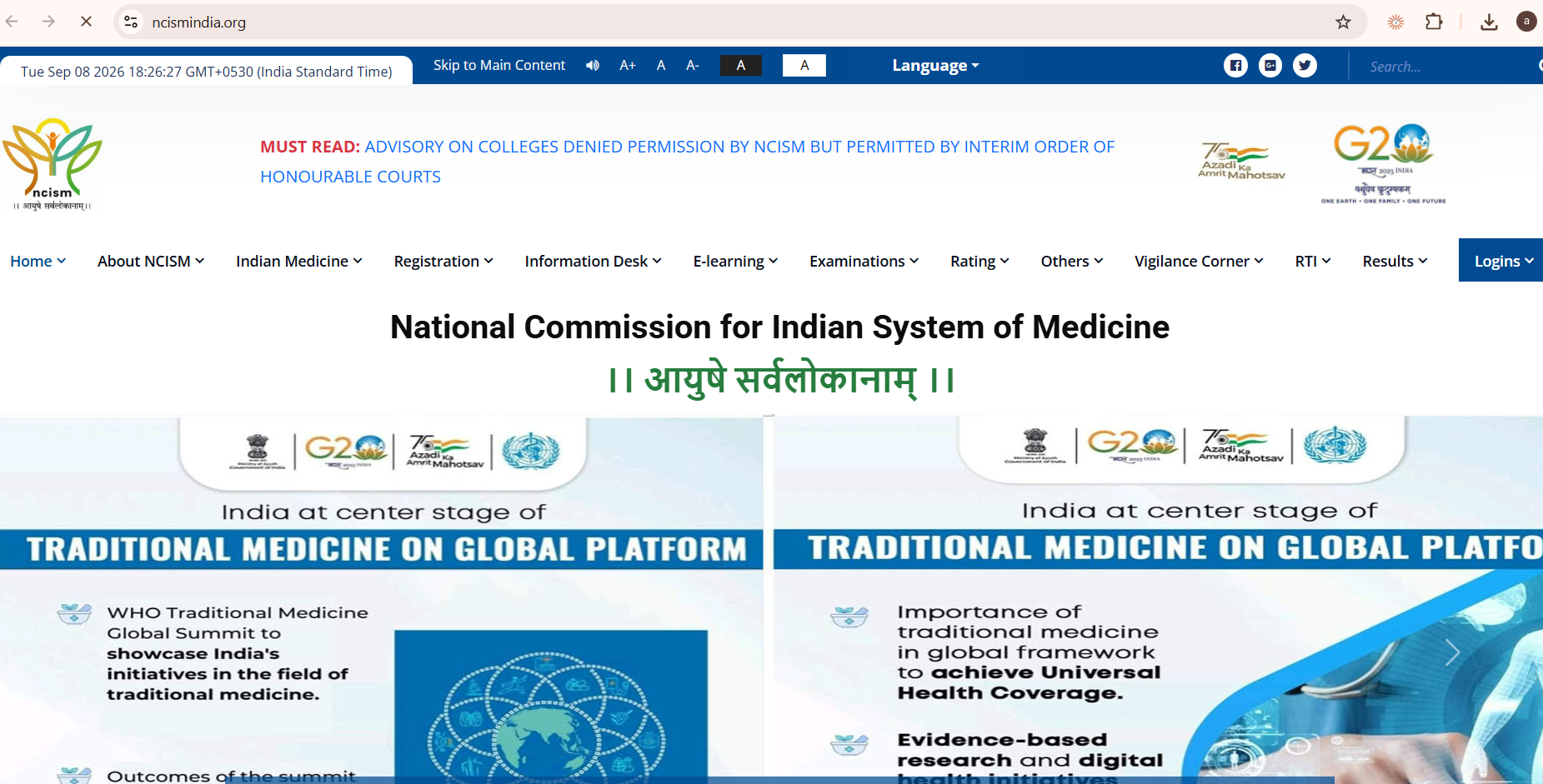
Answer: You can verify the official permission status and approved seat capacity for any Ayurvedic college directly on the NCISM portal (ncismindia.org) under the “Permission Status of ASU&H Colleges” section.