NMAT 2026 Registration is officially active on the official Graduate Management Admission Council (GMAC) examination portal at mba.com/exams/nmat for MBA and PGDM admissions across the 2026–2027 academic session. The online registration and slot booking window commenced on August 20, 2026, and candidates can submit their initial applications until October 10, 2026. The official NMAT 2026 exam delivery window spans from November 2, 2026, to December 20, 2026, across 70+ domestic test centres in India and home-proctored online modes. Candidates can schedule their preferred testing date, time slot, and section order, with up to three allowable attempts per testing cycle subject to a mandatory 15-day cooling-off period.
Latest status — verified on September 10, 2026: NMAT by GMAC 2026 registration and exam slot scheduling are currently active. Candidates must complete registration on mba.com by October 10, 2026, and schedule exam dates by October 22, 2026. Aspirants targeting NMIMS Mumbai, Bengaluru, Hyderabad, and Navi Mumbai must also complete the separate NMIMS application form before the concurrent closing deadline.
NMAT by GMAC 2026: Quick Facts Overview
NMAT by GMAC serves as the premier computer-delivered entrance test for admission to leading business schools across India, including SVKM’s NMIMS School of Business Management, TAPMI Manipal, XIM University Bhubaneswar, K J Somaiya Institute of Management, and SDA Bocconi Asia Center. The following quick facts summarize the core administrative parameters of the examination.
| Parameter | Official Specification |
|---|---|
| Exam Name | NMAT by GMAC™ 2026 |
| Conducting Authority | Graduate Management Admission Council (GMAC) |
| Target Programmes | MBA, PGDM, Global MBA, Specialized Masters (HR, Business Analytics, Digital Transformation) |
| Registration Window | August 20, 2026 to October 10, 2026 |
| Testing Window (Delivery) | November 2, 2026 to December 20, 2026 (75-Day Delivery Window) |
| Exam Mode | Computer-Based Test (CBT) at 70+ Test Centres / Online Proctored at Home |
| Maximum Allowable Attempts | 3 Attempts (1 Main Attempt + 2 Retakes) |
| Mandatory Retake Gap | 15 Calendar Days between consecutive attempts |
| Negative Marking Scheme | No Negative Marking (Zero Penalty for Incorrect Answers) |
| Official Registration Portal | mba.com/exams/nmat |
| Last Verified Date | September 10, 2026 |
Source: Graduate Management Admission Council (GMAC) Official Notification 2026
NMAT 2026 Registration Dates and Official Schedule Matrix
The Graduate Management Admission Council operates the NMAT under an extended rolling testing schedule that permits candidates to register, book slots, appear for the test, and schedule retakes over a multi-month testing calendar. Understanding each milestone ensures you do not miss testing slots or business school application cutoffs.
| Event / Milestone | Start Date | End Date / Deadline | Operational Status |
|---|---|---|---|
| NMAT Online Registration Window | August 20, 2026 | October 10, 2026 | Active (Apply Online) |
| Exam Slot Scheduling (Main Attempt) | August 20, 2026 | October 22, 2026 | Active (First-Come, First-Served) |
| Exam Delivery Window (Test Period) | November 2, 2026 | December 20, 2026 | Upcoming |
| Retake Registration Window | November 3, 2026 | December 17, 2026 | Activates Post 1st Attempt |
| Retake Slot Scheduling | November 3, 2026 | December 17, 2026 | Subject to 15-Day Gap |
| Exam Slot Rescheduling Window | August 20, 2026 | December 17, 2026 | Up to 72 Hours Prior to Slot |
| Official Scaled Scorecard Availability | Within 48 to 72 Hours Post Exam | Downloadable till March 31, 2027 | Automated Online Release |
| NMIMS Separate Application Deadline | August 20, 2026 | October 10, 2026 | Mandatory Concurrent Form |
Source: GMAC Information Bulletin and Schedule 2026
NMAT 2026 Registration Eligibility and Academic Requirements
To complete the NMAT 2026 Registration successfully, candidates must fulfill both the foundational NMAT exam eligibility guidelines set by GMAC and the specific postgraduate admission eligibility conditions set by each receiving business school before submitting their application.
1. Academic Degree Requirements
Candidates must possess a Bachelor’s degree of minimum 3 or 4 years duration in any discipline (Arts, Commerce, Science, Engineering, Management, Medicine, Pharmacy, or Law) from a recognized university or institute approved by the UGC or AIU. Candidates in the final year of their undergraduate degree are fully eligible to apply and sit for the exam, provided they complete all graduation degree requirements and submit final mark sheets proving minimum marks prior to the institutional verification deadline.
2. Minimum Qualifying Aggregate Marks
A minimum of 50% aggregate marks (or equivalent CGPA/grades) in graduation is required for admission to major participating institutes such as SVKM’s NMIMS, TAPMI, and K J Somaiya. Note that NMIMS requires a minimum of 50% aggregate marks across 10th, 12th, and all semesters of graduation. Candidates should review individual university prospectuses on the Explore Colleges Directory to verify branch-specific criteria.
3. Age Limit and Work Experience Criteria
There is strictly no minimum or upper age limit to appear for the NMAT by GMAC exam. Work experience is not compulsory to appear for NMAT. However, premier management programmes grant significant evaluation weightage (typically 5% to 15% in composite merit scoring) for verified post-qualification full-time work experience in executive, technical, or analytical roles.
Step-by-Step NMAT 2026 Registration and Slot Booking Workflow
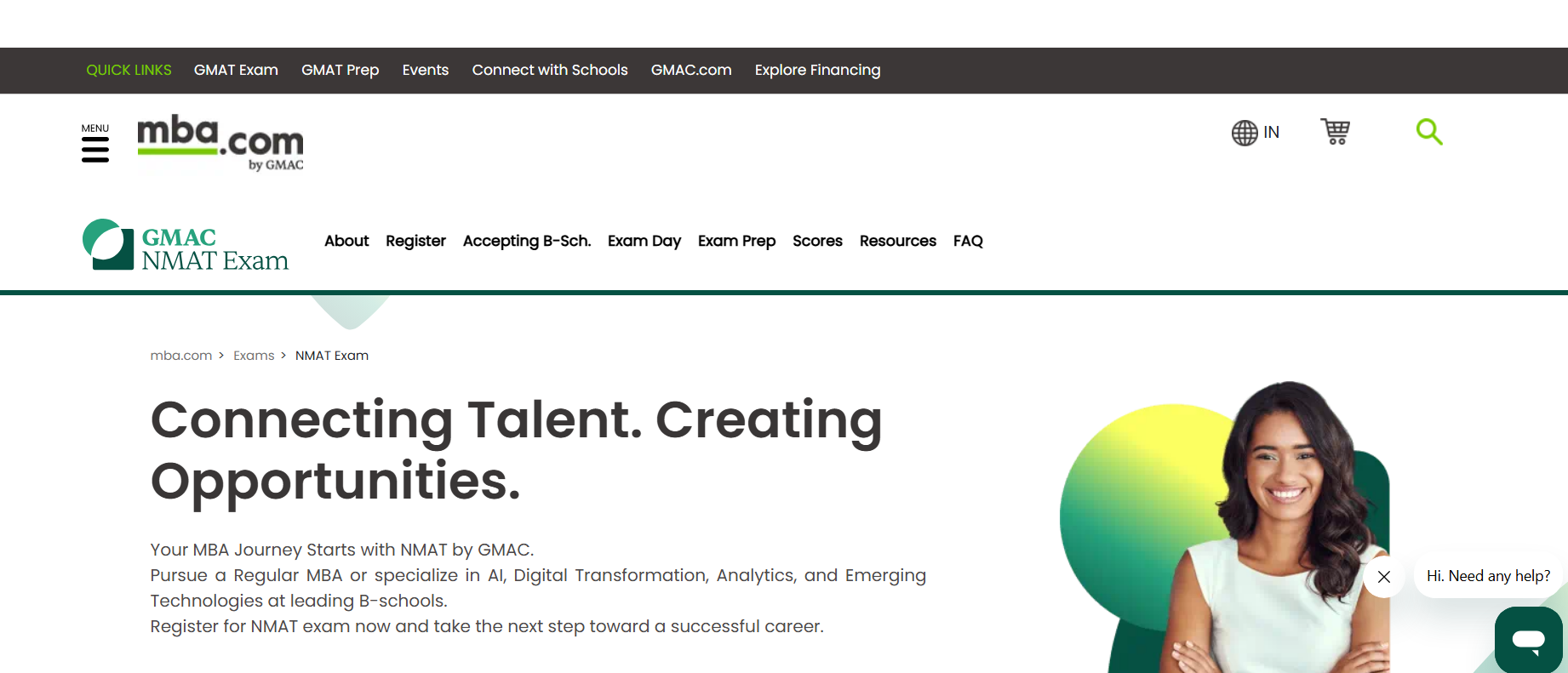
The NMAT 2026 Registration and slot scheduling workflow is entirely digital and completed through the unified GMAC portal. Follow these structured steps to ensure error-free application and slot allocation.
Step 1: Account Creation on mba.com
Visit the official portal at mba.com/exams/nmat and click on “Register for NMAT by GMAC”. Create a candidate account using a functional primary email address and mobile number. A verification link will be dispatched to your inbox to activate your user profile.
Step 2: Completing Personal and Academic Profile
Log in using your registered credentials and enter accurate personal data matching your government ID proof (Aadhaar Card, Passport, or PAN Card). Provide complete academic history, including 10th standard, 12th standard, undergraduate degree specialisation, university name, year of passing, and aggregate percentage.
Step 3: Business School Programme Selection
Select your target business schools and MBA programmes from the interactive list. The standard registration fee covers score transmission to up to 5 business school programmes at zero extra charge. You may add additional B-school choices beyond the initial 5 preferences for an additional fee per programme.
Step 4: Online Fee Payment
Review the filled details thoroughly before proceeding to the integrated payment gateway. Pay the registration fee using Credit Card (Visa, MasterCard, American Express), Debit Card, Net Banking, or UPI. Retain the generated transaction confirmation number and receipt.
Step 5: Exam Scheduling and Slot Allocation
Once payment confirmation is processed, the “Schedule Exam” button activates on your dashboard. Choose your preferred testing mode (Test Centre-based CBT or Online Proctored at Home). If choosing a physical test centre, select your preferred state, testing city, test date, and time slot (Morning or Afternoon). Confirm the booking to download your official NMAT Admit Card.
NMAT 2026 Registration Fee and Service Charges
When completing the online NMAT 2026 Registration, all fees payable to GMAC for NMAT testing, retakes, slot adjustments, and additional school choices are subject to applicable goods and services tax (18% GST). Fees once remitted are non-refundable under any circumstances.
| Service / Transaction Type | Base Fee (INR) | Applicable Taxes | Total Amount Payable (Approx.) |
|---|---|---|---|
| NMAT Test Registration (Main Attempt) | ₹3,000 | + 18% GST | ₹3,540 |
| Retake Registration (Per Attempt) | ₹3,000 | + 18% GST | ₹3,540 |
| Exam Slot Rescheduling Fee | ₹1,200 | + 18% GST | ₹1,416 |
| Additional B-School Programme Preference | ₹400 per programme | + 18% GST | ₹472 per choice |
| First 5 B-School Programme Preferences | Included in Registration | Nil | ₹0 (Complimentary) |
Source: GMAC Fee Schedule Notice 2026
NMAT 2026 Exam Pattern, Sectional Timing, and Scoring Blueprint
NMAT by GMAC is an objective computer-adaptive test designed to evaluate fundamental management readiness across three core aptitude competencies without penalising test-takers for wrong responses.
Key Architectural Features of the NMAT Exam
- No Negative Marking: Candidates receive scaled positive marks for every correct response and zero marks for incorrect or unattempted questions. No penalty is deducted for wrong answers.
- Section Order Selection: At the beginning of the exam, candidates can choose the specific sequence in which they wish to attempt the three sections (e.g., Logical Reasoning first, followed by Quantitative Skills and Language Skills).
- Strict Sectional Time Limits: Each section has a dedicated time allocation. Unused time in one section cannot be transferred or carried over to another section. Once a section is submitted, you cannot return to review or edit answers in that section.
- Scaled Scoring System: Raw scores are statistically converted into scaled scores ranging between 12 to 120 per section, resulting in a total scaled composite score range of 36 to 360 marks.
| Exam Section | Number of Questions | Allotted Time (Minutes) | Average Time per Question | Scaled Score Range |
|---|---|---|---|---|
| Language Skills | 36 Questions | 28 Minutes | ~46.6 Seconds | 12 – 120 Marks |
| Quantitative Skills | 36 Questions | 52 Minutes | ~86.6 Seconds | 12 – 120 Marks |
| Logical Reasoning | 36 Questions | 40 Minutes | ~66.6 Seconds | 12 – 120 Marks |
| Total Composite Exam | 108 Questions | 120 Minutes (2 Hours) | ~66.6 Seconds | 36 – 360 Marks |
Source: GMAC NMAT Exam Structure and Blueprint 2026
NMAT Retake Policy: 3 Total Attempts and 15-Day Cooling-Off Rules
The NMAT Retake Policy under NMAT by GMAC 2026 is one of the most distinctive features of the examination, allowing candidates up to three attempts in a single testing cycle to optimize their composite scaled performance.
1. Maximum Three Attempts per Cycle
Each registered candidate is permitted a maximum of three attempts during the testing cycle: one Main Attempt and up to two Retakes. Each retake requires a separate retake registration fee of ₹3,000 + GST.
2. Mandatory 15-Day Cooling-Off Period
Candidates cannot take a retake immediately after an attempt. GMAC enforces a strict minimum cooling-off gap of 15 calendar days between consecutive attempts. For example, if you take your first attempt on November 10, 2026, the earliest permissible date for your Retake 1 attempt is November 26, 2026.
3. Best Score Policy vs NMIMS First Attempt Rule
While GMAC transmits the highest scaled score among all your attempts to receiving institutions, individual business schools maintain distinct acceptance policies regarding retake attempts:
- Non-NMIMS Institutes (TAPMI, XIM, K J Somaiya, SDA Bocconi): Generally consider the highest / best score across all your attempts.
- NMIMS SBM Mumbai and Satellite Campuses (CRITICAL RULE): SVKM’s NMIMS strictly accepts ONLY the score achieved in your FIRST / MAIN attempt for flagship MBA programmes (MBA Core, MBA HR, MBA Business Analytics). Retake scores are not considered for primary MBA shortlisting at NMIMS Mumbai. Aspirants targeting NMIMS must prepare to peak on their first attempt.
NMIMS Cutoff 2026 Trends and Campus-Wise Score Analysis
Understanding the expected NMIMS Cutoff 2026 is vital for candidates completing their NMAT 2026 Registration. SVKM’s NMIMS School of Business Management (Mumbai) is the flagship destination for NMAT test-takers. NMIMS enforces both rigorous sectional cutoff requirements across all three sections and a competitive overall composite cutoff score.
| NMIMS Campus and Programme | Expected Overall Cutoff | Language Skills Cutoff | Quantitative Skills Cutoff | Logical Reasoning Cutoff |
|---|---|---|---|---|
| NMIMS Mumbai — MBA Core | 232 – 236+ Marks | 76+ Marks | 74+ Marks | 76+ Marks |
| NMIMS Mumbai — MBA Human Resources (HR) | 228 – 232+ Marks | 74+ Marks | 71+ Marks | 73+ Marks |
| NMIMS Mumbai — MBA Business Analytics | 224 – 228+ Marks | 72+ Marks | 70+ Marks | 72+ Marks |
| NMIMS Mumbai — MBA Digital Transformation | 220 – 224+ Marks | 70+ Marks | 68+ Marks | 70+ Marks |
| NMIMS Mumbai — MBA Pharmaceutical Management | 195 – 205+ Marks | 60+ Marks | 58+ Marks | 60+ Marks |
| NMIMS Bengaluru — MBA Core | 215 – 220 Marks | 70+ Marks | 68+ Marks | 68+ Marks |
| NMIMS Navi Mumbai — MBA Core | 210 – 215 Marks | 68+ Marks | 65+ Marks | 65+ Marks |
| NMIMS Hyderabad / Jadcherla — MBA Core | 200 – 208 Marks | 65+ Marks | 62+ Marks | 62+ Marks |
| NMIMS Indore — MBA Core | 190 – 200 Marks | 60+ Marks | 58+ Marks | 58+ Marks |
Source: NMIMS SBM Historical Admission Records and Official Cutoff Trends
Top Non-NMIMS B-Schools Accepting NMAT Scores and Cutoffs
Beyond NMIMS, scores from the NMAT exam are accepted by premier AICTE-approved and AACSB/AMBA-accredited management institutions across India for their flagship MBA and PGDM cohorts.
| Business School | Flagship Programmes Offered | Expected Cutoff Score (out of 360) | Retake Score Accepted? |
|---|---|---|---|
| XIM University (Bhubaneswar) | MBA-HRM, MBA-RM, MBA-SM, MBA-UMG | 220 – 230 Marks | Yes (Best Score Considered) |
| TAPMI (Manipal) | MBA Core, MBA-BKFS, MBA-HRM, MBA-Marketing | 220 – 225 Marks | Yes (Best Score Considered) |
| K J Somaiya Institute of Management (Mumbai) | MBA (General), MBA-Healthcare, MBA-Sports | 222 – 228 Marks | Yes (Best Score Considered) |
| SDA Bocconi Asia Center (Mumbai) | International Master in Business (IMB) | 200 – 210 Marks | Yes (Best Score Considered) |
| Great Lakes Institute of Management (Gurgaon) | PGDM (2-Year Management Programme) | 200 – 210 Marks | Yes (Best Score Considered) |
| Athena School of Management (Mumbai) | Post Graduate Programme in Management (PGPM) | 190 – 200 Marks | Yes (Best Score Considered) |
| Alliance School of Business (Bangalore) | Master of Business Administration (MBA) | 180 – 195 Marks | Yes (Best Score Considered) |
| BML Munjal University (Gurugram) | MBA (Imperial College London Mentored) | 180 – 190 Marks | Yes (Best Score Considered) |
| Amity University (Noida / Lucknow / Mumbai) | MBA (Multiple Specialisations) | 160 – 180 Marks | Yes (Best Score Considered) |
Source: Participating B-School Admission Notifications 2026
The NMIMS Two-Form Trap: How to Avoid Disqualification
During the active NMAT 2026 Registration window, one of the most critical pitfalls for management aspirants is the “Two-Form Trap.” Registering for the NMAT exam alone does not automatically submit an application to SVKM’s NMIMS.
To be eligible for admission to NMIMS MBA programmes, you must complete two independent forms:
- Form 1 — The NMAT Exam Registration: Completed on mba.com to register for the entrance test and schedule your exam date.
- Form 2 — The NMIMS Admission Application: Completed on the dedicated NMIMS admissions portal at
nmat.nmims.edu, where you select your preferred NMIMS campuses and specific MBA programmes and pay the institutional application fee.
The NMIMS application form deadline typically coincides with or closes immediately around the NMAT registration closing date (October 10, 2026). If you score 250 in NMAT but fail to complete and submit the NMIMS form before its official closing date, NMIMS will not issue a shortlist call for Stage 2 GD/PI rounds, regardless of your percentile.
Stage 2 Selection Process: Watson-Glaser Test and Personal Interview
Securing a qualifying NMAT score earns an invitation to Stage 2 of the selection process. For NMIMS and top B-schools, Stage 2 evaluates critical reasoning, verbal articulation, leadership aptitude, and domain awareness.
1. Watson-Glaser Critical Thinking Appraisal
NMIMS assesses shortlisted candidates through the internationally recognized Watson-Glaser Critical Thinking Appraisal. This test evaluates cognitive problem-solving across five sub-dimensions:
- Inference: Discerning between true, probably true, insufficient data, probably false, and false statements derived from premises.
- Recognition of Assumptions: Identifying unstated presuppositions underlying given assertions.
- Deduction: Determining whether specific conclusions logically follow necessarily from given premises.
- Interpretation: Weighing evidence and deciding if generalizations or conclusions are warranted.
- Evaluation of Arguments: Distinguishing between strong and weak arguments concerning contentious real-world situations.
2. Personal Interview (PI) and Extempore
Candidates face an expert interview panel evaluating undergraduate academic knowledge, work experience achievements, clarity of career goals, awareness of macroeconomic developments, and behavioral competencies. Several B-schools also incorporate an extempore speech (1–2 minutes impromptu presentation on a contemporary topic) or a Written Ability Test (WAT).
3. Final Composite Merit List Weightage
The final admission offer is determined by a weighted composite score model typically structured as follows:
- NMAT Scaled Score: 50% to 60% weightage
- Watson-Glaser Test / WAT / Extempore: 10% to 15% weightage
- Personal Interview (PI): 15% to 20% weightage
- Past Academic Record (10th, 12th, Graduation): 5% to 10% weightage
- Relevant Work Experience: 5% weightage
Strategic Preparation Tips to Maximize Your NMAT Scaled Score
After finishing your NMAT 2026 Registration and securing test dates, smart preparation elevates your scaled score. Because NMAT does not penalise incorrect answers and allows candidates to choose their section sequence, smart test strategies directly elevate scaled scores.
1. Choose Your Optimal Section Order
Select your strongest section first to build test momentum and reduce cognitive anxiety. If Language Skills is your strength, starting with it allows you to secure ~75+ marks quickly within 28 minutes before tackling the 52-minute Quantitative Skills section.
2. Master the Strict Time per Question Metric
With only 46.6 seconds per question in Language Skills, 66.6 seconds in Logical Reasoning, and 86.6 seconds in Quantitative Skills, pacing is essential. Avoid spending more than 2 minutes on any single question. If a problem is excessively computation-heavy, eliminate obvious distractors, choose your best calculated option, and move forward.
3. Never Leave Any Question Blank
Because there is zero negative marking, leaving even a single question unanswered is a major tactical error. In the final 60 seconds of any section, ensure every remaining question has an active response marked.
4. Plan Your Attempts Early in the Testing Window
Booking your first attempt in early to mid-November provides ample time to review your unofficial scorecard, analyse diagnostic section reports, and complete a 15-day retake before the December 20 testing window closes if you need to improve scores for non-NMIMS business schools.
What This Means for MBA Aspirants: Key Takeaways
The commencement of the official NMAT 2026 Registration window marks the start of the competitive MBA admissions season alongside CAT 2026 Registration and upcoming XAT schedules. Here is what you should do immediately:
- Complete NMAT 2026 Registration Promptly: Secure your preferred test city and morning/afternoon slot before centres reach maximum capacity.
- Submit the NMIMS Application: Do not defer the NMIMS form on
nmat.nmims.eduuntil after the exam. Complete both registrations concurrently. - Leverage Admission Predictors: Utilize the All India College Predictor Hub to identify matching B-schools based on your profile, graduation aggregate, and expected percentile tiers.
- Seek Expert Counselling: For personalised guidance on B-school selection, program specialisations, and Stage 2 Watson-Glaser preparation, Book a Free Admission Counselling Session with our senior management admission mentors.
Official Helpdesk and Contact Information
Candidates experiencing technical issues during the NMAT 2026 Registration process, payment processing, or slot scheduling can reach out to official support channels:
- GMAC NMAT Candidate Support Portal: mba.com/exams/nmat
- NMAT Helpdesk Email:
nmatsupport@gmac.com - NMAT Phone Helpline: +91 7303719945 / +91 9958760077 (Monday to Friday, 9:00 AM to 6:00 PM IST)
- NMIMS Admission Helpdesk:
admissionenquiry@nmims.edu| 1800 102 5138
Frequently Asked Questions (FAQs)
Q1: What is the last date for NMAT 2026 registration?
Answer: The official registration window for NMAT 2026 closes on October 10, 2026. Candidates must complete profile creation, choose up to 5 complimentary B-school preferences, and pay the registration fee before this deadline on the official portal at mba.com.
Q2: Is there negative marking in the NMAT by GMAC exam?
Answer: No, there is strictly no negative marking in the NMAT exam. Candidates receive positive scaled marks for correct answers and zero marks for incorrect or unattempted questions, making it beneficial to answer all 108 questions.
Q3: How many attempts are allowed for NMAT 2026?
Answer: Candidates are allowed a maximum of three attempts during a single testing year: one Main Attempt and up to two Retakes. A mandatory minimum gap of 15 calendar days is required between any two attempts.
Q4: Does NMIMS Mumbai accept NMAT retake scores?
Answer: No, SVKM’s NMIMS School of Business Management (Mumbai) strictly accepts only the score obtained in your First / Main attempt for flagship MBA programmes. Retake attempt scores are not considered for primary shortlisting at NMIMS Mumbai.
Q5: What is the expected NMAT cutoff for NMIMS Mumbai MBA Core?
Answer: The expected cutoff for NMIMS Mumbai MBA Core ranges between 232 and 236+ scaled marks out of 360, with balanced sectional cutoffs of approximately 76+ in Language Skills, 74+ in Quantitative Skills, and 76+ in Logical Reasoning.
Q6: Can I choose the order of sections in NMAT?
Answer: Yes, NMAT allows candidates to choose the sequence in which they wish to attempt the three sections (Language Skills, Quantitative Skills, and Logical Reasoning) before beginning the examination. However, each section has a strict non-transferable time limit.
Q7: What is the registration fee for NMAT 2026?
Answer: The standard test registration fee for NMAT 2026 is ₹3,000 plus 18% GST (totaling approximately ₹3,540). Each retake also costs ₹3,000 + GST, while exam slot rescheduling incurs a fee of ₹1,200 + GST.
Q8: What is the Watson-Glaser test conducted in NMIMS Stage 2?
Answer: The Watson-Glaser Critical Thinking Appraisal is an objective psychometric test used by NMIMS during Stage 2 selection to evaluate shortlisted candidates across inferences, assumptions, deductions, interpretations, and evaluation of arguments.
Q9: How soon are official NMAT scaled scores released?
Answer: An unofficial score summary is displayed on your computer screen immediately after submitting the test. The official, verified scaled scorecard is published on your GMAC dashboard within 48 to 72 hours of exam completion.
Q10: Which top business schools besides NMIMS accept NMAT scores?
Answer: Leading management institutes accepting NMAT scores include XIM University Bhubaneswar, TAPMI Manipal, K J Somaiya Institute of Management Mumbai, SDA Bocconi Asia Center, and Great Lakes Institute of Management Gurgaon.
Sources Checked and Editorial Verification
- Graduate Management Admission Council (GMAC) Official NMAT Portal
- SVKM’s NMIMS School of Business Management Official Admissions Bulletin
- GMAC Official Global Testing and Administration Framework
Update Policy: This page will be revised immediately when the Graduate Management Admission Council publishes new official notifications or revised scheduling guidelines.