
CAT 2026 Exam Date, Syllabus and Registration Guide
The CAT 2026 exam is expected to be held on 29 November 2026, with registration likely to begin in the first week of August 2026. Candidates aspiring for admission to IIMs and other top B-schools should understand the registration process, eligibility criteria, syllabus, and exam pattern well in advance to maximize their chances of success.

➡️ Explore our College Predictor: /college-predictor
Disclaimer: The dates and details mentioned below are based on previous CAT examination trends. Candidates should verify the latest updates on the official CAT website after the official notification is released.
What is CAT 2026?
The Common Admission Test (CAT) is India’s most popular MBA entrance examination conducted annually by one of the Indian Institutes of Management (IIMs) on a rotational basis. CAT scores are accepted by all IIMs and more than 1,200 management institutes across India.
Every year, over three lakh candidates appear for the examination, making it one of the most competitive entrance exams for management education.
A good CAT percentile can help candidates secure admission to prestigious institutes such as IIM Ahmedabad, IIM Bangalore, IIM Calcutta, IIM Lucknow, IIM Kozhikode, FMS Delhi, SPJIMR Mumbai, MDI Gurgaon, and several other leading business schools.
Expected CAT 2026 Important Dates
Visit Official Website : /iimcat.ac.in/
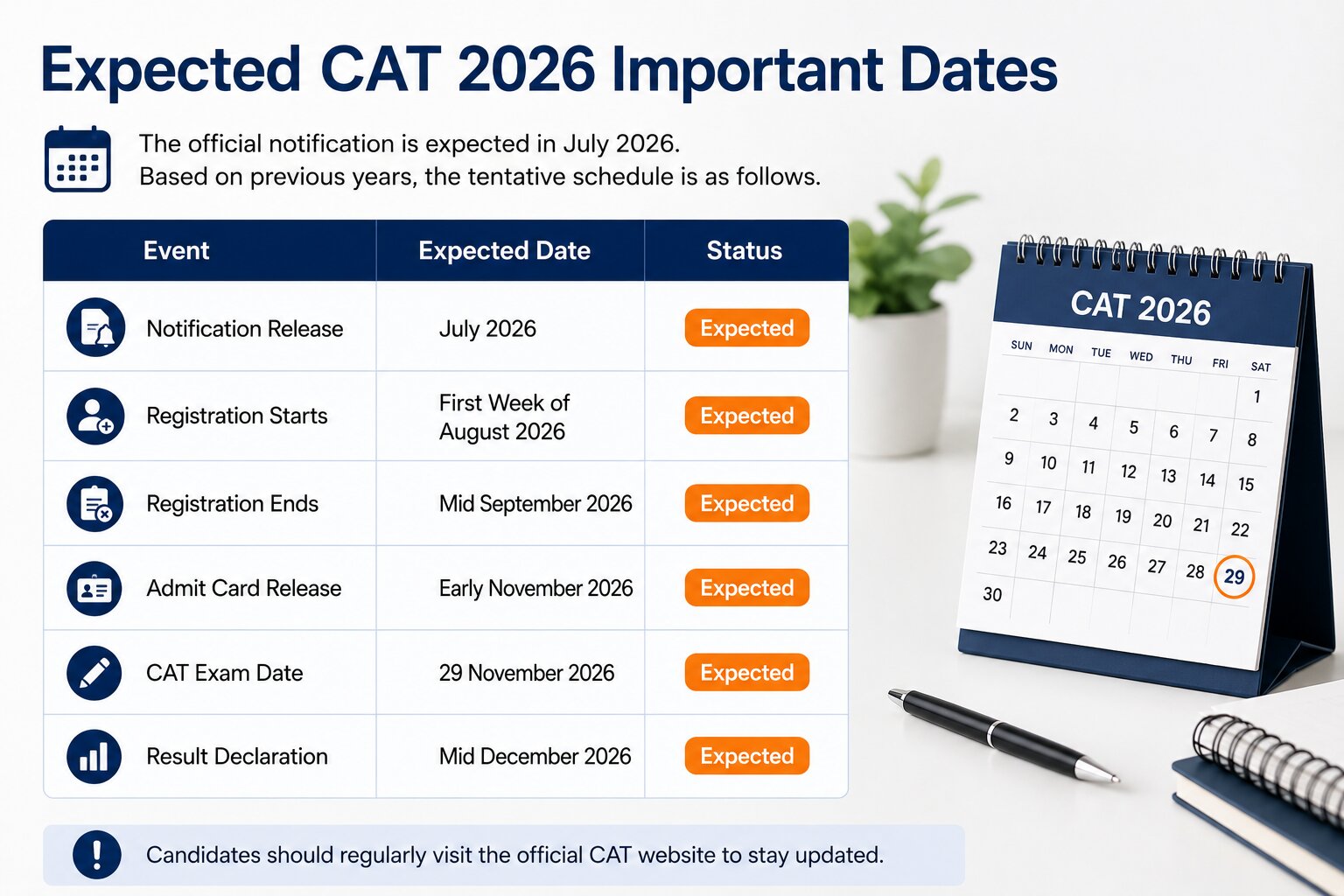
The official notification is expected in July 2026. Based on previous years, the tentative schedule is as follows.
| Event | Expected Date | Status |
|---|---|---|
| Notification Release | July 2026 | Expected |
| Registration Starts | First Week of August 2026 | Expected |
| Registration Ends | Mid September 2026 | Expected |
| Admit Card Release | Early November 2026 | Expected |
| CAT Exam Date | 29 November 2026 | Expected |
| Result Declaration | Mid December 2026 | Expected |
Candidates should regularly visit the official CAT website to stay updated.
CAT 2026 Eligibility Criteria
Before applying, candidates must ensure that they meet the eligibility requirements.
| Criteria | Requirement | Status |
|---|---|---|
| Educational Qualification | Bachelor’s Degree | Mandatory |
| Minimum Marks | 50% (45% for Reserved Categories) | Mandatory |
| Final Year Students | Eligible | Yes |
| Age Limit | No Age Limit | Applicable |
Candidates awaiting their final year results are also eligible to apply.
CAT 2026 Registration Process
The registration process is conducted entirely online.
Step 1: Visit Official Website
Open the official CAT registration portal once applications begin.
Step 2: Create Login
Register using:
- Name
- Email ID
- Mobile Number
You will receive login credentials.
Step 3: Fill Personal Details
Complete information including:
- Personal Details
- Academic Qualification
- Work Experience
- Category
- Communication Address
Step 4: Upload Documents
Upload scanned copies of:
- Passport Size Photograph
- Signature
- Category Certificate (if applicable)
- PwD Certificate (if applicable)
Step 5: Select Test Cities
Choose up to six preferred examination cities.
Step 6: Pay Application Fee
Complete the payment using online banking, debit card, credit card, or UPI.
Step 7: Submit Application
Review the application carefully before final submission.
Expected CAT 2026 Application Fee
➡️ Get Personalized Guidance: College Predictor
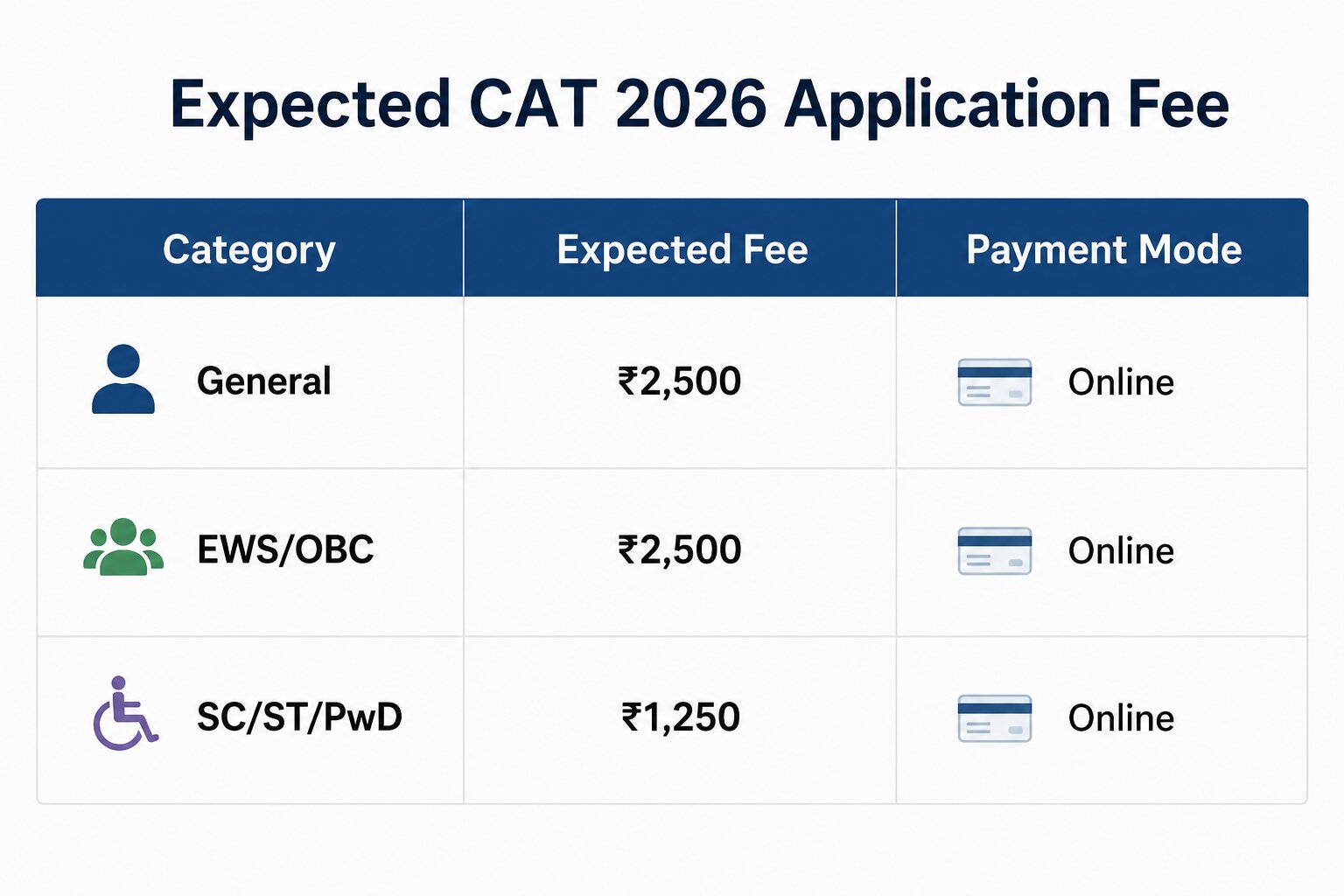
| Category | Expected Fee | Payment Mode |
|---|---|---|
| General | ₹2,500 | Online |
| EWS/OBC | ₹2,500 | Online |
| SC/ST/PwD | ₹1,250 | Online |
CAT 2026 Exam Pattern
The CAT exam is conducted as a Computer-Based Test (CBT).
| Section | Questions | Time |
|---|---|---|
| VARC | 24 | 40 Minutes |
| DILR | 22 | 40 Minutes |
| Quantitative Aptitude | 22 | 40 Minutes |
Total Duration: 120 Minutes
Total Questions: 68
Maximum Marks: 204
CAT 2026 Marking Scheme
Understanding the marking scheme helps candidates avoid unnecessary negative marking.
| Response | Marks | Applicable |
|---|---|---|
| Correct Answer | +3 | Yes |
| Incorrect MCQ | -1 | Yes |
| Non-MCQ Wrong Answer | 0 | No Negative Marking |
CAT 2026 Syllabus
The CAT syllabus is divided into three sections.
Verbal Ability and Reading Comprehension (VARC)
Topics include:
- Reading Comprehension
- Para Summary
- Para Jumbles
- Odd Sentence Out
- Vocabulary
- Grammar
- Critical Reasoning
Reading speed and comprehension skills play a crucial role in this section.
Data Interpretation and Logical Reasoning (DILR)
Important topics include:
- Bar Graphs
- Pie Charts
- Line Graphs
- Seating Arrangement
- Blood Relations
- Tables
- Venn Diagrams
- Puzzles
- Logical Arrangement
Consistent practice is essential for scoring well in DILR.
Quantitative Aptitude (QA)
Major topics include:
- Arithmetic
- Algebra
- Geometry
- Number System
- Percentages
- Profit and Loss
- Ratio and Proportion
- Time Speed Distance
- Probability
- Permutation and Combination
Arithmetic contributes the highest weightage in recent CAT exams.
Best Preparation Strategy
Candidates should prepare a structured study plan.
| Activity | Recommended Time | Priority |
|---|---|---|
| Learn Concepts | 2 Months | High |
| Practice Questions | Daily | High |
| Mock Tests | Weekly | High |
| Analyze Mistakes | After Every Mock | High |
| Revision | Last Month | Very High |
Mock tests play an important role in improving speed and accuracy.
Common Mistakes to Avoid
Many candidates lose marks because of avoidable mistakes.
- Ignoring mock tests
- Spending too much time on one section
- Weak time management
- Skipping revision
- Not analyzing previous year papers
- Guessing too many MCQs
- Ignoring sectional cutoffs
Expert Tips for CAT 2026
- Start preparation at least six months before the exam.
- Solve previous years’ CAT papers regularly.
- Focus on accuracy before speed.
- Take full-length mock tests every week.
- Improve reading habits for VARC.
- Strengthen arithmetic fundamentals for QA.
- Analyze every mock test carefully.
How Admittance Edutech Can Help
Admittance Edutech provides expert guidance for MBA aspirants through exam updates, preparation resources, counselling support, college comparisons, and admission guidance. Our goal is to help students choose the right MBA colleges based on their CAT scores and career goals.
Final Verdict
The CAT 2026 exam is one of the most important gateways to India’s top management institutes. A strong preparation strategy, timely registration, and thorough understanding of the syllabus can significantly improve your chances of securing a high percentile. Candidates should focus on building conceptual clarity, practicing mock tests regularly, and staying updated with official announcements throughout the admission cycle.
Success in CAT is not just about hard work—it also requires smart planning, consistent practice, and effective time management. With the right preparation and a disciplined approach, candidates can maximize their performance and secure admission to their dream MBA college.

Related Post | CLAT 2026 NLU seat allotment round 2 — what to do next
Frequently Asked Questions (FAQs)
1. When will CAT 2026 registration begin?
CAT 2026 registration is expected to begin in the first week of August 2026, while the official notification is likely to be released in July 2026. Candidates should regularly check the official CAT website for confirmed dates.
2. What is the expected CAT 2026 exam date?
The CAT 2026 examination is expected to be conducted on 29 November 2026 (Sunday). The exam is usually held on the last Sunday of November every year.
3. What is the eligibility criteria for CAT 2026?
Candidates must hold a Bachelor’s degree with at least 50% marks (45% for reserved categories). Final-year undergraduate students are also eligible to apply for the examination.
4. What are the three sections in the CAT exam?
CAT consists of three sections: Verbal Ability & Reading Comprehension (VARC), Data Interpretation & Logical Reasoning (DILR), and Quantitative Aptitude (QA). Each section has a separate time limit of 40 minutes.
5. Is there negative marking in CAT 2026?
Yes. Each correct MCQ carries +3 marks, while every incorrect MCQ results in -1 mark. However, there is no negative marking for non-MCQ (Type-in-the-Answer) questions.
ALSO,
How AI College Predictor Makes Smarter Admissions
JoSAA Float vs Freeze vs Exit: Round 1 Guide 2026
When will CAT 2026 registration begin?
CAT 2026 registration is expected to begin in the first week of August 2026, while the official notification is likely to be released in July 2026. Candidates should regularly check the official CAT website for confirmed dates.
What is the expected CAT 2026 exam date?
The CAT 2026 examination is expected to be conducted on 29 November 2026 (Sunday). The exam is usually held on the last Sunday of November every year.
What is the eligibility criteria for CAT 2026?
Candidates must hold a Bachelor's degree with at least 50% marks (45% for reserved categories). Final-year undergraduate students are also eligible to apply for the examination.
What are the three sections in the CAT exam?
CAT consists of three sections: Verbal Ability & Reading Comprehension (VARC), Data Interpretation & Logical Reasoning (DILR), and Quantitative Aptitude (QA). Each section has a separate time limit of 40 minutes.
Is there negative marking in CAT 2026?
Yes. Each correct MCQ carries +3 marks, while every incorrect MCQ results in -1 mark. However, there is no negative marking for non-MCQ (Type-in-the-Answer) questions. ALSO,u00a0 How AI College Predictor Makes Smarter Admissions JoSAA Float vs Freeze vs Exit: Round 1 Guide 2026