
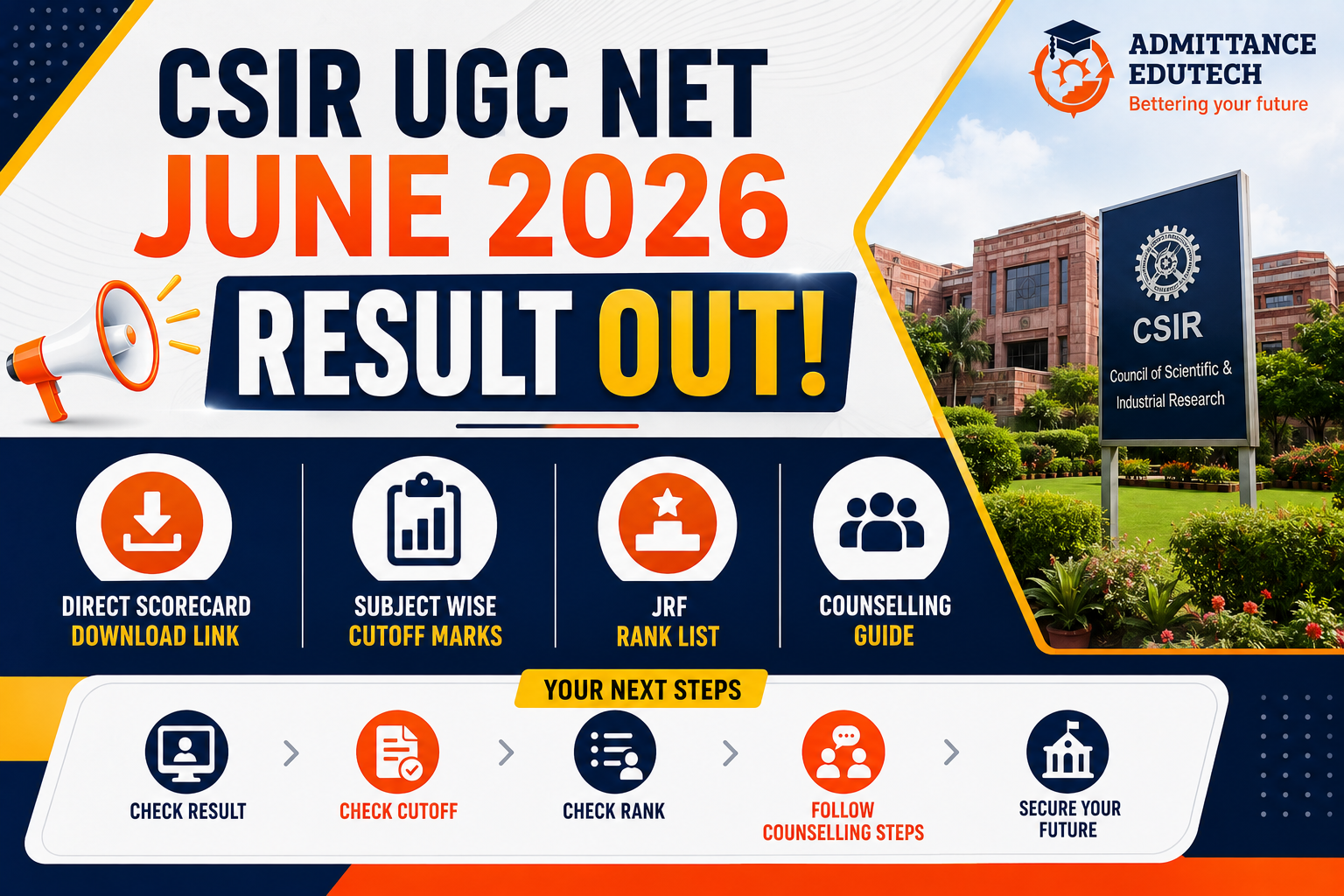
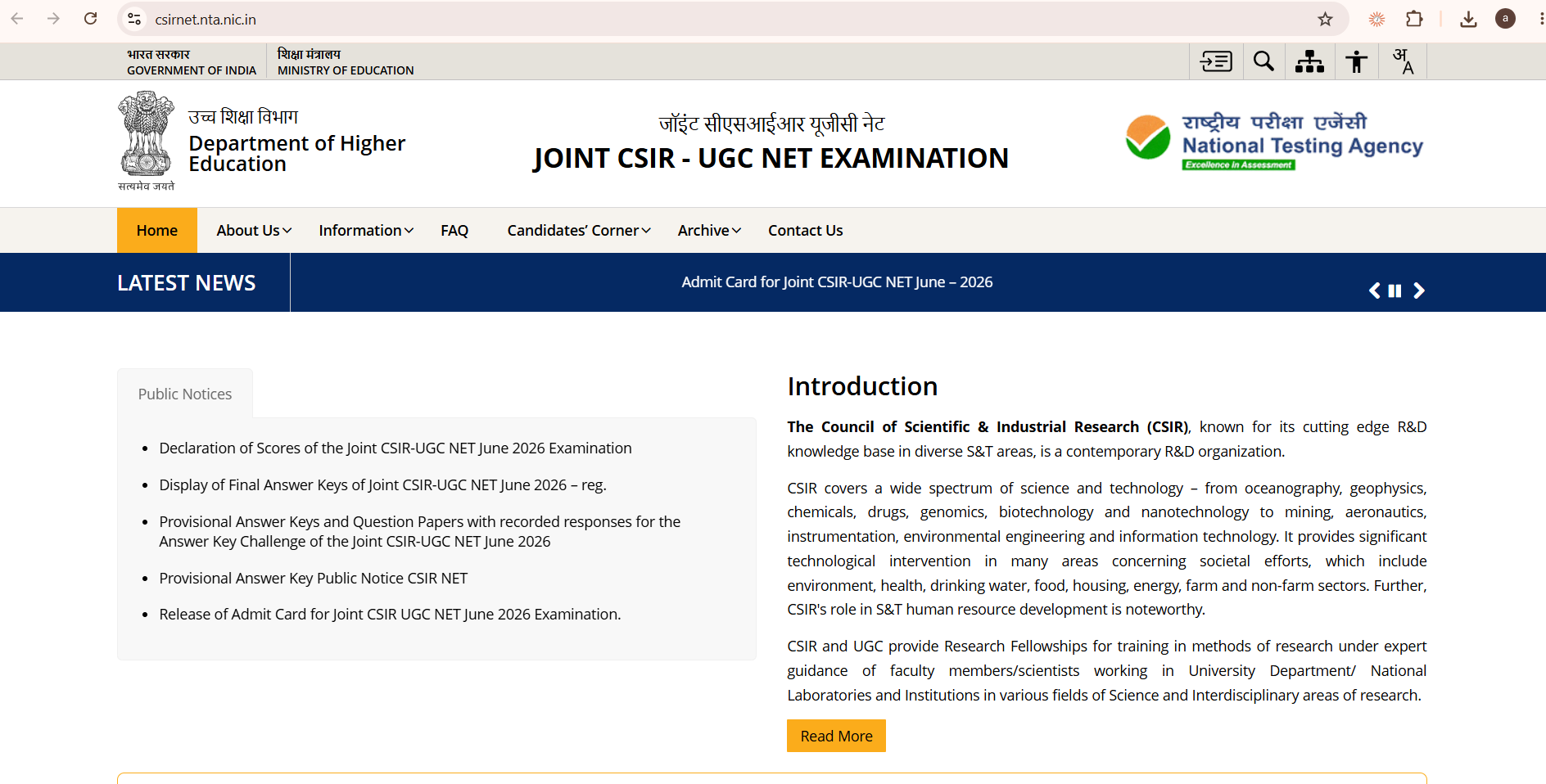
CSIR UGC NET June 2026 Result has officially been declared by the National Testing Agency (NTA) on August 29, 2026, on its official examination portal at csirnet.nta.nic.in and nta.ac.in. Candidates who appeared for the Joint CSIR-UGC National Eligibility Test (NET) conducted on July 17 and July 18, 2026, across computer-based test (CBT) centers nationwide can now access and download their official NTA scorecards. The declaration of the result concludes the evaluation of five core science disciplines: Chemical Sciences, Earth, Atmospheric, Ocean and Planetary Sciences, Life Sciences, Mathematical Sciences, and Physical Sciences. Candidates can log in to the portal using their Application Number and Date of Birth to view their subject-wise raw marks, normalized percentile scores, and eligibility status for Junior Research Fellowship (JRF), Assistant Professorship, and Ph.D. admissions for the 2026-2027 academic session. For candidates evaluating higher education research opportunities, doctoral programs, and university admissions, our All India College Predictor Hub provides instant rank insights, while students seeking academic mentorship can schedule a guidance session via Book a Free Admission Counselling Session and explore top universities through our Explore Colleges Directory and Medical Admissions Category portal.
The release of the CSIR UGC NET June 2026 Result marks a critical milestone for science graduates, postgraduates, and research scholars aiming for prestigious Council of Scientific and Industrial Research (CSIR) fellowships and faculty positions across Indian universities, IITs, IISc Bangalore, and national research laboratories. Under the revised NTA evaluation guidelines, candidate performance has been categorized into three distinct eligibility tiers: Category 1 (Eligible for JRF and Assistant Professor), Category 2 (Eligible for Assistant Professor and Ph.D. Admission), and Category 3 (Eligible for Ph.D. Admission Only). Candidates are strongly advised to download and preserve their official scorecards, as physical marksheets will not be dispatched by NTA.
CSIR UGC NET June 2026 Result Key Highlights and Overview
Staying informed about the official examination parameters, conducting authority timelines, and result metrics is essential for all qualified research aspirants. Below is the detailed summary of the Joint CSIR-UGC NET June 2026 examination and result declaration:
| CSIR NET Examination Metric | Official Details / Published Data |
|---|---|
| Conducting Body | National Testing Agency (NTA) |
| Exam Name | Joint CSIR-UGC National Eligibility Test (NET) June 2026 |
| Mode of Examination | Computer Based Test (CBT) Mode |
| Examination Dates | July 17, 2026 and July 18, 2026 |
| Provisional Answer Key Challenge Window | August 09 to August 11, 2026 |
| Result Declaration Date | August 29, 2026 |
| Total Core Science Subjects Covered | 5 Subjects (Chemical, Earth, Life, Mathematical, Physical) |
| Official NTA Portal URLs | csirnet.nta.nic.in / csirnet.nta.ac.in / nta.ac.in |
| Login Credentials Required | Application Number and Date of Birth / Password |
| JRF Award Validity Period | 2 Years from the date of issuance of JRF Award Letter |
| Assistant Professor Eligibility Validity | Lifetime Validity across all Indian Universities and Colleges |
Step-by-Step Guide to Download CSIR UGC NET June 2026 Result Scorecard
Candidates can view and download their individual NTA scorecards by following the step-by-step verified procedure outlined below:
- Visit the Official NTA CSIR NET Portal: Open your web browser and go to csirnet.nta.nic.in or nta.ac.in.
- Locate the Scorecard Download Link: On the homepage notification panel under “Candidate Activity”, click on the active link titled “Joint CSIR-UGC NET June 2026 Score Card”.
- Enter Your Login Credentials: On the login page, enter your 12-digit Application Number and Date of Birth (DD/MM/YYYY format) or Password.
- Enter Security Pin: Input the captcha security pin displayed on the screen accurately and click the “Submit” button.
- View NTA Scorecard Dashboard: Your official CSIR-UGC NET June 2026 Scorecard will be displayed on the screen showing subject-wise marks, total percentile, and qualifying category.
- Verify Personal Details: Cross-check your Candidate Name, Roll Number, Father’s Name, Mother’s Name, Category (General/EWS/OBC-NCL/SC/ST/PwD), Gender, and Subject Code.
- Download and Print: Save a digital PDF copy of the scorecard to your device and take multiple color printouts for university admissions and JRF award verification.
Detailed Subject Wise Breakdown Across Core Science Disciplines
The CSIR-UGC NET examination evaluates candidate aptitude and subject knowledge across five specialized scientific domains. Below is the detailed breakdown of the test structure, total questions, and evaluation criteria for each subject:
| Subject Code & Name | Part A (General Aptitude) | Part B (Subject Knowledge) | Part C (Higher Order Analytical) | Total Paper Marks |
|---|---|---|---|---|
| 701: Chemical Sciences | 20 Questions (Attempt 15) = 30 Marks | 40 Questions (Attempt 35) = 70 Marks | 60 Questions (Attempt 25) = 100 Marks | 200 Marks (3 Hours) |
| 702: Earth, Atmospheric, Ocean & Planetary | 20 Questions (Attempt 15) = 30 Marks | 50 Questions (Attempt 35) = 70 Marks | 80 Questions (Attempt 25) = 100 Marks | 200 Marks (3 Hours) |
| 703: Life Sciences | 20 Questions (Attempt 15) = 30 Marks | 50 Questions (Attempt 35) = 70 Marks | 75 Questions (Attempt 25) = 100 Marks | 200 Marks (3 Hours) |
| 704: Mathematical Sciences | 20 Questions (Attempt 15) = 30 Marks | 40 Questions (Attempt 25) = 75 Marks | 60 Questions (Attempt 20) = 95 Marks | 200 Marks (3 Hours) |
| 705: Physical Sciences | 20 Questions (Attempt 15) = 30 Marks | 25 Questions (Attempt 20) = 70 Marks | 30 Questions (Attempt 20) = 100 Marks | 200 Marks (3 Hours) |
High Weightage Syllabus Modules Covered in CSIR NET Exam
Candidates preparing for scientific research eligibility must master key high-weightage modules within their respective core science domains. Below is the domain-wise syllabus distribution evaluated in the June 2026 examination:
- Chemical Sciences (Code 701): Inorganic Chemistry (Organometallics, Bioinorganic, Main Group Elements), Organic Chemistry (Reaction Mechanisms, Pericyclic Reactions, Photochemistry, Spectroscopy), Physical Chemistry (Quantum Mechanics, Chemical Kinetics, Thermodynamics, Electrochemistry).
- Earth, Atmospheric, Ocean & Planetary Sciences (Code 702): Geology, Structural Geology and Tectonics, Paleontology, Meteorology, Oceanography, Climatology, Environmental Geosciences.
- Life Sciences (Code 703): Molecules and their Interaction, Cellular Organization, Fundamental Processes (Replication, Transcription, Translation), Cell Communication and Cell Signaling, Developmental Biology, System Physiology (Plant & Animal), Inheritance Biology, Ecological Principles, Evolution and Behavior, Applied Biology, Methods in Biology.
- Mathematical Sciences (Code 704): Analysis (Real & Complex Analysis), Linear Algebra, Abstract Algebra, Ordinary and Partial Differential Equations, Numerical Analysis, Calculus of Variations, Classical Mechanics, Probability and Statistics.
- Physical Sciences (Code 705): Mathematical Methods of Physics, Classical Mechanics, Electromagnetic Theory, Quantum Mechanics, Thermodynamic and Statistical Physics, Electronics and Experimental Methods, Atomic & Molecular Physics, Condensed Matter Physics, Nuclear and Particle Physics.
Subject Wise Cutoff Marks and Percentiles for CSIR UGC NET June 2026 Result
The National Testing Agency compiles subject-wise and category-wise qualifying cutoff percentiles for Junior Research Fellowship (JRF) and Assistant Professor eligibility. Because examinations in multi-shift subjects are conducted across different sessions, NTA uses a standardized normalization procedure based on Percentile Scores ranging from 100 to 0. Below is the expected qualifying cutoff matrix across the 5 core science subjects:
| Subject Discipline | Unreserved (UR) JRF Cutoff | EWS / OBC JRF Cutoff | SC / ST JRF Cutoff | Assistant Professor Cutoff (UR) |
|---|---|---|---|---|
| Chemical Sciences | 53.50% – 56.00% | 47.50% – 50.50% | 35.00% – 39.00% | 48.00% – 50.50% |
| Earth, Atmospheric, Ocean & Planetary Sciences | 58.00% – 61.00% | 52.00% – 55.50% | 39.50% – 43.00% | 52.50% – 55.00% |
| Life Sciences (Percentile Normalized) | 98.80+ Percentile | 96.50+ Percentile | 89.50+ Percentile | 96.20+ Percentile |
| Mathematical Sciences | 54.00% – 57.00% | 48.00% – 51.50% | 36.00% – 40.00% | 48.50% – 51.00% |
| Physical Sciences | 51.50% – 54.50% | 45.00% – 48.50% | 33.50% – 37.50% | 46.00% – 49.00% |
Category Wise Eligibility Classification Under CSIR UGC NET June 2026 Result
In accordance with the updated University Grants Commission (UGC) guidelines implemented from the 2024-2025 academic session onwards, candidate performance in the CSIR UGC NET June 2026 Result is categorized into three distinct qualifying tiers to streamline doctoral admissions and faculty recruitments across higher education institutions:
| Qualifying Category Tier | JRF Fellowship Status | Assistant Professor Eligibility | Ph.D. Admission Eligibility |
|---|---|---|---|
| Category 1 (Top Merit Rankers) | Eligible for CSIR / UGC JRF Monthly Fellowship | Eligible for Direct Appointment as Assistant Professor | Eligible for Ph.D. Admission + Interview Weightage |
| Category 2 (Second Tier Merit) | Not Eligible for JRF Monthly Fellowship | Eligible for Direct Appointment as Assistant Professor | Eligible for Ph.D. Admission + Interview Weightage |
| Category 3 (Third Tier Merit) | Not Eligible for JRF Monthly Fellowship | Not Eligible for Assistant Professor Appointment | Eligible for Ph.D. Admission Only (Score Valid 1 Year) |
Normalisation Method and NTA Percentile Score Computation
For subjects conducted in multiple shifts (such as Life Sciences), NTA implements an advanced Percentile Normalization procedure to transform raw scores across different test sessions into a uniform scale:
Percentile Score = 100 x (Number of candidates appeared in session with raw score equal to or less than candidate) / (Total number of candidates who appeared in that session)
The calculated NTA Percentile Score reflects the relative performance of a candidate compared to all other test-takers in that shift. Percentile scores are calculated up to 7 decimal places to avoid tie situations during merit list compilation.
Comparison Between Joint CSIR-UGC NET and UGC NET Examination Frameworks
Science postgraduates often seek clarity regarding the distinction between Joint CSIR-UGC NET and standard UGC NET examinations. Understanding the structural differences is key for academic planning:
| Comparison Dimension | Joint CSIR-UGC NET Exam | UGC NET Exam |
|---|---|---|
| Subject Stream Scope | 5 Core Science Streams (Chemical, Earth, Life, Math, Physical) | 83 Humanities, Social Sciences & Language Subjects |
| Funding Agency for JRF | Council of Scientific and Industrial Research (CSIR) & UGC | University Grants Commission (UGC) Only |
| Paper Structure | Single 3-Hour Paper divided into Part A, Part B, and Part C | Single 3-Hour Paper divided into Paper 1 and Paper 2 |
| Negative Marking | Negative marking applies (-0.25 to -1 mark based on section) | No Negative Marking in any section |
JRF Fellowship Stipend and Career Opportunities Post CSIR NET Result
Candidates qualifying under Category 1 of the CSIR UGC NET June 2026 Result earn the prestigious Junior Research Fellowship (JRF) awarded by the Council of Scientific and Industrial Research or University Grants Commission. Key fellowship highlights and career pathways include:
1. Revised JRF and SRF Monthly Fellowship Stipend
Selected JRF fellows receive financial support during their doctoral research tenure as per the enhanced Ministry of Science and Technology fellowship norms:
- Junior Research Fellow (JRF) Tenure (First 2 Years): Rs. 37,000/- per month + applicable House Rent Allowance (HRA at 9%, 18%, or 27% based on city category).
- Senior Research Fellow (SRF) Tenure (3rd Year Onwards): Upgraded to Rs. 42,000/- per month + applicable HRA post successful assessment of research progress.
- Annual Contingency Grant: Rs. 20,000/- per annum for purchase of research equipment, books, and chemical consumables.
2. Top Research Institutes Participating in CSIR JRF
Qualified JRF candidates can secure doctoral research seats across top-tier Indian scientific institutions including:
- CSIR Laboratories: 37 CSIR national institutes (such as CSIR-NCL Pune, CSIR-CDRI Lucknow, CSIR-IGIB Delhi, CSIR-CCMB Hyderabad, CSIR-CFTRI Mysore).
- Indian Institutes of Technology (IITs): Ph.D. research fellowships across IIT Bombay, IIT Delhi, IIT Madras, IIT Kanpur, and IIT Kharagpur.
- Indian Institute of Science (IISc): Direct Ph.D. admissions at IISc Bangalore.
- Indian Institutes of Science Education and Research (IISERs): Research positions across IISER Pune, Kolkata, Mohali, Bhopal, and Thiruvananthapuram.
- Central Universities: JRF doctoral seats at JNU New Delhi, BHU Varanasi, University of Hyderabad, and DU.
CSIR UGC NET June 2026 Result Certificate Verification and E-Certificate Download
Post result declaration, NTA and CSIR NET Unit issue digital eligibility certificates and JRF Award Letters to qualified candidates on the official e-certificate portal at ecertificate.nta.ac.in. Key verification steps include:
1. Step-by-Step E-Certificate Download Process
- Visit ecertificate.nta.ac.in.
- Select Institution as “Joint CSIR-UGC NET”.
- Select Captcha and click “Proceed”.
- Enter Application Number, Date of Birth, and Exam Session (June 2026).
- Download the password-protected digital eligibility e-certificate.
2. Document Verification by CSIR NET Unit
Candidates who qualify for JRF must submit self-attested copies of their qualifying documents to the Head, HRDG, CSIR Complex, Library Avenue, Pusa, New Delhi. Mandatory documents for verification include:
- NTA CSIR NET Scorecard June 2026: Printed scorecard download.
- Class 10th Certificate: Proof of date of birth.
- Master’s Degree Marksheet and Passing Certificate: M.Sc / BS-MS / B.Tech or equivalent degree with minimum 55% marks (50% for SC/ST/PwD/OBC-NCL).
- Valid Category Certificate: OBC-NCL, EWS, SC, ST, or PwD certificate in Central Government format.
3. Certificate Validity Duration
- JRF Award Letter Validity: Valid for 2 years from the date of issue for joining a Ph.D. program.
- Assistant Professor Certificate Validity: Lifetime validity across all colleges and universities in India.
Higher Education Admissions and Research Guidance Resources
Pursuing higher education, doctoral fellowships, and university faculty positions requires comprehensive guidance regarding admission criteria, institutional rankings, and research infrastructure. Candidates can access our specialized academic resources:
- Higher Education Directory: Search top research universities, academic departments, and faculty guidelines in our Medical Admissions Category and higher education directories.
- All India Predictor Hub: Calculate rank odds and admission chances using our All India College Predictor Hub.
- One-on-One Counselling Mentorship: Connect directly with expert academic advisors by booking a session at Book a Free Admission Counselling Session.
- Explore Colleges Directory: Access verified campus profiles, NIRF rankings, research laboratory approvals, and hostel infrastructure in our Explore Colleges Directory.
Frequently Asked Questions (FAQs) on CSIR UGC NET June 2026 Result
Q1: What is the official website to check the CSIR UGC NET June 2026 Result?
Answer: The official NTA portal to check the CSIR UGC NET June 2026 Result and download scorecards is csirnet.nta.nic.in. Updates are also published on nta.ac.in.
Q2: On what date was the CSIR UGC NET June 2026 Result officially declared?
Answer: The result was officially declared by NTA on August 29, 2026, following the examination held on July 17 and July 18, 2026.
Q3: What login credentials are required to download the CSIR NET scorecard?
Answer: Candidates require their 12-digit Application Number and Date of Birth (or Password) to log in and download their scorecard.
Q4: What are the 5 science subjects covered under Joint CSIR-UGC NET?
Answer: The 5 subjects are Chemical Sciences, Earth, Atmospheric, Ocean and Planetary Sciences, Life Sciences, Mathematical Sciences, and Physical Sciences.
Q5: What is the monthly stipend for CSIR JRF qualified candidates?
Answer: Qualified JRF fellows receive Rs. 37,000 per month + HRA for the first 2 years, which is upgraded to Rs. 42,000 per month + HRA for Senior Research Fellowship (SRF) from the 3rd year onwards.
Q6: What is the validity period of the CSIR JRF Award Letter?
Answer: The CSIR JRF Award Letter is valid for 2 years from the date of issue for securing admission to a Ph.D. program.
Q7: What is the validity of the Assistant Professor eligibility certificate?
Answer: The CSIR-UGC NET eligibility certificate for Assistant Professorship carries lifetime validity across all recognized Indian universities and colleges.
Q8: What are the three qualifying categories under the updated UGC NET rules?
Answer: Category 1 (JRF + Assistant Professor + Ph.D.), Category 2 (Assistant Professor + Ph.D. Admission), and Category 3 (Ph.D. Admission Only).
Q9: How are marks calculated for multi-shift subjects like Life Sciences?
Answer: Multi-shift subjects use NTA Percentile Normalization based on raw scores to ensure equal evaluation across different question paper sets.
Q10: Where can candidates download their digital CSIR NET e-certificates?
Answer: Digital e-certificates can be downloaded from the official NTA e-certificate portal at ecertificate.nta.ac.in post certificate verification.
Q11: Will NTA send hard copies of the CSIR NET scorecard by post?
Answer: No, NTA does not send physical scorecards by post. Candidates must download and print their scorecards directly from csirnet.nta.nic.in.
Q12: Where can candidates find research admission predictors and guidance for higher education?
Answer: Aspirants can access rank tools and mentorship on the All India College Predictor Hub and explore university options in our Medical Admissions Category directory on Admittance Edutech.
“””
with open(‘scratch/generated_csir_net_post.html’, ‘w’, encoding=’utf-8′) as out:
out.write(html_body)
print(“Generated CSIR NET article written to scratch/generated_csir_net_post.html”)