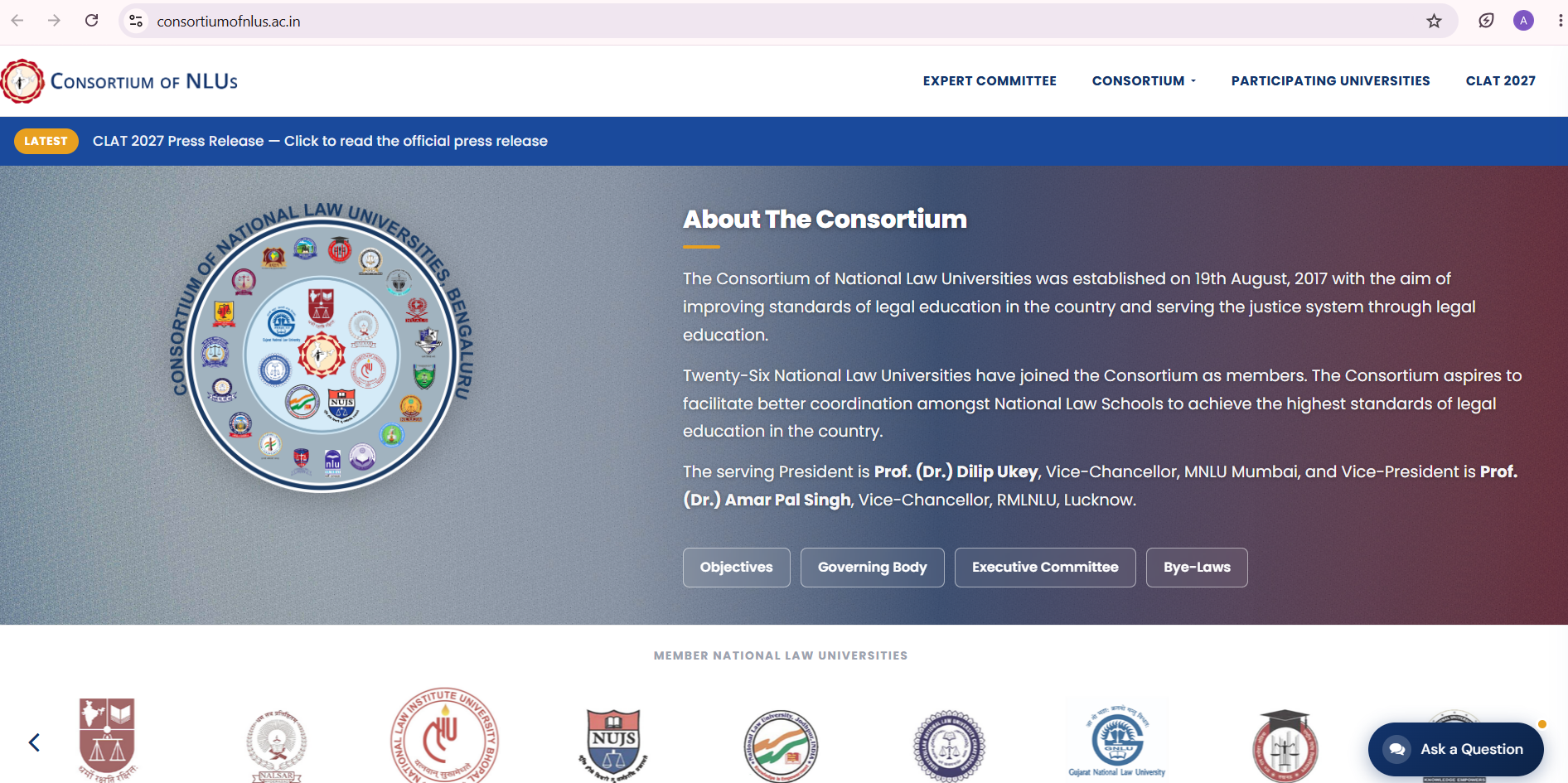
CLAT 2027 Registration is the official gateway for admission to undergraduate 5-year integrated law programs and postgraduate Master of Laws (LLM) programs across 24 participating National Law Universities (NLUs) in India, administered by the Consortium of National Law Universities on its official portal at consortiumofnlus.ac.in. The Common Law Admission Test (CLAT) is conducted annually in offline pen-and-paper mode, assessing candidate aptitude in reading comprehension, analytical reasoning, and legal principles. Candidates preparing for legal careers can complete their online application, upload verified educational documents, select preferred NLU test centres, and understand the updated passage-based examination pattern.
Latest status — verified on September 13, 2026: The Consortium of National Law Universities has opened the online application portal for the CLAT 2027 national entrance examination. Eligible law aspirants can register and submit their application forms on consortiumofnlus.ac.in before the official closing date.
Quick Facts: CLAT 2027 Entrance Examination Overview
The table below provides a quick, clear summary of key details regarding the Common Law Admission Test (CLAT 2027), conducting body, eligibility criteria, and official links.
| Exam Parameter | Official Details |
|---|---|
| Exam Name | Common Law Admission Test (CLAT) 2027 |
| Conducting Authority | Consortium of National Law Universities (Consortium of NLUs) |
| Academic Programs Offered | Undergraduate (BA LLB, BBA LLB, B.Com LLB, BSc LLB) and Postgraduate (LLM) |
| Mode of Examination | Offline Pen-and-Paper Test (OMR Sheet Based) |
| Exam Duration | 2 Hours (120 Minutes) |
| Number of Questions | 120 Objective Multiple-Choice Questions (MCQs) |
| Participating Institutions | 24 National Law Universities (NLUs) across India |
| Official Web Portal | consortiumofnlus.ac.in |
| Last Verified Date | September 13, 2026 |
Source: Consortium of National Law Universities Official Information Brochure (consortiumofnlus.ac.in)
Official Update Breakdown: CLAT 2027 Examination Timeline
The Consortium of National Law Universities organises CLAT once a year to streamline admissions into premier legal institutions. The examination schedule follows a well-structured roadmap, from initial online registration to admit card release, test conduction, answer key challenges, and centralized counselling allocation.
Candidates must carefully track all milestones on the official portal to ensure timely form submission and test venue planning. The offline exam is conducted across hundreds of test centres in major Indian cities.
| Counselling / Examination Milestone | Official Schedule Details |
|---|---|
| Commencement of Online Registration | Live on consortiumofnlus.ac.in |
| Last Date for Online Application Form Submission | As notified in the official admission calendar |
| Application Form Correction Window | Provided after registration closure for select fields |
| Release of Official Admit Cards (Hall Tickets) | Approximately 2 to 3 weeks prior to exam date |
| CLAT 2027 Examination Date | Conducted in single afternoon shift (02:00 PM to 04:00 PM) |
| Provisional Answer Key Release and Objection Window | Published within 24 to 48 hours post-exam |
| Final Answer Key and Result Declaration | Published on the official candidate dashboard |
| Centralized Online Admission Counselling | Multi-round seat allotment and fee payment process |
Source: Consortium of NLUs Official Admission Schedule and Information Bulletin
CLAT 2027 Eligibility Criteria for UG and PG Programs
Before initiating the application process, candidates must verify their educational qualifications and age criteria for their chosen academic level. The eligibility criteria established by the Consortium of NLUs are transparent and student-centric.
| Eligibility Parameter | Undergraduate (UG) 5-Year Integrated LLB | Postgraduate (PG) 1-Year LLM Program |
|---|---|---|
| Qualifying Examination | Senior Secondary School Examination (Class 12 / Intermediate / Higher Secondary) or equivalent recognized board examination. | Bachelor of Laws (3-Year LLB or 5-Year Integrated LLB degree) from a Bar Council of India recognized university. |
| Minimum Qualifying Marks (General / OBC / NRI / PwD) | Minimum 45% aggregate marks (or equivalent grade) in Class 12. | Minimum 50% aggregate marks (or equivalent grade) in LLB degree. |
| Minimum Qualifying Marks (SC / ST Categories) | Minimum 40% aggregate marks (or equivalent grade) in Class 12. | Minimum 45% aggregate marks (or equivalent grade) in LLB degree. |
| Candidates Appearing in Final Year | Eligible to apply. Must produce proof of passing Class 12 at the time of final admission. | Eligible to apply. Must produce proof of passing LLB degree at the time of final admission. |
| Upper Age Limit | No Upper Age Limit: Candidates of any age can appear. | No Upper Age Limit: Candidates of any age can appear. |
Source: Consortium of National Law Universities Statutory Eligibility Norms
Step-by-Step Registration Guide for CLAT 2027
Submitting the online application requires complete accuracy in filling personal details, academic history, test city preferences, and reservation categories. Follow these clear steps to complete your registration:
- Visit the official Consortium portal at consortiumofnlus.ac.in.
- Click on the CLAT 2027 portal link on the homepage.
- Click on Register to create a new user account by providing your active mobile number and valid email address.
- Set a secure password and enter the One-Time Password (OTP) received on your mobile phone to activate your account.
- Log in with your registered mobile number and password to access the online application form.
- Select your program preference: Undergraduate (5-Year Integrated Law) or Postgraduate (LLM).
- Fill in your personal information, communication address, and category details (General, SC, ST, OBC, EWS, PwD, Domicile status).
- Upload clear scanned copies of your passport-size photograph, signature, and relevant category certificates in the prescribed image formats.
- Select three preferred examination cities in order of convenience from the list of available test locations.
- Review the complete application summary, make the online application fee payment via debit card, credit card, or net banking, and download the confirmation receipt for your records.
CLAT 2027 Application Fee Structure
The application fee must be paid entirely online during form submission. The fee is strictly non-refundable and varies by candidate category as mandated by the Consortium.
| Candidate Category | Application Fee Amount | Official Previous Years’ Question Papers (Optional) |
|---|---|---|
| General / Other Backward Classes (OBC) / PwD / NRI / OCI / PIO | Rs. 4,000 | Rs. 500 (Optional add-on) |
| Scheduled Caste (SC) / Scheduled Tribe (ST) / Below Poverty Line (BPL) | Rs. 3,500 | Rs. 500 (Optional add-on) |
Source: Consortium of NLUs Official Information Brochure and Fee Policy
CLAT 2027 Undergraduate (UG) Exam Pattern and Sectional Weightage
The undergraduate CLAT examination tests comprehension and analytical abilities rather than rote memory. The entire paper consists of passage-based objective multiple-choice questions across five distinct subject areas. Each passage is followed by a series of 4 to 6 questions directly linked to the context.
| Subject Section | Number of Questions (Approximate) | Percentage Weightage | Marks Allocated | Passage Source and Type |
|---|---|---|---|---|
| English Language | 22 – 26 Questions | ~20% | 22 – 26 Marks | Passages of ~450 words from contemporary and historic fiction/non-fiction. |
| Current Affairs including General Knowledge | 28 – 32 Questions | ~25% | 28 – 32 Marks | Passages of ~450 words derived from news articles, journalistic sources, and non-fiction essays. |
| Legal Reasoning | 28 – 32 Questions | ~25% | 28 – 32 Marks | Passages of ~450 words relating to legal matters, public policy questions, and philosophical law principles. |
| Logical Reasoning | 22 – 26 Questions | ~20% | 22 – 26 Marks | Passages of ~300 words with critical arguments, premise evaluations, and logical patterns. |
| Quantitative Techniques | 10 – 14 Questions | ~10% | 10 – 14 Marks | Short sets of facts, textual data, graphs, diagrams, and numerical caselets based on Class 10 arithmetic. |
| Grand Total | 120 Questions | 100% | 120 Marks | Total Duration: 2 Hours (120 Minutes) |
Source: Consortium of NLUs Official Syllabus and Pattern Guidelines
Marking Scheme and Negative Marking Rule
- Correct Answer: +1 mark is awarded for every correct response marked on the OMR sheet.
- Incorrect Answer: -0.25 marks are deducted for every wrong response.
- Unattempted Questions: 0 marks (no penalty or deduction).
Detailed Section-by-Section Syllabus Breakdown for CLAT UG
To prepare effectively, candidates must understand what skills each section evaluates and how the questions are formulated from the passages.
1. English Language Section
Candidates are provided with reading comprehension passages of approximately 450 words each. The passages test your ability to read and comprehend text written at a 12th-grade level:
- Understanding the central theme, main arguments, and supporting viewpoints presented in the passage.
- Drawing accurate inferences and conclusions based directly on the passage context.
- Summarizing the core message of the passage in simple words.
- Identifying vocabulary in context, synonyms, antonyms, and grammatical constructs.
2. Current Affairs including General Knowledge
This section features passages of up to 450 words extracted from reputable news sources, historic texts, and analytical essays. The questions evaluate your awareness of:
- Contemporary events of national and international significance.
- Major historical milestones, arts, culture, and constitutional evolution.
- International bodies, international law treaties, and global summits.
- Government schemes, public policy initiatives, and landmark judicial pronouncements.
3. Legal Reasoning Section
The legal reasoning section contains passages of approximately 450 words discussing legal scenarios, court judgments, or philosophical legal principles. You do not need prior legal knowledge to solve these questions:
- Identifying the legal rules, principles, and propositions stated within the passage.
- Applying these extracted rules to specific hypothetical fact situations provided in the questions.
- Analyzing how changes in facts or rules alter the final legal outcome.
- Core subject exposure includes constitutional law, law of contracts, law of torts, criminal law, and general legal maxims.
4. Logical Reasoning Section
This section evaluates your critical and analytical thinking through short argument passages of around 300 words each:
- Recognizing arguments, premises, assumptions, and conclusions.
- Critically assessing the strength or weakness of reasoning used by the author.
- Identifying logical fallacies, inconsistencies, and analogies.
- Drawing valid deductions and predicting outcomes based on the provided logical premises.
5. Quantitative Techniques Section
The quantitative techniques section includes short sets of numerical information, graphical charts, caselets, or textual propositions based on basic Class 10 mathematics:
- Extracting and organizing numerical data from passages, tables, and bar/pie charts.
- Applying foundational arithmetic concepts including percentages, ratios and proportions, averages, profit and loss, time and work, and simple interest.
- Performing quick mathematical computations to arrive at precise numerical solutions.
CLAT 2027 Postgraduate (PG LLM) Exam Pattern and Syllabus
The Master of Laws (LLM) entrance examination is designed for law graduates seeking advanced academic degrees. The paper tests comprehensive understanding of core foundational law subjects.
| LLM Paper Parameter | Official Structure and Details |
|---|---|
| Mode and Format | Offline Pen-and-Paper Test (OMR Sheet Based) |
| Duration | 2 Hours (120 Minutes) |
| Total Number of Questions | 120 Objective Multiple-Choice Questions |
| Total Marks | 120 Marks |
| Marking Scheme | +1 mark for correct answer; -0.25 mark for wrong answer |
| Passage Structure | Extracts from primary legal materials, landmark Supreme Court / High Court judgements, statutes, and statutory regulations. |
| Core Legal Subjects Covered | Constitutional Law, Jurisprudence, Administrative Law, Law of Contract, Law of Torts, Family Law, Criminal Law (IPC, CrPC, Evidence), Property Law, Company Law, Public International Law, Tax Law, Environmental Law, and Labour Law. |
Source: Consortium of NLUs Postgraduate Law Information Brochure
List of Participating 24 National Law Universities (NLUs)
A single CLAT rank opens admission doors across 24 prestigious National Law Universities established under state legislative statutes throughout India.
| S.No | National Law University Name | Location / State | Undergraduate Programs Offered |
|---|---|---|---|
| 1 | National Law School of India University (NLSIU) | Bengaluru, Karnataka | BA LLB (Hons) |
| 2 | NALSAR University of Law | Hyderabad, Telangana | BA LLB (Hons) |
| 3 | The West Bengal National University of Juridical Sciences (WBNUJS) | Kolkata, West Bengal | BA LLB (Hons), BSc LLB (Hons) |
| 4 | National Law University (NLUJ) | Jodhpur, Rajasthan | BA LLB (Hons), BBA LLB (Hons) |
| 5 | Gujarat National Law University (GNLU) | Gandhinagar, Gujarat | BA LLB, BBA LLB, B.Com LLB, BSc LLB |
| 6 | National Law Institute University (NLIU) | Bhopal, Madhya Pradesh | BA LLB (Hons), BSc LLB (Hons) |
| 7 | Dr. Ram Manohar Lohiya National Law University (RMLNLU) | Lucknow, Uttar Pradesh | BA LLB (Hons) |
| 8 | Rajiv Gandhi National University of Law (RGNUL) | Patiala, Punjab | BA LLB (Hons) |
| 9 | Chanakya National Law University (CNLU) | Patna, Bihar | BA LLB (Hons), BBA LLB (Hons) |
| 10 | National University of Advanced Legal Studies (NUALS) | Kochi, Kerala | BA LLB (Hons) |
| 11 | National Law University Odisha (NLUO) | Cuttack, Odisha | BA LLB (Hons), BBA LLB (Hons) |
| 12 | National University of Study and Research in Law (NUSRL) | Ranchi, Jharkhand | BA LLB (Hons) |
| 13 | National Law University and Judicial Academy (NLUJA) | Guwahati, Assam | BA LLB (Hons) |
| 14 | Damodaram Sanjivayya National Law University (DSNLU) | Visakhapatnam, Andhra Pradesh | BA LLB (Hons) |
| 15 | Tamil Nadu National Law University (TNNLU) | Tiruchirappalli, Tamil Nadu | BA LLB (Hons), B.Com LLB (Hons) |
| 16 | Maharashtra National Law University (MNLU) | Mumbai, Maharashtra | BA LLB (Hons), BBA LLB (Hons) |
| 17 | Maharashtra National Law University (MNLU) | Nagpur, Maharashtra | BA LLB (Hons), BBA LLB (Hons) |
| 18 | Maharashtra National Law University (MNLU) | Aurangabad (Chhatrapati Sambhajinagar), Maharashtra | BA LLB (Hons), BBA LLB (Hons) |
| 19 | Himachal Pradesh National Law University (HPNLU) | Shimla, Himachal Pradesh | BA LLB (Hons), BBA LLB (Hons) |
| 20 | Dharmashastra National Law University (DNLU) | Jabalpur, Madhya Pradesh | BA LLB (Hons) |
| 21 | Dr. B.R. Ambedkar National Law University (DBRANLU) | Sonipat, Haryana | BA LLB (Hons) |
| 22 | National Law University Tripura (NLUT) | Agartala, Tripura | BA LLB (Hons) |
| 23 | Gujarat National Law University (GNLU Silvassa Campus) | Silvassa, Dadra and Nagar Haveli | BA LLB (Hons) |
| 24 | National Law School of India University / Allied NLU Portals | Participating NLU Campuses | Integrated Law Degrees |
Source: Consortium of National Law Universities Member Directory
What This Means for Students: Practical Preparation Strategies
CLAT is a test of reading speed, analytical stamina, and critical deduction. Here are actionable steps to build a high-scoring strategy:
- Enhance Reading Speed and Comprehension: The entire paper requires reading approximately 20 to 22 lengthy passages within 120 minutes. Practice reading editorials from quality national dailies (such as The Hindu and The Indian Express) daily to build a reading speed of 250 to 300 words per minute.
- Master Principle-Fact Legal Applications: Focus on understanding how legal principles operate in practice. Never assume external facts beyond what is explicitly mentioned in the passage.
- Take Timed Mock Tests on Physical OMR Sheets: Because CLAT is an offline test, bubbling answers accurately on an OMR sheet takes around 10 to 12 minutes. Practice full-length mocks on printed OMR sheets under strict 2-hour limits.
- Analyze Negative Marking Patterns: Avoid blind guessing. With a 0.25-mark penalty for every incorrect response, attempt questions where you can eliminate at least two plausible options.
- Explore Academic and Career Counseling: Aspirants evaluating various higher education tracks can explore our All India College Predictor Hub, discover premier law institutes in our Explore Colleges Directory, or Book a Free Admission Counselling Session with expert educational mentors.
Frequently Asked Questions (FAQs)
Q1: What is the official website for CLAT 2027 Registration?
Answer: The official website for registration is consortiumofnlus.ac.in. Candidates must submit their application form, upload documents, and complete online fee payment exclusively through this official portal.
Q2: Is there any upper age limit to appear for CLAT 2027?
Answer: No, there is no upper age limit for either the undergraduate (5-Year Integrated LLB) or postgraduate (LLM) CLAT examination. Candidates of any age can appear if they meet the minimum educational marks criteria.
Q3: What is the minimum percentage required in Class 12 for CLAT UG?
Answer: Candidates from General, OBC, NRI, and PwD categories must secure at least 45% aggregate marks in Class 12, while SC and ST candidates require a minimum of 40% aggregate marks.
Q4: Is CLAT 2027 conducted online or offline?
Answer: CLAT is conducted strictly in offline pen-and-paper mode. Candidates are provided with a physical question booklet and must mark their responses on an optical mark recognition (OMR) answer sheet using black or blue ballpoint pens.
Q5: How many questions are asked in the CLAT UG examination?
Answer: The CLAT UG question paper contains exactly 120 objective multiple-choice questions carrying 1 mark each, making the total test score 120 marks. The total exam duration is 2 hours (120 minutes).
Q6: Does CLAT 2027 have negative marking?
Answer: Yes, there is negative marking in CLAT. Each correct answer carries +1 mark, and 0.25 marks are deducted for every incorrect answer. No marks are deducted for unattempted questions.
Q7: Can final-year Class 12 students apply for CLAT 2027?
Answer: Yes, students appearing for their Class 12 board examinations in the qualifying year are fully eligible to apply. They must submit proof of passing the qualifying examination at the time of final admission counselling.
Q8: Is National Law University Delhi (NLU Delhi) included in CLAT?
Answer: No, National Law University Delhi does not participate in CLAT. NLU Delhi conducts its own separate national-level entrance test known as AILET (All India Law Entrance Test) for admissions to its BA LLB and LLM programs.
Q9: What is the application fee for CLAT 2027?
Answer: The online application fee is Rs. 4,000 for General, OBC, NRI, and PwD candidates, and Rs. 3,500 for SC, ST, and BPL candidates. An optional fee of Rs. 500 applies if candidates choose to access official previous years’ question papers.
Q10: What are the main sections in the CLAT UG syllabus?
Answer: The CLAT UG syllabus consists of five passage-based sections: English Language, Current Affairs including General Knowledge, Legal Reasoning, Logical Reasoning, and Quantitative Techniques based on Class 10 arithmetic.
Sources Checked and Editorial Verification
- Consortium of National Law Universities (Consortium of NLUs) Official Portal
- Consortium of NLUs Official Information Brochure and Admission Guidelines
- Bar Council of India (BCI) Statutory Legal Education Rules
Update Policy: This page will be revised immediately when the counselling authority publishes a new official notification or revised schedule.