
NLSIU Bangalore Cutoff 2026: CLAT Rank for General and Reserved Categories
The official first-round NLSIU Bangalore cutoff 2026 for the five-year B.A., LL.B. (Hons.) programme closed at All India Rank 101 for the General category, 702 for EWS, 1,018 for OBC, 3,072 for SC and 5,000 for ST. The corresponding first-list horizontal-category cutoffs included AIR 336 for General Category–Karnataka, 3,536 for OBC–Karnataka, 9,719 for SC–Karnataka and 16,879 for ST–Karnataka.
These ranks show how competitive admission to the National Law School of India University, Bengaluru remains. However, a cutoff is not a fixed qualifying rank announced before counselling. It is the rank of the last candidate allotted a seat in a particular category, reservation pool and counselling round.
NLSIU admits students to its five-year B.A., LL.B. (Hons.) programme entirely through CLAT merit and the centralised counselling process conducted by the Consortium of National Law Universities. The university requires at least 45% in the qualifying examination for General, OBC and PwD candidates and 40% for SC and ST candidates.
Candidates must interpret the cutoff according to the correct vertical and horizontal reservation category. Karnataka reservation, women’s reservation and disability reservation may overlap with General, EWS, OBC, SC or ST categories, so the highest rank appearing in the allotment list is not the regular General cutoff.
Last Updated – July 11, 2026

➡️ Explore our College Predictor: /college-predictor
Official disclaimer: This article is an independent admission guide and is not an official notification from NLSIU or the Consortium of NLUs. Cutoffs can vary across rounds and reservation combinations. Candidates must verify allotment lists, eligibility, certificates, fees and reporting instructions through the official CLAT and NLSIU admission portals.
NLSIU Bangalore Cutoff 2026: Category-Wise Ranks
The Consortium’s official first provisional allotment list includes a cutoff table for every major vertical and horizontal reservation category.
| Category | Official Round 1 AIR cutoff |
|---|---|
| General | 101 |
| EWS | 702 |
| OBC | 1,018 |
| SC | 3,072 |
| ST | 5,000 |
| Additional Karnataka Students seats | 427 |
| General PwD | 8,756 |
| General Category–Karnataka | 336 |
| OBC–Karnataka | 3,536 |
| SC–Karnataka | 9,719 |
| ST–Karnataka | 16,879 |
| EWS–Karnataka | 10,063 |
These are All India Ranks from the first provisional list, not expected marks or category ranks. The official document separately records category-rank cutoffs, but students generally use AIR when comparing their admission position.
The Round 1 list contained 121 General seats, 81 OBC seats, 45 SC seats, 30 EWS seats, 23 ST seats and additional horizontally reserved seats. Some candidates qualified simultaneously under vertical, Karnataka, women or PwD reservations.
General-Category Cutoff
The regular General-category cutoff in the first allotment list was AIR 101. This means that an unreserved candidate ordinarily needed to be within approximately the top 100 CLAT 2026 ranks for a first-round seat.
Some later reported round-wise summaries place the General cutoff around AIR 108 in subsequent lists. The small movement reflects the fact that most candidates allotted NLSIU at the top of the rank list are likely to retain it.
| General AIR range | Practical interpretation |
|---|---|
| 1–80 | Very strong position |
| 81–101 | Within the official Round 1 range |
| 102–110 | Borderline for later-round movement |
| Above 110 | Increasingly uncertain for regular General seats |
This is counselling guidance rather than a guarantee. Category, horizontal reservation and vacancy movement can change the actual outcome.
EWS and OBC Cutoffs
The official first-list cutoff was:
- EWS: AIR 702
- OBC: AIR 1,018
Candidates must possess valid certificates in the required format. An EWS or OBC claim entered in the CLAT application does not by itself establish eligibility. If the certificate is invalid, outdated or inconsistent with the claimed category, the candidate may lose reserved-category consideration.
The Consortium states that where a discrepancy concerns eligibility for a reservation category, a candidate may be considered in subsequent rounds without that reservation benefit, subject to the applicable rules and rank.
| Category | Competitive 2026 reference |
|---|---|
| EWS | Target within AIR 700 |
| OBC | Target within AIR 1,000 |
| EWS–Karnataka | Separate horizontal interaction applies |
| OBC–Karnataka | Separate horizontal interaction applies |
Candidates should not compare an OBC–Karnataka allotment with the regular All India OBC cutoff because the applicable seat pools are different.
SC and ST Cutoffs
The official Round 1 cutoff was:
- SC: AIR 3,072
- ST: AIR 5,000
These ranks reflect the final candidates admitted against the relevant vertical category in the first provisional list. The list also included candidates admitted through SC–Karnataka and ST–Karnataka horizontal reservation at ranks extending beyond the regular SC and ST closing ranks.
| Reserved category | Official Round 1 cutoff |
|---|---|
| SC | AIR 3,072 |
| ST | AIR 5,000 |
| SC–Karnataka | AIR 9,719 |
| ST–Karnataka | AIR 16,879 |
A higher AIR under a Karnataka horizontal category does not mean the regular SC or ST cutoff extended to that rank. It means the candidate was allotted through an overlapping reservation framework.
How Karnataka Reservation Works

NLSIU follows a 25% compartmentalised horizontal reservation for Karnataka students. This reservation operates within vertical categories such as General, EWS, OBC, SC and ST instead of functioning as one independent vertical category.
The university explains that the policy is intended to ensure that at least 25% of admitted students are Karnataka students. It does not impose a maximum cap, so more Karnataka candidates can gain admission through regular merit.
| Karnataka reservation point | Explanation |
|---|---|
| Nature | Compartmentalised horizontal reservation |
| Minimum representation | 25% of admissions |
| Categories covered | General, EWS, OBC, SC and ST |
| Merit admission | Karnataka candidates can also qualify without the benefit |
| Relevant document | Karnataka study certificate |
For the fourth-round 2026 reporting process, NLSIU required a Karnataka study certificate from recognised institutions confirming the prescribed period of study in Karnataka.
Candidates should follow the exact 2026 certificate conditions communicated through the university rather than relying on an older interpretation of domicile eligibility.
Why NLSIU Cutoffs Change Between Rounds
Cutoff movement occurs when candidates:
- choose another NLU;
- exit counselling;
- fail to pay the confirmation or university fee;
- are found ineligible during verification;
- surrender an allotted seat;
- move to a higher preference;
- leave a vacancy that is offered to the next eligible candidate.
NLSIU is usually the first preference of many top-ranked candidates, so movement is often smaller than at lower-preference NLUs.
| Factor | Effect on closing rank |
|---|---|
| Seat withdrawals | Can push the cutoff to a higher AIR |
| Certificate rejection | Creates a category-specific vacancy |
| Preference changes | Affect which candidates are considered |
| Fee non-payment | Causes seat cancellation |
| Horizontal reservation | Produces different overlapping cutoffs |
The fifth provisional allotment list has been published, and any vacancies remaining after central counselling may be handled through university-specific procedures.
NLSIU B.A., LL.B. Eligibility 2026

Visit Official Website : nls.ac.in
Admission is based on CLAT 2026 merit, but every candidate must separately satisfy academic and documentary requirements.
| Candidate category | Minimum qualifying marks |
|---|---|
| General, OBC and PwD | 45% or equivalent grade |
| SC and ST | 40% or equivalent grade |
Candidates must pass Class 12 or an equivalent examination and appear for CLAT to secure admission to the five-year programme.
Students awaiting their Class 12 results may receive provisional admission subject to submitting the marksheet and proving eligibility by the deadline prescribed by NLSIU. The fourth-round notification required pending Class 12 documents to be submitted by September 30, 2026.
Merely receiving a CLAT rank or provisional allotment does not override the academic eligibility conditions.
CLAT 2026 Counselling Schedule
The central counselling process was conducted over five rounds.
| Counselling event | Official date or period |
|---|---|
| Counselling registration opened | December 17, 2025, 6:00 PM |
| Registration closed | December 27, 2025, 10:00 PM |
| Third allotment list | February 5, 2026 |
| Fee deadline for candidates freezing in Rounds 1–3 | April 24, 2026 |
| Fourth allotment list | May 2, 2026 |
| Fourth-round action window | May 2–8, 2026 |
| Fifth and final allotment list | May 15, 2026 |
| Fifth-round action window | May 15–20, 2026 |
The Consortium initially scheduled five rounds, with the fourth and fifth rounds used to fill vacancies remaining after the earlier university-fee deadline.
Candidates should retain copies of all later notices because revised institutional dates may differ from the central calendar.
CLAT Registration and Counselling Process
Direct Link of CLAT website : consortiumofnlus.ac.in
1. Complete the CLAT application
The candidate must register for CLAT, enter accurate personal and category information, upload the required documents and appear for the examination.
2. Receive a counselling invitation
Only eligible candidates invited according to the CLAT rank list and NLU admission matrix can register for central counselling. Invitations are communicated through the CLAT portal, email and SMS.
3. Enter NLU preferences
Candidates were required to provide at least 15 UG preferences. They are considered only for NLUs included in the submitted list. Preferences could be updated until counselling registration closed.
4. Pay the counselling fee
The 2026 counselling-registration fee was:
| Category | Registration fee |
|---|---|
| General | ₹30,000 |
| SC, ST, OBC, BC, EWS and PwD | ₹20,000 |
The registration fee was refundable subject to the official withdrawal and allotment rules.
5. Respond after allotment
An allotted candidate must select Freeze, Float or Exit and complete the applicable confirmation-fee requirements.
Freeze, Float and Exit Explained
| Option | What it means |
|---|---|
| Freeze | Accept the allotted NLU and stop seeking an upgrade |
| Float | Retain the current seat while remaining eligible for a higher preference |
| Exit | Leave counselling and surrender any allotted seat |
Float allows movement only to an NLU placed higher in the submitted preference list. If upgraded, the candidate cannot return to the previous allotted NLU. Float was available until the fourth round, while the fifth and final round required candidates to Freeze or Exit.
Failure to select an option within the deadline can result in loss of the seat and removal from subsequent counselling.
Documents Required for NLSIU Admission
NLSIU’s fourth-round notification required candidates to upload or provide the following documents:
| Document category | Required records |
|---|---|
| CLAT documents | Signed CLAT 2026 admit card |
| Academic records | Class 10 and Class 12 marksheets |
| Identity | Government-issued photo ID |
| Photograph | Recent passport-size colour photograph |
| Reservation | Caste, OBC-NCL, EWS or disability certificate |
| Karnataka claim | Karnataka study certificate |
| Previous NLU payment | Fee receipt, where applicable |
Accepted identification examples included Aadhaar, passport, voter ID, driving licence, ration card and PAN card.
Certificates must be issued by competent authorities. Students should ensure that names, category details and dates match across the CLAT application and original documents.
Seat Allotment and Reporting Process
The provisional allotment is based on:
- CLAT AIR;
- category and applicable horizontal reservation;
- NLU preference order;
- seat availability;
- counselling-round movement.
After receiving NLSIU, the candidate generally needs to:
- select Freeze or Float on the CLAT portal;
- pay the confirmation fee;
- complete the NLSIU admission form;
- upload the prescribed documents;
- attend online or physical verification as directed;
- pay the remaining university fee;
- submit pending academic documents by the specified deadline;
- obtain confirmation of provisional admission.
The fourth-round NLSIU notification required selected candidates to submit the online admission form and documents before verification on May 11, 2026.
All central allotments remain provisional until NLSIU validates eligibility and documents.
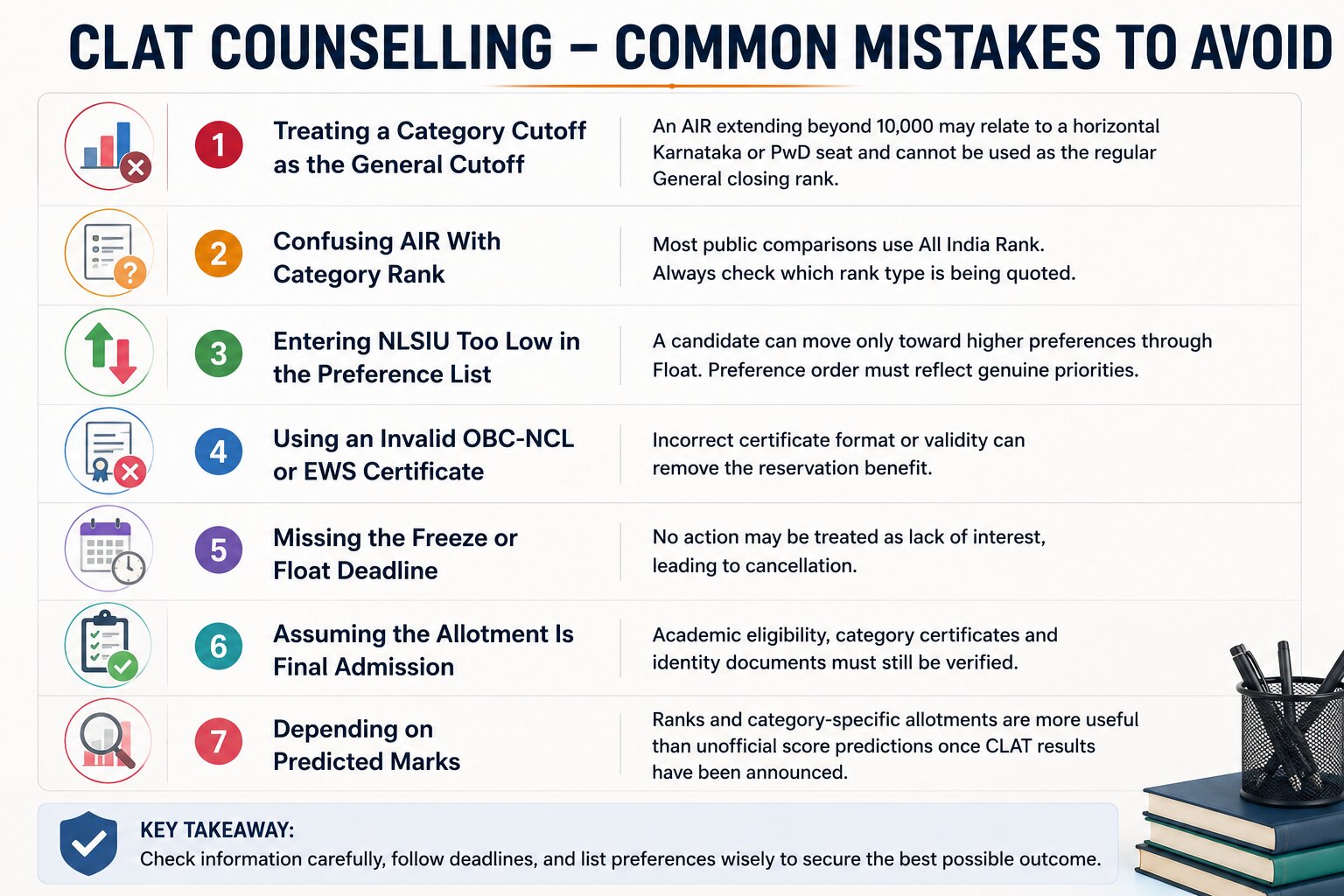
Common Mistakes to Avoid
➡️ Get Personalized Guidance: College Predictor
Treating a Category Cutoff as the General Cutoff
An AIR extending beyond 10,000 may relate to a horizontal Karnataka or PwD seat and cannot be used as the regular General closing rank.
Confusing AIR With Category Rank
Most public comparisons use All India Rank. Always check which rank type is being quoted.
Entering NLSIU Too Low in the Preference List
A candidate can move only toward higher preferences through Float. Preference order must reflect genuine priorities.
Using an Invalid OBC-NCL or EWS Certificate
Incorrect certificate format or validity can remove the reservation benefit.
Missing the Freeze or Float Deadline
No action may be treated as lack of interest, leading to cancellation.
Assuming the Allotment Is Final Admission
Academic eligibility, category certificates and identity documents must still be verified.
Depending on Predicted Marks
Ranks and category-specific allotments are more useful than unofficial score predictions once CLAT results have been announced.
Expert Counselling Tips
- Compare your AIR, not only your CLAT marks, with the correct category cutoff.
- Keep NLSIU first only when it is genuinely your preferred NLU.
- Evaluate both vertical and horizontal eligibility before estimating your chances.
- Prepare fresh OBC-NCL or EWS certificates according to the prescribed session requirements.
- Use the official first-list cutoff as a strong benchmark but continue through later rounds if your rank is close.
- Do not Exit merely because no seat appears in an early list.
- Save every counselling receipt, preference list and fee-payment confirmation.
- Compare NLSIU with other available NLUs before freezing, considering programme fit, location and cost—not reputation alone.
How Admittance Edutech Can Help
Admittance Edutech can assist CLAT candidates with:
- NLSIU cutoff and category analysis;
- General, EWS, OBC, SC and ST rank assessment;
- Karnataka reservation guidance;
- NLU preference-list planning;
- CLAT counselling registration support;
- Freeze, Float and Exit strategy;
- certificate and document review;
- round-wise allotment tracking;
- NLSIU versus other NLU comparison;
- fee-payment and reporting guidance;
- vacancy-round planning;
- complete law-admission counselling.
The objective is to help candidates interpret their rank correctly and avoid losing an opportunity because of an incorrect preference order, invalid certificate or missed counselling action.
Conclusion
The NLSIU Bangalore cutoff 2026 confirms that admission to the five-year B.A., LL.B. (Hons.) programme remains highly competitive. In the official first allotment list, the regular General category closed at AIR 101. The corresponding cutoffs were AIR 702 for EWS, 1,018 for OBC, 3,072 for SC and 5,000 for ST.
Students must interpret these ranks carefully. Karnataka, women and PwD reservations operate horizontally and may overlap with vertical categories. Consequently, a higher rank appearing in the complete allotment list does not automatically represent the ordinary category cutoff.
Admission depends on more than crossing a historical closing rank. Candidates must have included NLSIU in their preference list, completed counselling registration, selected Freeze or Float within the deadline and paid the required fees. They must also satisfy the academic requirement and produce valid identity, category and Karnataka-study documents where applicable.
A candidate close to the Round 1 cutoff should continue monitoring later rounds because withdrawals and upgrades can create limited movement. However, NLSIU generally experiences relatively small General-category movement due to strong demand.
The safest strategy is to compare the correct AIR and reservation pool, prepare documents before allotment and monitor both the CLAT and NLSIU portals. Careful counselling participation is as important as the entrance rank itself.

Related Post | Private Law Colleges Accepting CLAT 2026: Top Colleges, Fees, Expected Rank
Frequently Asked Questions
1. What was the NLSIU General-category cutoff in CLAT 2026?
The official first provisional allotment list closed at All India Rank 101 for the regular General category.
2. What were the NLSIU OBC, SC and ST cutoffs for 2026?
In Round 1, the official cutoffs were AIR 1,018 for OBC, 3,072 for SC and 5,000 for ST.
3. What was the NLSIU EWS cutoff in 2026?
The official EWS cutoff in the first CLAT 2026 allotment list was AIR 702.
4. Does NLSIU have a Karnataka reservation?
Yes. NLSIU follows a 25% compartmentalised horizontal reservation for Karnataka students across vertical categories such as General, EWS, OBC, SC and ST.
5. Can the NLSIU cutoff move after Round 1?
Yes, limited movement can occur due to withdrawal, non-payment, upgrades or document rejection. However, NLSIU typically experiences relatively small movement because it is a top preference among high-ranked candidates.
ALSO,
-
IIIT Hyderabad Cutoff 2026: JEE Main Closing Rank for CSE and ECE
-
Admission Counselling vs Self Research: Which Saves More Time in 2026
What was the NLSIU General-category cutoff in CLAT 2026?
The official first provisional allotment list closed at All India Rank 101 for the regular General category.
What were the NLSIU OBC, SC and ST cutoffs for 2026?
In Round 1, the official cutoffs were AIR 1,018 for OBC, 3,072 for SC and 5,000 for ST.
What was the NLSIU EWS cutoff in 2026?
The official EWS cutoff in the first CLAT 2026 allotment list was AIR 702.
Does NLSIU have a Karnataka reservation?
Yes. NLSIU follows a 25% compartmentalised horizontal reservation for Karnataka students across vertical categories such as General, EWS, OBC, SC and ST.
Can the NLSIU cutoff move after Round 1?
Yes, limited movement can occur due to withdrawal, non-payment, upgrades or document rejection. However, NLSIU typically experiences relatively small movement because it is a top preference among high-ranked candidates. ALSO,