Admission Counselling vs Self Research: Which Saves More Time in 2026
Admission counselling usually saves more time than self research when a student is applying to several colleges, comparing multiple counselling authorities or dealing with complex eligibility, cutoff and documentation rules. A professional counsellor can organise the process, shortlist suitable colleges, track deadlines and help the student avoid repeated research. However, self research can be sufficient—and less expensive—for students who already know their preferred course, understand the admission system and have enough time to verify official information independently.
The best option is not always to choose one method completely. A combined approach often works better: students can research their interests and personal priorities themselves, while using professional counselling for cutoff analysis, preference ordering, application review and deadline management.
The time saved depends on the complexity of the admission journey. Applying to one or two familiar colleges may require only basic research. In contrast, medical, engineering, management and multi-state admissions can involve different portals, eligibility conditions, seat matrices, fees, counselling rounds and reporting rules.
This guide compares admission counselling vs self research across time, cost, accuracy, college selection and decision quality. It also explains who should choose each method, what documents to prepare, how the counselling process works and how to avoid common admission mistakes.
Last Updated – July 11, 2026
➡️ Explore our College Predictor: /college-predictor
Official disclaimer: This article provides general educational and admission guidance. It is not an official notification from any examination authority, university, counselling body or government department. Students must verify eligibility, deadlines, fees, seat availability and admission rules through the relevant official website before taking action.
Admission Counselling vs Self Research: Quick Comparison
| Factor | Practical comparison |
|---|---|
| Time required | Counselling is generally faster; self research usually takes longer |
| Cost | Self research may cost less; counselling involves a professional fee |
| Personal control | Self research offers complete control; counselling provides guided decision-making |
| Accuracy | Both can be accurate when based on official sources |
| Deadline tracking | Counsellors usually provide structured reminders |
| College comparison | Counselling is useful when many options must be compared |
| Best for | Counselling suits complex cases; self research suits straightforward applications |
Admission counselling does not automatically guarantee better admission. Its main value is organisation, interpretation and strategic decision support.
What Is Admission Counselling?
Admission counselling is a structured guidance service that helps students understand and manage the college-admission process.
Depending on the service, a counsellor may assist with:
- course and career selection;
- college shortlisting;
- cutoff and rank analysis;
- eligibility checks;
- application-form review;
- counselling registration;
- choice filling;
- document preparation;
- scholarship and fee comparison;
- seat-allotment decisions;
- reporting and admission formalities.
A good counsellor does not simply recommend famous colleges. The counsellor should evaluate the student’s academic profile, entrance-exam performance, budget, location preference and long-term goals.
Professional guidance becomes especially useful when the admission process includes multiple rounds or when the student is eligible for several quotas, states, courses or institutions.
What Does Self Research Involve?
Self research means that the student and family independently collect, compare and verify all admission information.
This usually includes:
- visiting official examination and college websites;
- checking brochures and prospectuses;
- comparing previous cutoffs;
- verifying course eligibility;
- studying college fees and placement data;
- tracking application dates;
- preparing preference lists;
- joining counselling rounds;
- completing documents and reporting.
Self research can provide a strong understanding of the admission process. It also allows the student to make decisions without depending heavily on an outside adviser.
However, the process can become time-consuming because information is often spread across several websites, notices and downloadable documents. Students must also distinguish between official information and outdated third-party claims.
Which Option Saves More Time?
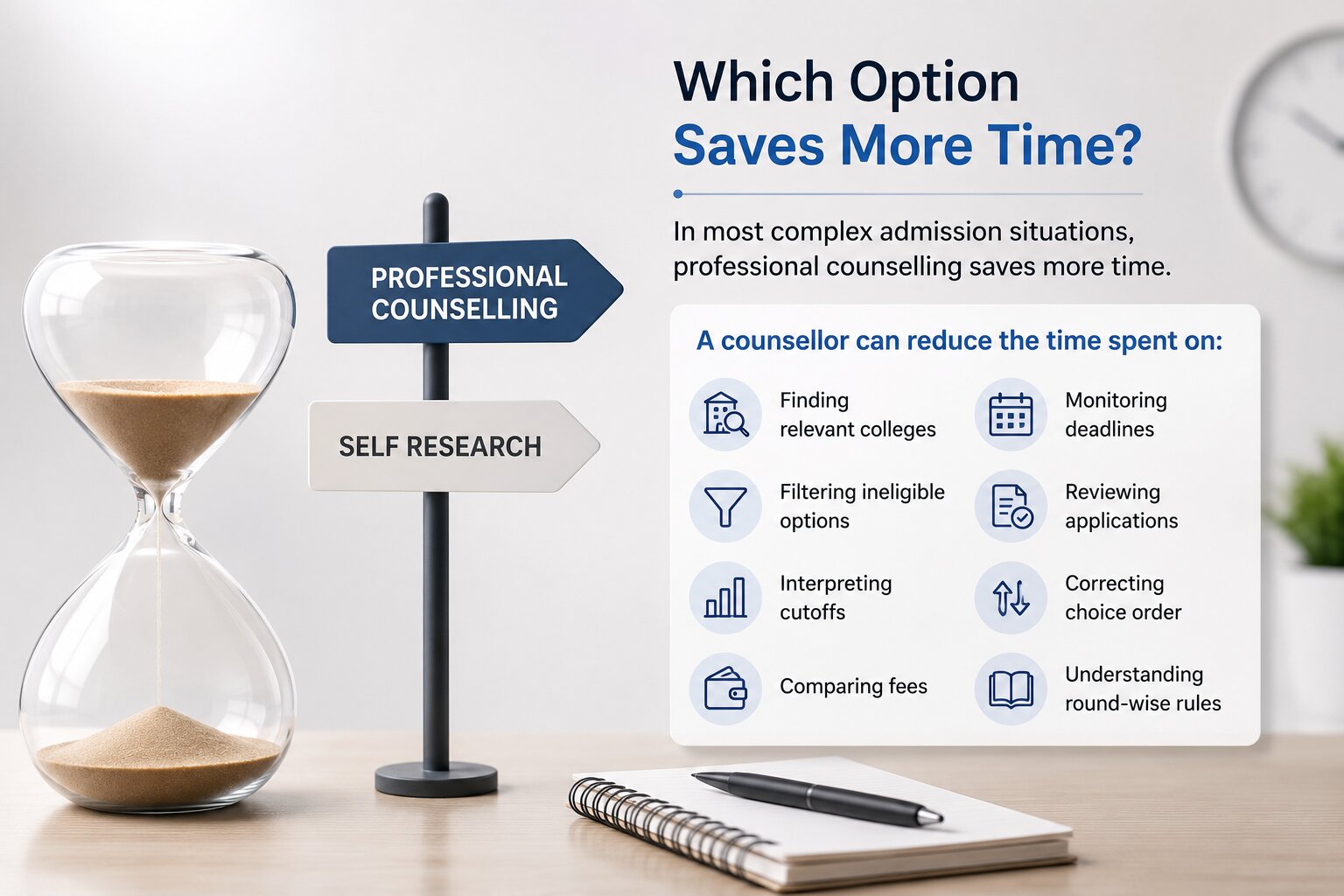
In most complex admission situations, professional counselling saves more time.
A counsellor can reduce the time spent on:
- finding relevant colleges;
- filtering ineligible options;
- interpreting cutoffs;
- comparing fees;
- monitoring deadlines;
- reviewing applications;
- correcting choice order;
- understanding round-wise rules.
Self research may take several hours or days for each major decision, particularly when the student is comparing colleges across states or counselling systems.
| Admission situation | More time-efficient option |
|---|---|
| Applying to one familiar college | Self research |
| Applying through one simple merit process | Self research |
| Participating in national and state counselling | Admission counselling |
| Comparing many private and government colleges | Admission counselling |
| Managing several application deadlines | Admission counselling |
| Student already understands the process | Self research or hybrid support |
| Family needs personalised guidance | Admission counselling |
The quality of the counsellor is important. Poor counselling can waste time if it provides generic or inaccurate recommendations. Students should therefore select counsellors who use current official information and explain the reasoning behind every suggestion.
Time Required for Self Research
Self research is not limited to reading college rankings. A careful student may need to complete several separate research tasks.
| Research task | What the student must examine |
|---|---|
| Course selection | Curriculum, eligibility and career outcomes |
| College comparison | Accreditation, fees, infrastructure and location |
| Cutoff analysis | Category, quota, round and rank type |
| Application management | Forms, payments, uploads and corrections |
| Choice filling | Preference order and realistic backup options |
| Reporting | Documents, fees, deadlines and physical verification |
The process takes longer when different authorities publish information in different formats.
For example, one college may publish fees in a prospectus, another may list them in an official notice and a third may provide only a partial breakdown on its website. The student must collect and compare this information carefully.
Self research also requires repeated checking because dates, seat matrices and reporting instructions can change.
How Admission Counselling Saves Time
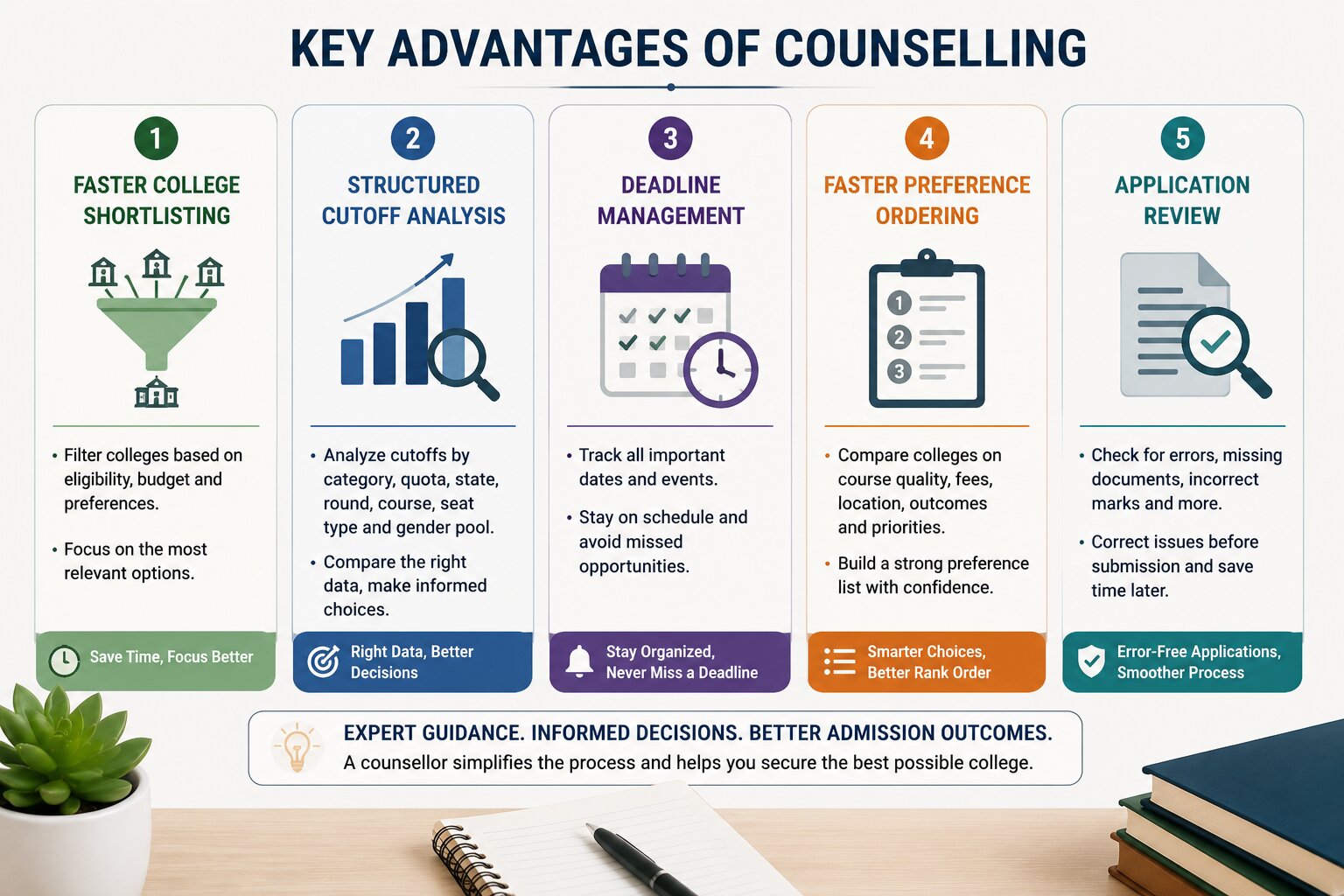
1. Faster College Shortlisting
A counsellor can begin with the student’s profile and remove colleges that do not match the student’s eligibility, budget or preferences.
Instead of researching hundreds of colleges, the student can focus on a smaller group of relevant options.
2. Structured Cutoff Analysis
Cutoffs can vary by:
- category;
- quota;
- state;
- counselling round;
- course;
- seat type;
- gender pool, where applicable.
A counsellor can help the student compare the correct data rather than mixing unrelated cutoffs.
3. Deadline Management
Admission processes may involve:
- registration dates;
- application deadlines;
- fee-payment windows;
- document-verification periods;
- choice-locking deadlines;
- allotment results;
- reporting dates.
A structured admission calendar reduces the risk of missed opportunities.
4. Faster Preference Ordering
Students often spend significant time deciding which college should be placed above another. A counsellor can create a comparison framework based on course quality, fees, location, outcomes and personal priorities.
5. Application Review
A second review can identify:
- spelling errors;
- category mistakes;
- incomplete uploads;
- incorrect marks;
- missing documents;
- wrong programme selection.
Correcting these issues before submission can save time later.
When Self Research Is the Better Choice
Self research may be the better option when:
- the student has already finalised the course;
- only a few colleges are being considered;
- the admission rules are simple;
- the family has enough time to research;
- the student is comfortable reading official documents;
- there is no complex quota or reservation issue;
- the student wants full control over the process;
- professional counselling fees are outside the budget.
Self research is also useful even when a counsellor is involved. Students should understand their own admission choices instead of accepting recommendations without question.
A student who researches independently can ask better questions and evaluate whether the counsellor’s advice is reasonable.
Who Should Consider Admission Counselling?
There is no formal eligibility requirement for using an admission counsellor. However, professional support is particularly useful for certain students.
| Student situation | Why counselling may help |
|---|---|
| Confused about course selection | Helps connect interests with suitable programmes |
| Average or uncertain entrance rank | Identifies realistic and backup options |
| Applying in multiple states | Organises separate rules and schedules |
| Considering private colleges | Supports fee and value comparison |
| First-generation college applicant | Provides process-level guidance |
| Limited time for research | Reduces repetitive information gathering |
| Concerned about choice filling | Helps arrange preferences strategically |
| Managing several admission offers | Supports final college comparison |
Students should still verify important information independently before making payments or reporting to a college.
Admission Counselling Registration Process
The process may vary by counselling provider, but a professional service generally follows these steps.
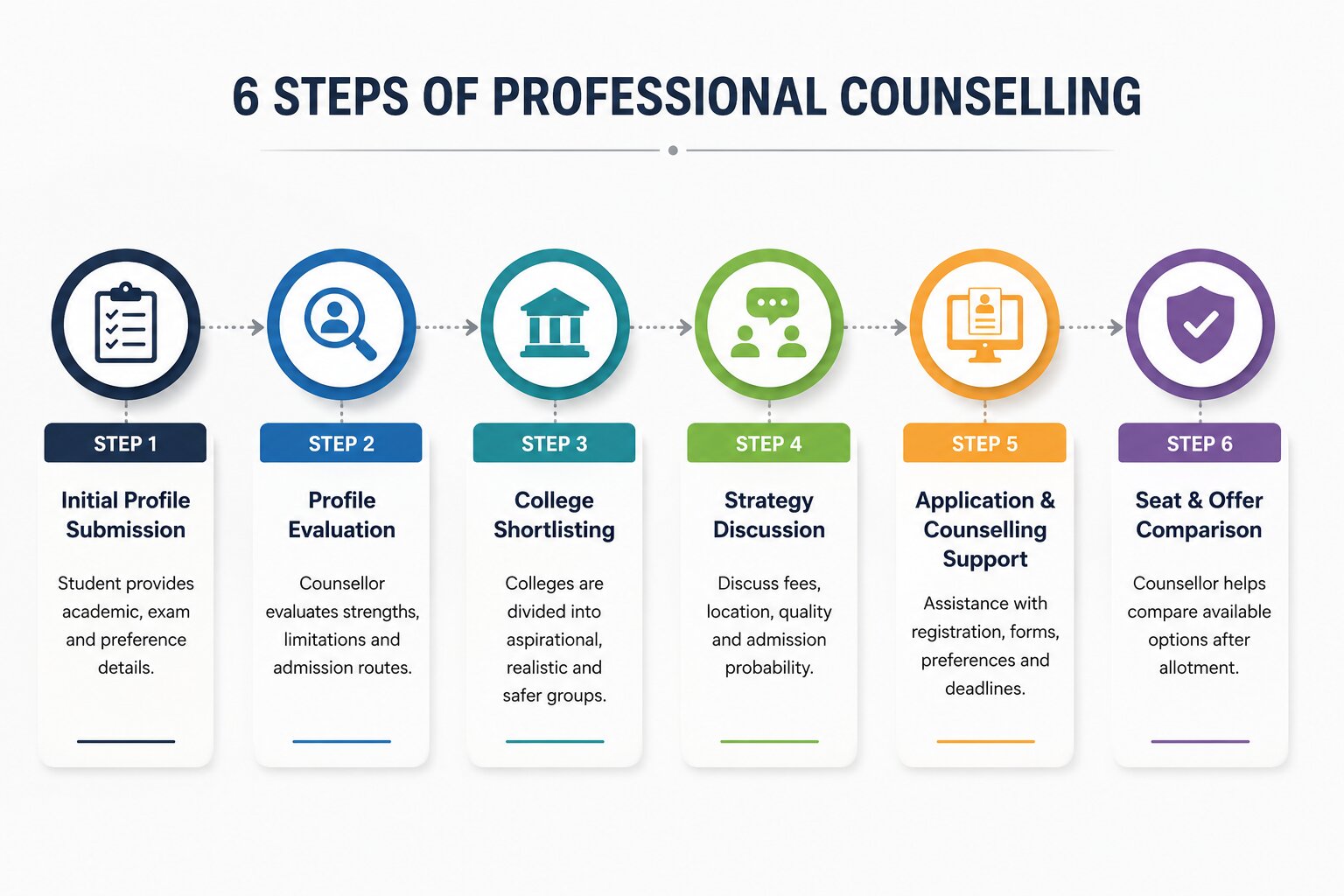
Step 1: Initial Profile Submission
The student provides academic, exam and preference details.
This may include:
- Class 10 and 12 marks;
- graduation marks, where applicable;
- entrance-exam score or rank;
- category and domicile;
- preferred courses;
- preferred locations;
- budget;
- career goals.
Step 2: Profile Evaluation
The counsellor evaluates the student’s strengths, limitations and available admission routes.
Step 3: College Shortlisting
Colleges are divided into aspirational, realistic and safer groups.
Step 4: Strategy Discussion
The student and family discuss fees, location, programme quality and admission probability.
Step 5: Application and Counselling Support
The counsellor may assist with registration, forms, preference ordering and deadline tracking.
Step 6: Seat and Offer Comparison
After allotment or admission offers, the counsellor helps compare available options.
| Counselling stage | Main purpose |
|---|---|
| Profile evaluation | Understand eligibility and priorities |
| Shortlisting | Reduce unsuitable college options |
| Application planning | Organise forms and deadlines |
| Choice filling | Arrange preferences strategically |
| Final decision | Compare offers and reporting conditions |
Documents Required
Students should prepare a complete digital and physical document folder before beginning applications.
| Document category | Commonly required records |
|---|---|
| Academic documents | Class 10, Class 12 and graduation marksheets |
| Entrance-exam documents | Admit card, scorecard and rank letter |
| Identity documents | Aadhaar card, passport or accepted ID proof |
| Category documents | SC, ST, OBC-NCL, EWS or PwD certificate |
| Residence documents | Domicile or residence certificate, if required |
| Application documents | Photograph, signature and payment receipt |
| Admission documents | Allotment letter, migration and transfer certificates |
| Supporting records | Income, NRI, minority or work-experience proof |
Students should confirm the exact document list through the relevant official authority. A counselling provider can organise the checklist, but the student remains responsible for submitting valid documents.
Admission Selection and Seat-Allotment Process
➡️ Get Personalized Guidance: College Predictor
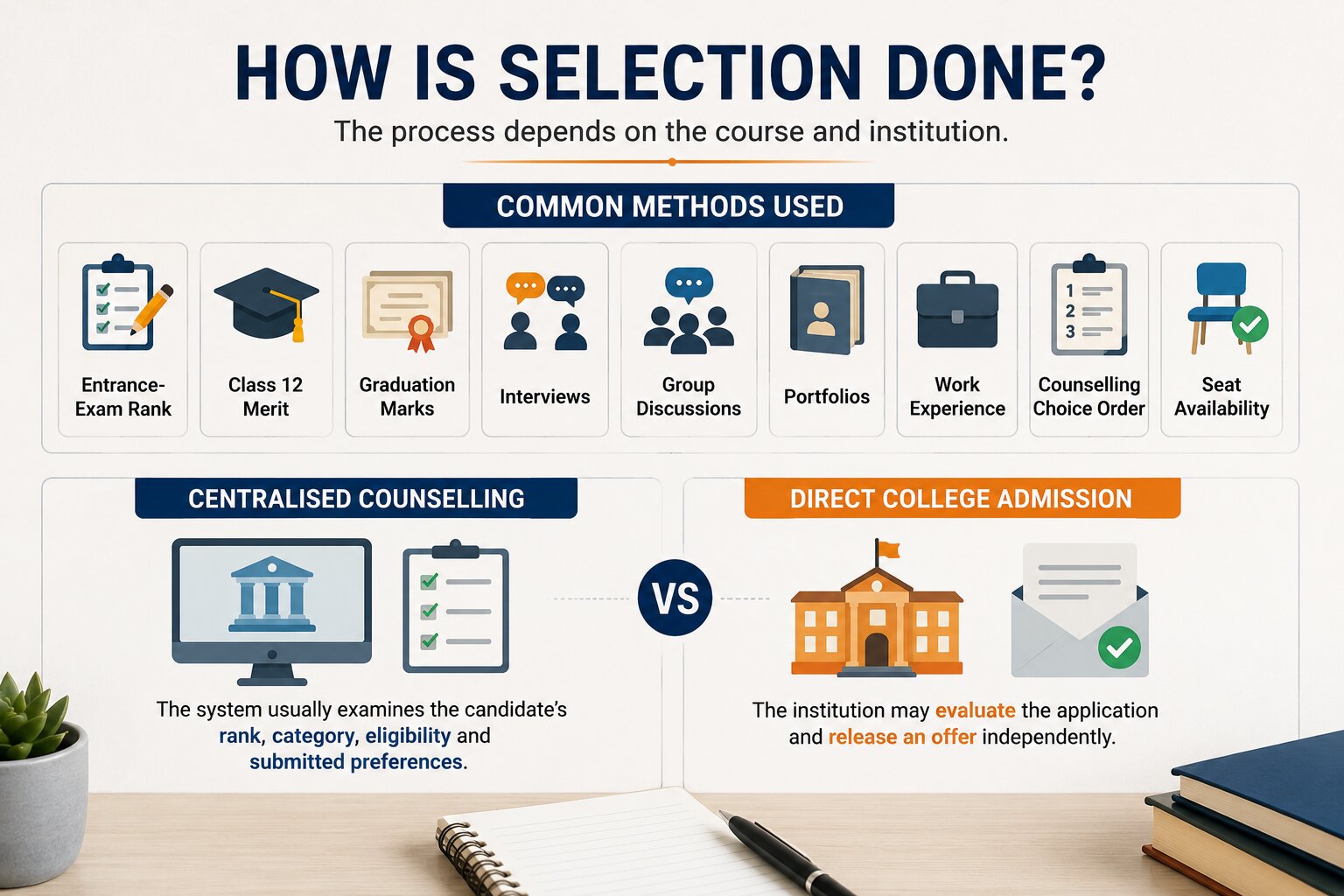
The selection process depends on the course and institution.
Common methods include:
- entrance-exam rank;
- Class 12 merit;
- graduation marks;
- interviews;
- group discussions;
- portfolios;
- work experience;
- counselling choice order;
- seat availability.
In centralised counselling, the system usually examines the candidate’s rank, category, eligibility and submitted preferences.
In direct college admission, the institution may evaluate the application and release an offer independently.
| Admission route | Main selection basis |
|---|---|
| Entrance counselling | Rank, category, preference and seat availability |
| Merit admission | Qualifying-examination marks |
| Management programme | Test score, academics, experience and interview |
| Direct institutional admission | Eligibility, documents and available seats |
| Portfolio-based course | Academic profile, portfolio and interview |
Admission counsellors can explain these processes, but they cannot legitimately guarantee a seat that depends on merit, rank or institutional selection.
Which Method Is More Accurate?
Accuracy depends on the quality of the information, not merely on whether it comes from a counsellor or the student.
Self research can be highly accurate when the student uses:
- official counselling websites;
- current prospectuses;
- regulatory databases;
- official fee notices;
- verified placement reports;
- recent seat matrices.
Counselling can also be accurate when the adviser uses current official sources and provides transparent analysis.
The risk of error increases when students or counsellors rely on:
- old cutoff data without context;
- social-media rumours;
- unofficial fee figures;
- promotional placement claims;
- outdated admission schedules;
- assumptions about eligibility.
The best practice is to treat official notices as the final authority.
Cost vs Time Saved
Self research may appear free, but it has a time cost.
Students may spend many hours:
- comparing colleges;
- reading prospectuses;
- creating spreadsheets;
- checking deadlines;
- correcting errors;
- understanding counselling rounds.
Counselling involves a financial cost but can reduce this workload.
| Main consideration | Better option |
|---|---|
| Lowest direct cost | Self research |
| Lowest time investment | Admission counselling |
| Maximum independent control | Self research |
| Structured guidance | Admission counselling |
| Complex multi-round process | Admission counselling |
| Simple single-college application | Self research |
Families should compare the counselling fee with the complexity and financial importance of the admission decision.
An expensive counselling package is not automatically better. The service should offer clear deliverables, qualified advisers and transparent recommendations.
Common Mistakes
Depending Entirely on College Rankings
Generic rankings may not reflect course quality, affordability, location or personal suitability.
Using Unverified Information
Students may rely on social-media posts instead of official notifications.
Missing Deadlines
Incomplete tracking can result in missed registration, choice locking or reporting.
Comparing the Wrong Cutoffs
Category, quota and round differences can make a cutoff comparison inaccurate.
Choosing a Counsellor Who Guarantees Admission
No ethical counsellor should guarantee a merit-based or rank-based seat.
Allowing the Counsellor to Make Every Decision
The final choice should belong to the student and family.
Doing Research Without a System
Unstructured browsing can create confusion and duplicate work.
Ignoring Total Cost
Tuition is only one part of college expenses. Hostel, transport, deposits and other charges must also be considered.
Expert Counselling Tips
- Begin with personal priorities. Decide the preferred course, budget, location and career direction before comparing colleges.
- Use a hybrid research method. Complete basic research independently and seek professional help for complex decisions.
- Verify every major claim. Check fees, eligibility and deadlines through official sources.
- Prepare one master spreadsheet. Record colleges, cutoffs, fees, deadlines and personal preference scores.
- Ask counsellors to explain their recommendations. Do not accept unexplained rankings or college lists.
- Avoid admission guarantees. Choose transparent guidance rather than unrealistic promises.
- Review the final preference order personally. Every listed college should be genuinely acceptable.
- Keep copies of all submissions. Save forms, receipts, choice lists and allotment letters.
How Admittance Edutech Can Help
Admittance Edutech can help students reduce the time and confusion involved in college admissions through structured, personalised support.
Services may include:
- course and career guidance;
- profile-based college shortlisting;
- entrance-rank and cutoff analysis;
- government and private college comparison;
- budget-based filtering;
- counselling registration guidance;
- application-form review;
- choice-filling strategy;
- document checklist preparation;
- deadline tracking;
- seat-allotment guidance;
- final college comparison;
- reporting and admission support.
The purpose of counselling is not to replace the student’s judgment. It is to organise information, explain options and help the family make a more confident decision.
A well-designed counselling plan can be especially valuable when the student is applying through multiple portals or facing several admission choices at the same time.
Conclusion
Admission counselling generally saves more time than self research when the admission process is complex, competitive or spread across multiple authorities. A professional counsellor can shorten the college-selection process, interpret cutoffs, organise documents, monitor deadlines and help students prepare a realistic preference list.
Self research, however, remains a strong option for students who already understand the admission process and are applying to a limited number of colleges. It offers complete control and avoids professional service fees, but it requires discipline, time and careful verification.
The most effective approach is often a combination of both methods. Students should independently understand their course interests, financial limits and preferred locations. Professional counselling can then be used for specialised tasks such as profile analysis, cutoff comparison, choice filling and application review.
Neither counselling nor self research can guarantee admission. The final result depends on eligibility, merit, entrance performance, seat availability and institutional rules. Students should remain involved in every decision and verify critical information through official sources.
Ultimately, admission counselling saves time when it converts scattered information into a clear action plan. Self research saves money and builds independent understanding. The right choice depends on the complexity of the application, the student’s confidence and the amount of time the family can realistically dedicate to the process.

Related Post | How AI College Predictor Makes Smarter Admissions
Frequently Asked Questions
1. Does admission counselling save more time than self research?
Yes, in most complex admission processes. Counselling can reduce the time spent on college shortlisting, cutoff comparison, form review, choice filling and deadline tracking.
2. Is self research enough for college admission?
Self research can be enough when the student understands the admission rules, is considering a limited number of colleges and has enough time to verify official information carefully.
3. Can an admission counsellor guarantee a college seat?
No. Ethical counsellors cannot guarantee admission when selection depends on rank, merit, interviews, seat availability or official counselling rules.
4. Is professional admission counselling worth the cost?
It may be worth the cost for students applying through multiple counselling systems, comparing many colleges or needing personalised support. The value depends on the quality and scope of the service.
5. What is the best approach: counselling or self research?
A hybrid approach is often best. Students can research personal priorities independently and use professional counselling for complex analysis, preference ordering, application review and deadline management.
ALSO,
Does admission counselling save more time than self research?
Yes, in most complex admission processes. Counselling can reduce the time spent on college shortlisting, cutoff comparison, form review, choice filling and deadline tracking.
Is self research enough for college admission?
Self research can be enough when the student understands the admission rules, is considering a limited number of colleges and has enough time to verify official information carefully.
Can an admission counsellor guarantee a college seat?
No. Ethical counsellors cannot guarantee admission when selection depends on rank, merit, interviews, seat availability or official counselling rules.
Is professional admission counselling worth the cost?
It may be worth the cost for students applying through multiple counselling systems, comparing many colleges or needing personalised support. The value depends on the quality and scope of the service.
What is the best approach: counselling or self research?
A hybrid approach is often best. Students can research personal priorities independently and use professional counselling for complex analysis, preference ordering, application review and deadline management. ALSO,