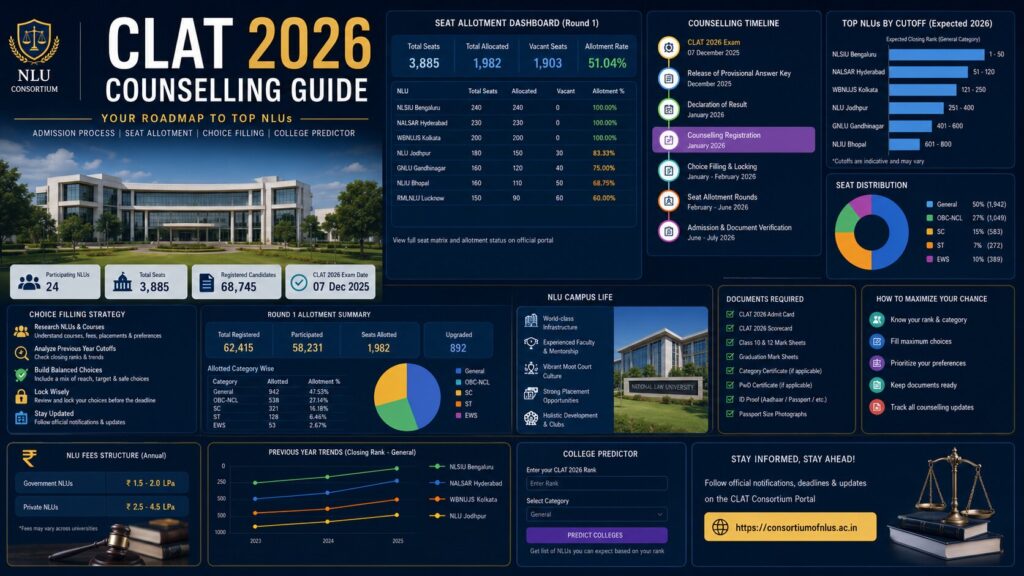
CLAT 2026 Counselling Guide: NLU Seat Allotment, Documents, Admission Process
After the declaration of CLAT 2026 results, the next crucial stage begins—the CLAT Counselling Process.
For thousands of law aspirants, securing a strong rank is only the first step. Admission to National Law Universities (NLUs) depends not only on CLAT scores but also on counselling participation, preference lists, seat allotment decisions and document verification.

Predict Your Dream College and Plan Smarter : CLICK HERE
Every year, many candidates lose admission opportunities because they do not fully understand the counselling process.
This guide explains everything about CLAT 2026 Counselling, including NLU seat allotment, counselling rounds, required documents, admission procedures and strategies to maximize your chances of getting your preferred law school.
What is CLAT Counselling?
CLAT Counselling is the centralized admission process conducted after declaration of CLAT results.
Visit Official Website : CLICK HERE
The counselling process is used for admissions into participating National Law Universities (NLUs).
Through counselling, seats are allotted based on:
- CLAT rank
- Candidate preferences
- Category eligibility
- Reservation policies
- Seat availability
Candidates who wish to join participating NLUs must complete counselling formalities within the prescribed schedule.
Who Conducts CLAT Counselling?
The Consortium of National Law Universities conducts the CLAT admission and counselling process.
The Consortium is responsible for:
- Result declaration
- Rank publication
- Counselling registration
- Seat allotment
- Admission coordination
All official notifications are released through the Consortium’s official platform.
Why CLAT Counselling is Important
Many students focus entirely on their CLAT rank.
However, admission depends on several additional factors.
Counselling determines:
- Which NLU you receive
- Which category seat is allotted
- Whether you receive your preferred institution
- Whether you remain eligible for future upgrades
A good counselling strategy can significantly improve final admission outcomes.
What Happens After CLAT Results?
After results are announced, shortlisted candidates become eligible for counselling participation according to official rules.
The general process includes:
Result Declaration
Candidates receive ranks.
Counselling Invitation
Eligible candidates are invited.
Preference Consideration
Institution preferences are evaluated.
Seat Allotment
Seats are allotted according to rank and availability.
Admission Confirmation
Candidates complete admission formalities.
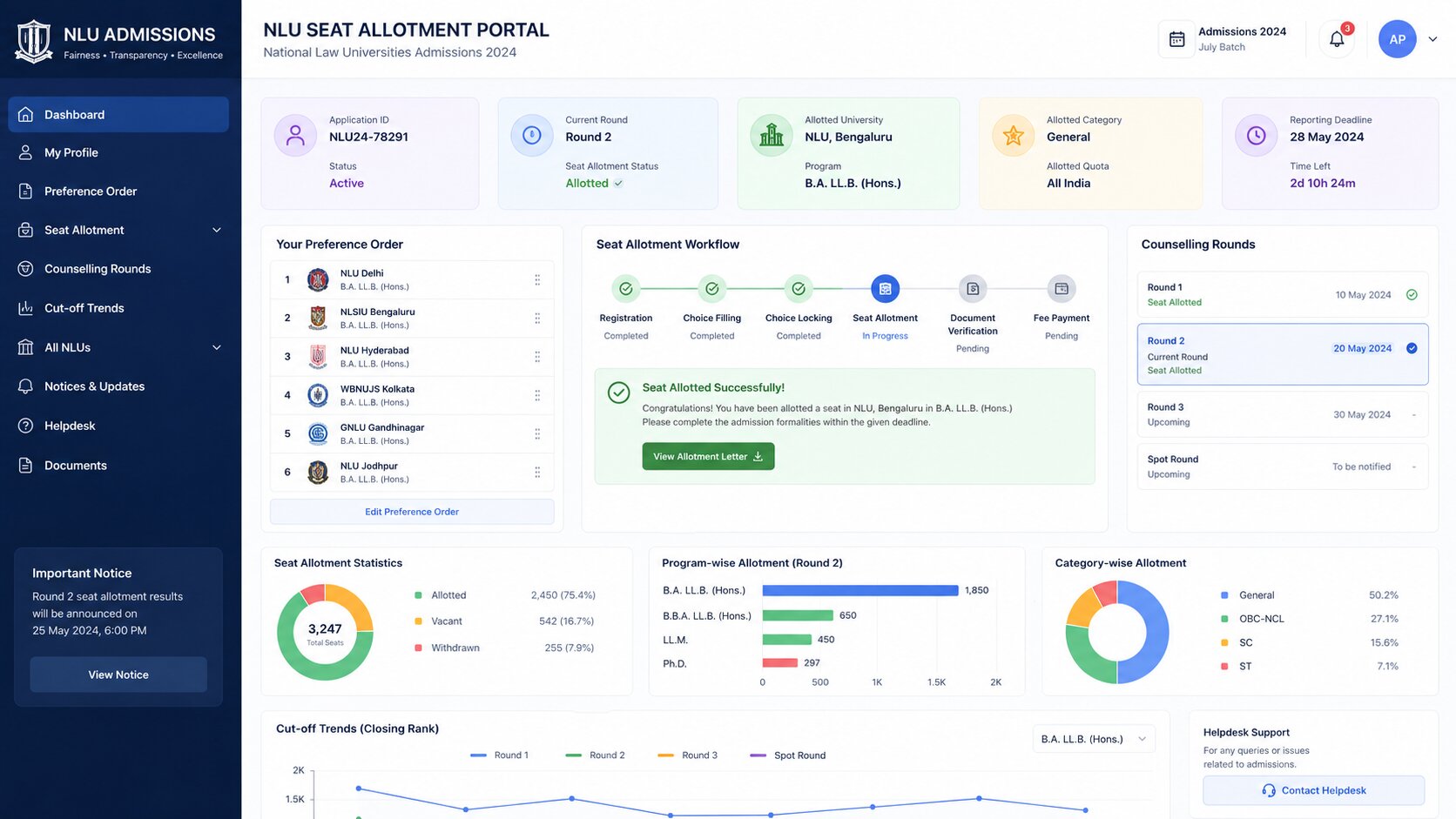
Understanding NLU Seat Allotment
Seat allotment is the heart of CLAT counselling.

Seat Allotment : CLICK HERE
The allocation process considers:
CLAT Rank
Higher-ranked candidates receive greater priority.
Preference Order
Candidate choices play a major role.
Reservation Rules
Applicable reservation policies are followed.
Seat Availability
Available seats determine allotment possibilities.
The system attempts to allocate the highest possible preferred institution available to a candidate.
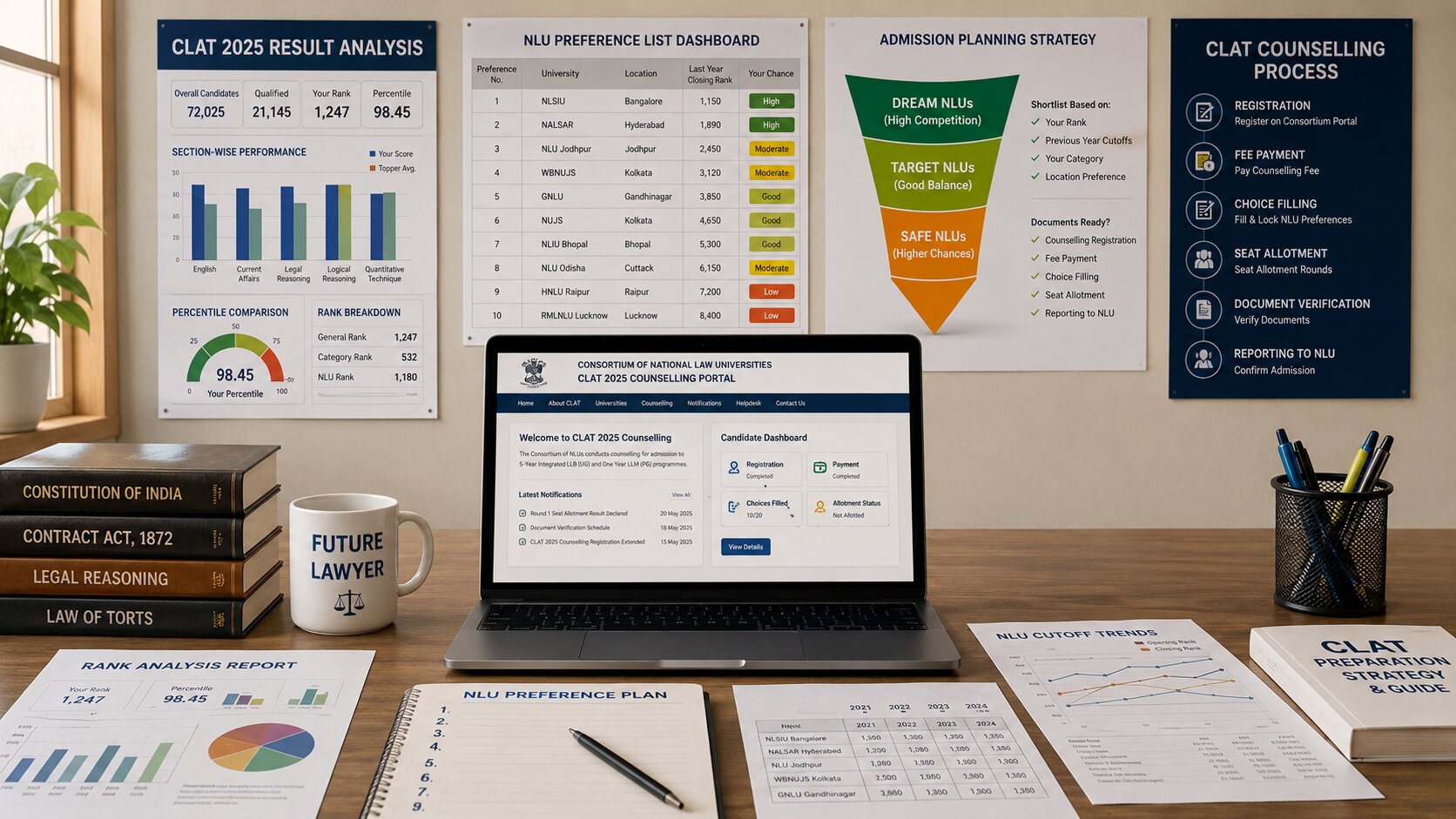
How NLU Preference Lists Work
Candidates are required to provide preferences for participating National Law Universities.
The order matters significantly.
The allotment system evaluates:
- Candidate rank
- Preferred NLUs
- Seat availability
The highest available preference is allotted.
This is why careful preference planning is extremely important.
Should You Fill More NLU Preferences?
Generally, candidates should consider all institutions they are genuinely willing to join.
A broader preference list may improve admission opportunities.
However, candidates should include only those NLUs they would realistically accept.
What is Seat Allotment?
Seat allotment is the process through which candidates receive admission offers from participating NLUs.
Once allotted, candidates must follow official instructions within the prescribed deadline.
Failure to respond may affect admission eligibility.
Counselling Rounds in CLAT
The counselling process generally involves multiple allotment rounds.
Each round considers:
- Vacant seats
- Candidate movement
- Withdrawals
- Upgrades
As seats become available, fresh allotments may occur in subsequent rounds.
Candidates should carefully monitor every counselling round.
What Happens After Getting a Seat?
Once a seat is allotted, candidates must review available options according to official counselling rules.
This may include:
- Accepting the seat
- Retaining eligibility for future movement
- Completing admission formalities
Specific options and timelines are published by the Consortium.
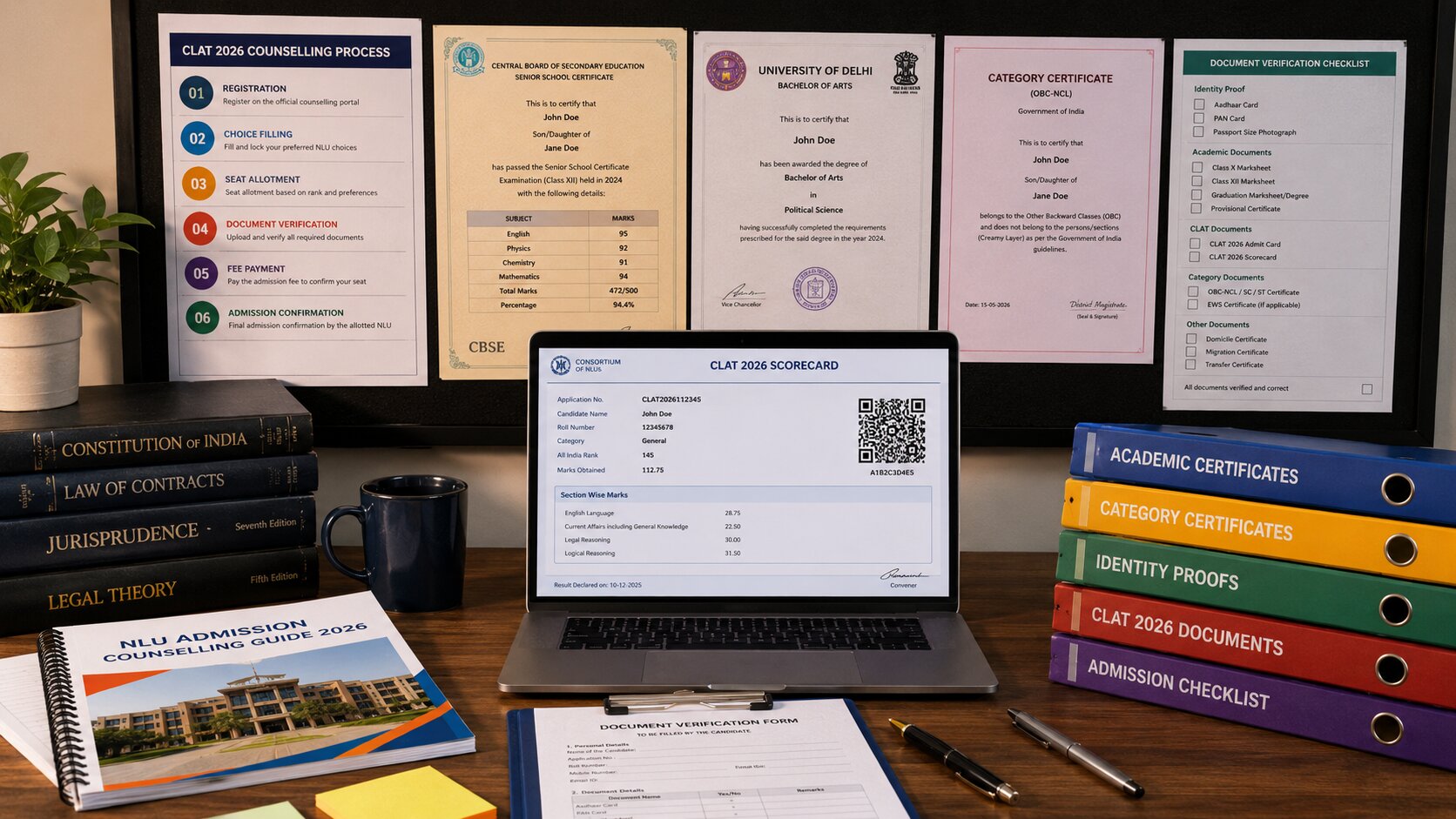
Required Documents for CLAT Counselling
Document verification is one of the most important stages.
Candidates should keep all required documents ready.
Commonly required documents include:
- CLAT admit card
- CLAT scorecard
- Class 10 marksheet
- Class 12 marksheet
- Identity proof
- Category certificate (if applicable)
- Domicile certificate (if applicable)
- Passport-size photographs
Additional documents may be required according to category and NLU-specific requirements.
Importance of Document Verification
Verification confirms:
- Candidate identity
- Academic eligibility
- Reservation eligibility
- Category claims
Incorrect or incomplete documentation can delay admission.
Candidates should carefully verify all records before submission.
Reservation Policies in CLAT Counselling
NLUs follow reservation policies according to their approved admission frameworks.
Reservations may include:
- Scheduled Castes
- Scheduled Tribes
- Other eligible categories
- State-specific reservations
- Special categories
The exact reservation structure varies among institutions.
Candidates should carefully review official NLU admission policies.
Top NLUs Participating Through CLAT

College List : CLICK HERE
Some of the most sought-after National Law Universities include:
- NLSIU Bengaluru
- NALSAR Hyderabad
- WBNUJS Kolkata
- NLIU Bhopal
- HNLU Raipur
- GNLU Gandhinagar
- RMLNLU Lucknow
- MNLU Mumbai
Competition for these institutions remains extremely high every year.
What Rank is Needed for Top NLUs?
Admission competition varies annually.
Factors affecting cutoffs include:
- Number of applicants
- Seat availability
- Reservation policies
- Candidate preferences
Higher-ranked candidates generally have greater access to top NLUs.
However, exact admission outcomes vary each year.
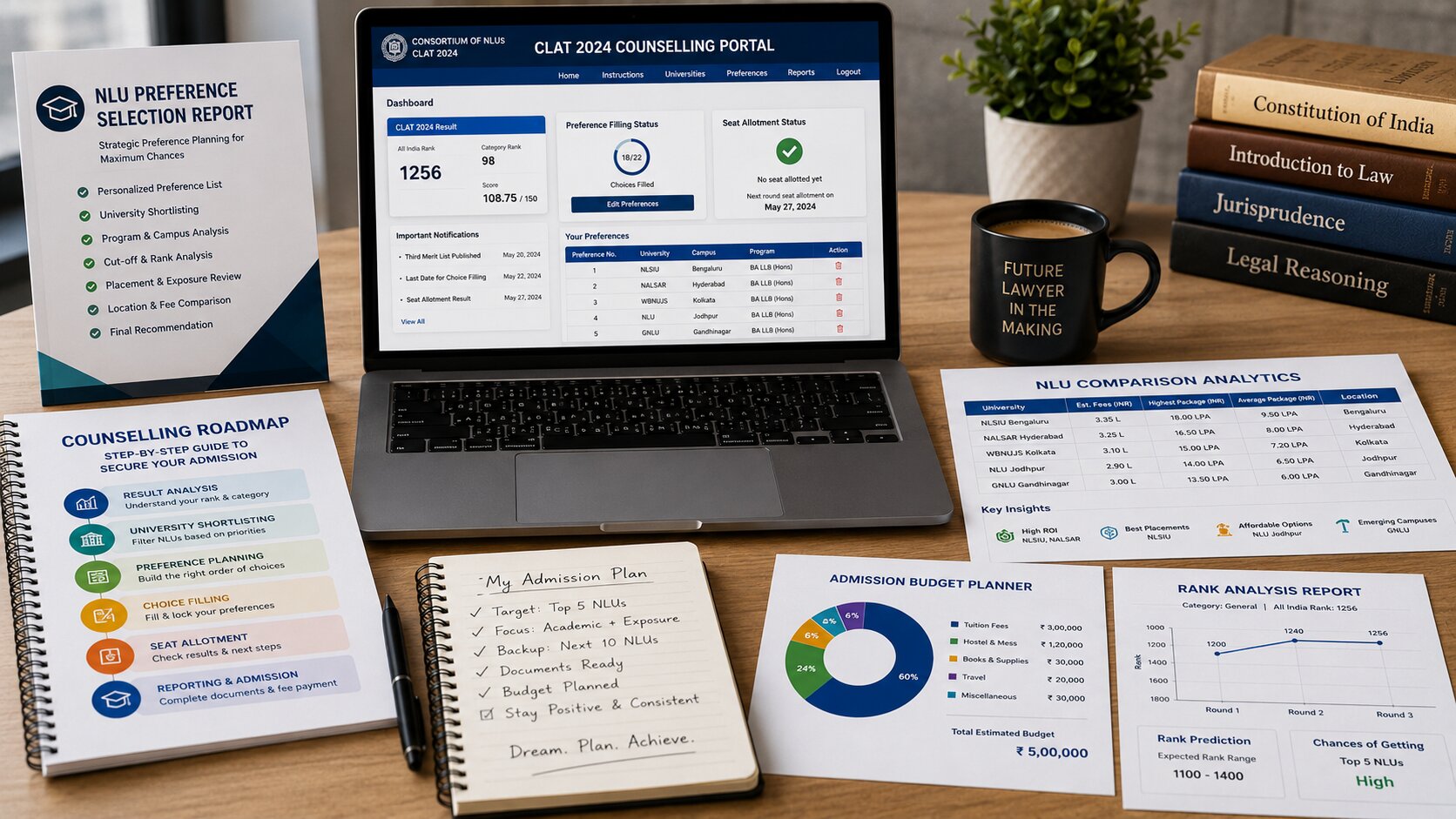
Check Out Our Official Website : CLICK HERE
Common Mistakes During CLAT Counselling
Ignoring Counselling Deadlines
Many candidates focus only on results and miss important counselling dates.
Poor Preference Ordering
Preference order directly affects seat allotment.
Incomplete Documentation
Missing documents can create admission issues.
Not Monitoring Counselling Updates
Official notifications should be checked regularly.
Assuming First Allotment is Final
Subsequent rounds may offer additional opportunities.
How to Maximise Your Chances of Getting a Better NLU
Research Every NLU
Understand campus, academics and opportunities.
Arrange Preferences Carefully
Always rank institutions according to genuine preference.
Follow Deadlines
Never miss counselling timelines.
Keep Documents Ready
Preparation reduces last-minute issues.
Monitor Every Round
Additional opportunities may arise through seat movement.
NLU Selection Factors Beyond Rankings
Students often focus only on rankings.
However, important factors include:
- Faculty
- Curriculum
- Internship opportunities
- Moot court culture
- Alumni network
- Location
- Placement support
A balanced evaluation often leads to better long-term decisions.
Placement Opportunities in NLUs
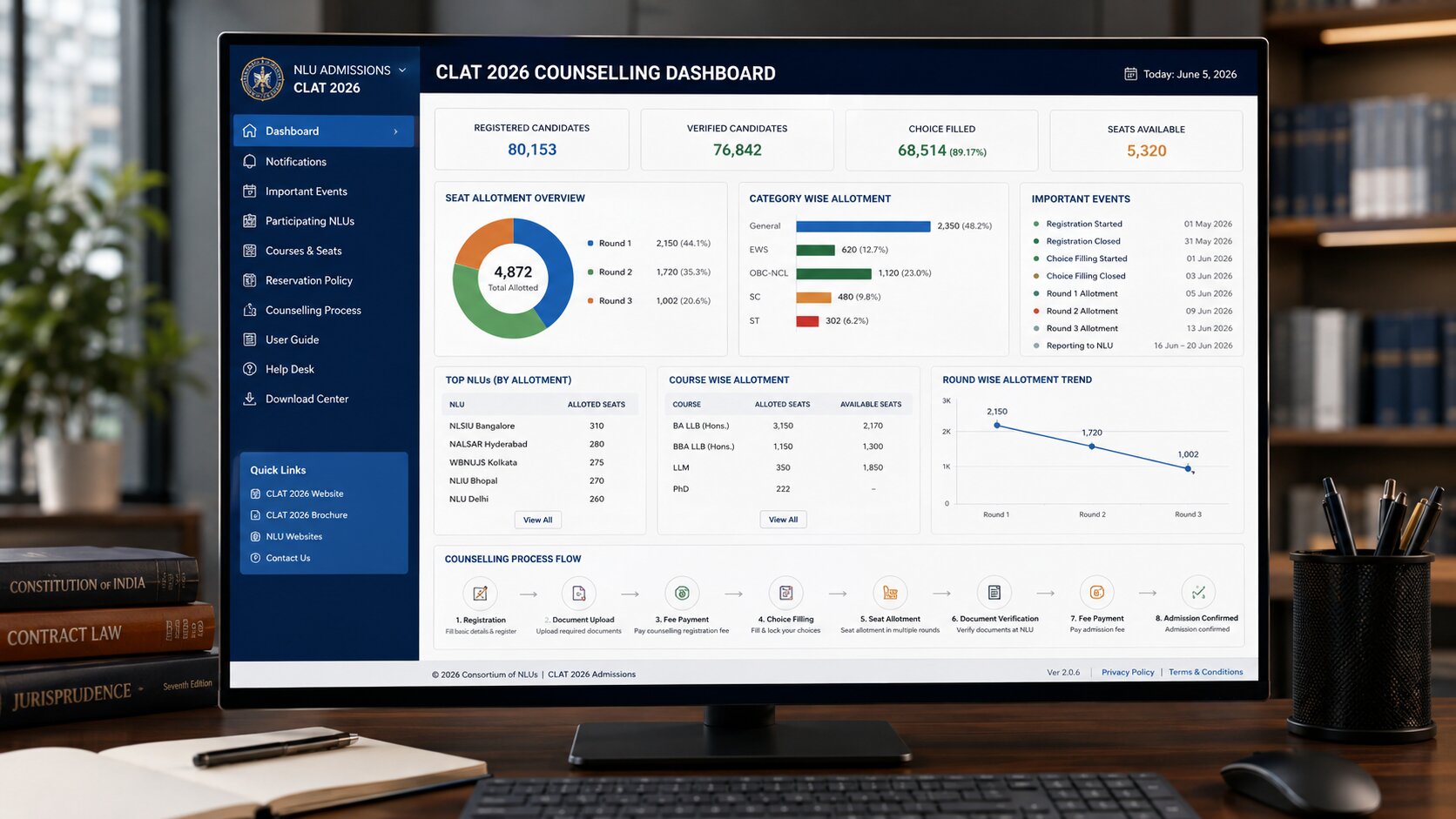
Most leading NLUs offer strong placement ecosystems.
Opportunities may include:
- Law firms
- Corporate legal teams
- Litigation
- Judicial services preparation
- Public policy
- Academia
Students should evaluate long-term career goals when selecting institutions.
Internship Culture in Law Schools
Internships are critical for legal careers.
Students should consider:
- Access to courts
- Corporate exposure
- Legal research opportunities
- Industry connections
Location often plays a role in internship availability.
What If You Don’t Get Your Preferred NLU?
Candidates should not panic.
Several possibilities exist:
- Future counselling rounds
- Upgrades
- Seat movement
- Alternative NLUs
Admission outcomes can change across rounds.
Remaining active throughout counselling is important.
CLAT Counselling Checklist
Before counselling begins:
✓ CLAT scorecard downloaded
✓ Documents prepared
✓ Category certificates verified
✓ NLU research completed
✓ Preference order finalized
✓ Counselling notifications monitored
✓ Admission budget planned
✓ Deadlines noted
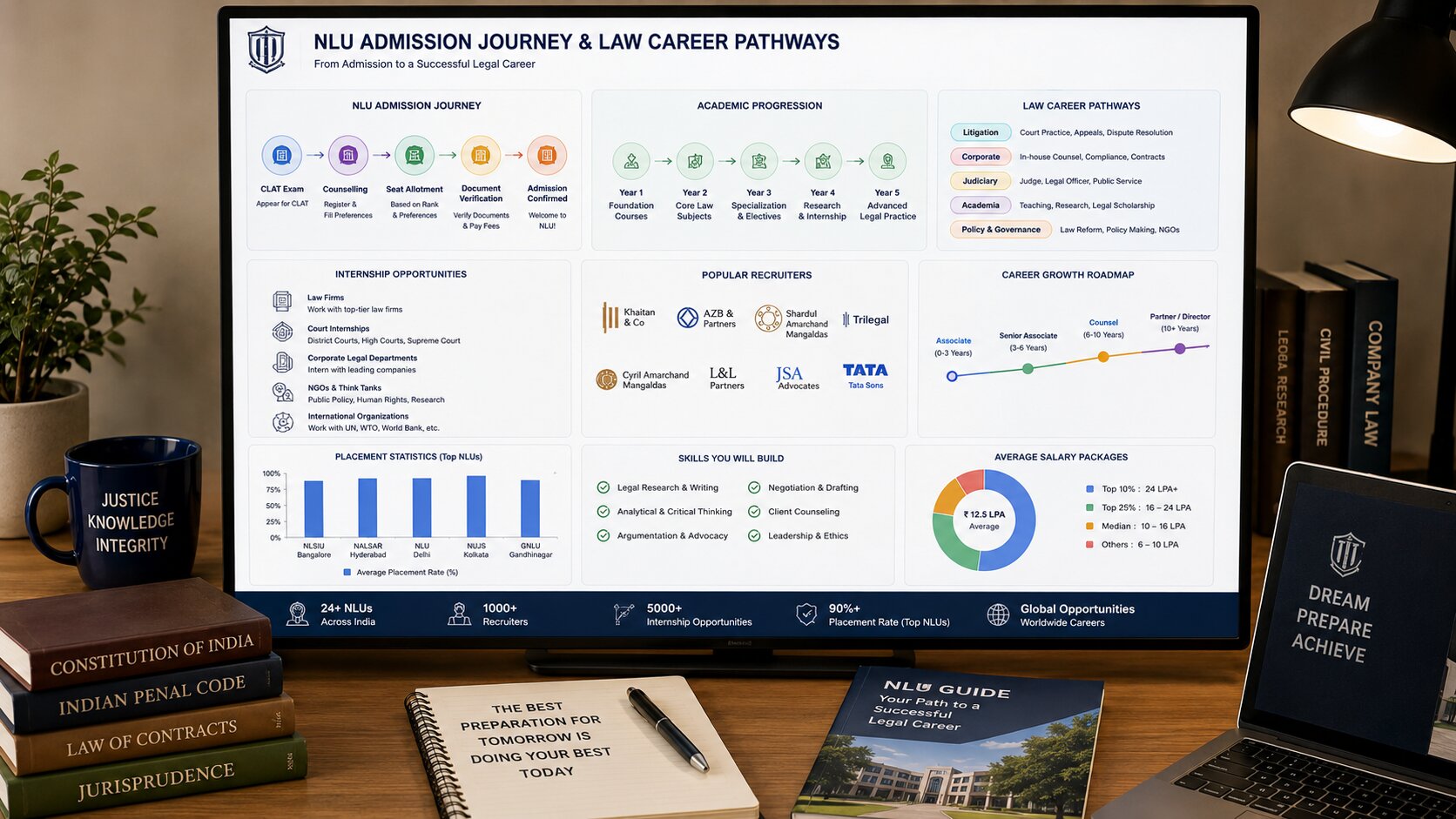
Explore More Posts Here :
Direct Admission vs Merit Quota: Difference, Fees, Which Is Better?
What is a Good Percentile in MHT CET? College-Wise Cutoff Reality Check
Final Verdict
CLAT 2026 Counselling is the most important stage after the examination result.
A strong rank creates opportunities, but successful admission depends on understanding the counselling process, preparing documents correctly and making informed preference decisions.
Candidates should focus on:
- Careful NLU selection
- Proper document preparation
- Timely counselling participation
- Strategic preference ordering
Those who stay informed and actively participate in every counselling stage significantly improve their chances of securing admission to their preferred National Law University.
The key to CLAT admission success is not only scoring well but also navigating the counselling process effectively.
Pingback: MBA Entrance Exams 2026 Compared: CAT vs CMAT vs CET
Pingback: Top Private Law Colleges in India 2026: Fees, Admissions