
SPJIMR Mumbai Cutoff 2026: CAT Percentile and GEPI Selection Process
The SPJIMR Mumbai Cutoff 2026 is important for MBA aspirants targeting the Post Graduate Diploma in Management programmes offered by S.P. Jain Institute of Management and Research. Unlike institutes that shortlist candidates almost entirely through CAT percentile, SPJIMR follows a profile-sensitive admission process. Academic consistency, work experience, achievements, entrance-test performance and interview performance can all influence the final outcome.
Last Updated – July 12, 2026
➡️ Explore our College Predictor: /college-predictor
For the 2026–28 admission cycle, SPJIMR accepted CAT 2025 or eligible GMAT scores. The institute’s published qualifying requirement for PGDM (Business Management) was 85 percentile overall and 75 percentile in each CAT section. However, these figures were minimum qualifying cutoffs—not assured interview-call percentiles. A candidate with a stronger overall profile may receive a profile-based shortlist, while another applicant may be evaluated through a profile-cum-score shortlist.
Applicants often describe the post-shortlisting stage as “GEPI.” SPJIMR’s official process is more accurately described as two rounds of group interviews rather than a standard group discussion followed by a conventional personal interview. Final selection is based on a composite evaluation of the candidate’s profile, academics, test score, work experience and performance in both interview rounds.
About SPJIMR Mumbai
S.P. Jain Institute of Management and Research is a leading management institute located in Andheri West, Mumbai. Its flagship PGDM is a two-year, full-time residential programme approved by AICTE. The institute also offers PGDM in Business Management, which provides broader general-management exposure.
| Particular | Details |
|---|---|
| Institute | S.P. Jain Institute of Management and Research |
| Location | Andheri West, Mumbai |
| Flagship courses | PGDM and PGDM (Business Management) |
| Accepted tests | CAT and GMAT |
| Programme format | Two-year, full-time residential |
| Work experience | Not mandatory |
SPJIMR allows recent graduates as well as professionals with up to five years of experience to apply. Final-year undergraduate candidates are also eligible, subject to completing the required degree conditions.
SPJIMR Mumbai Cutoff 2026
Visit Website : spjimr.org
The official qualifying cutoff for the 2026–28 PGDM (Business Management) admission cycle was published as follows:
| CAT requirement | Official qualifying percentile |
|---|---|
| VARC sectional percentile | 75 |
| DILR sectional percentile | 75 |
| QA sectional percentile | 75 |
| Overall CAT percentile | 85 |
These are eligibility thresholds. Clearing them does not guarantee an interview call because SPJIMR separately evaluates the quality and consistency of each applicant’s profile.
Expected Competitive CAT Percentile
The following ranges are practical planning estimates rather than official SPJIMR cutoffs:
| Applicant profile | Practical CAT target |
|---|---|
| Exceptional academics and achievements | 90–95+ percentile |
| Strong balanced profile | 95–97+ percentile |
| Average or inconsistent profile | 97–99+ percentile |
| Weak academics with limited differentiation | 99+ may still not guarantee a call |
SPJIMR does not publish a single guaranteed percentile for interview shortlisting. A lower CAT percentile may work for an exceptional profile, while a high percentile alone may not compensate for an undifferentiated or inconsistent application.
Minimum Cutoff vs Actual Interview-Call Level
Candidates must understand the distinction between the minimum qualifying score and the realistic score needed to compete.
| Term | Meaning |
|---|---|
| Qualifying cutoff | Minimum score needed to remain eligible |
| Competitive percentile | Score range that may strengthen shortlisting chances |
| Profile-based call | Interview call led primarily by profile quality |
| Profile-cum-score call | Interview call based on profile and test performance |
SPJIMR explicitly divides shortlisted applicants into Profile-based and Profile-cum-Score-based groups. Even profile-based candidates must eventually satisfy the prescribed entrance-test cutoff before appearing for the interview.
Eligibility Criteria

Applicants must meet the programme’s academic and entrance-test requirements.
| Requirement | SPJIMR eligibility |
|---|---|
| Graduation | Bachelor’s degree from a recognised university |
| Minimum graduation marks | At least 50% or equivalent CGPA |
| Entrance examination | CAT or eligible GMAT |
| Work experience | Freshers and applicants with up to five years may apply |
| Final-year students | Eligible, subject to completing degree requirements |
SPJIMR’s official admission page confirms that candidates from any academic discipline may apply, provided they have at least 50% in graduation or an equivalent CGPA.
SPJIMR Selection Process
The admission process can be divided into six major stages.
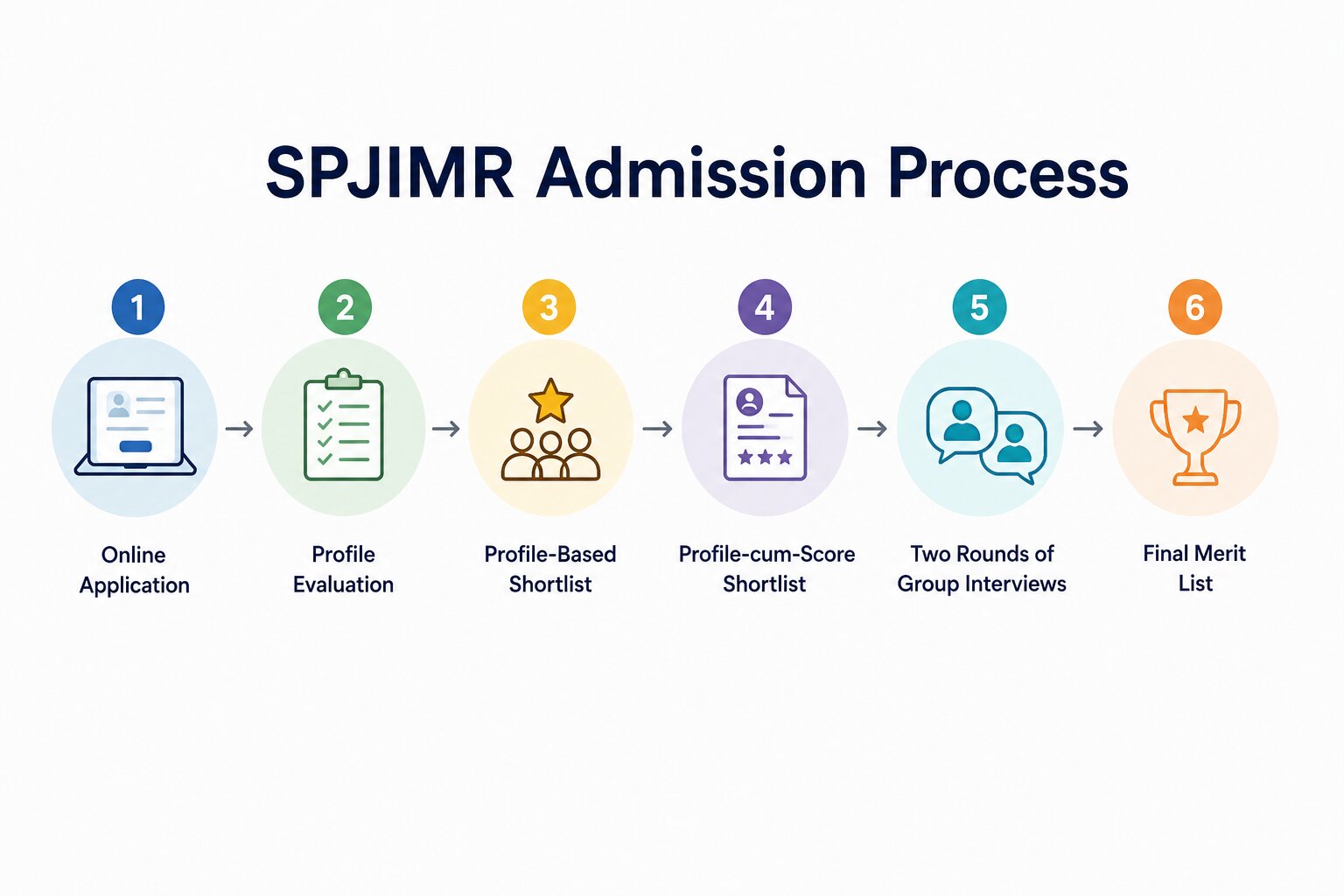
1. Online Application
Candidates must apply separately to SPJIMR. Merely appearing for CAT does not create an SPJIMR application. The institute generally opens applications in mid-September and closes them toward the end of November. Its admission page lists an application fee of ₹2,000, subject to revision.
2. Profile Evaluation
The institute evaluates:
- Class 10 performance
- Class 12 performance
- Graduation record
- Quality and relevance of work experience
- Achievements and extracurricular activities
- Versatility and evidence of initiative
- Alignment with the chosen specialisation
These factors are explicitly listed in SPJIMR’s official selection criteria.
3. Profile-Based Shortlist
Some applicants are shortlisted before entrance-test scores become the dominant differentiator. The call is based on the overall quality of their submitted profile. However, they must still clear the official CAT or GMAT qualifying cutoff.
4. Profile-cum-Score-Based Shortlist
After CAT or GMAT results become available, SPJIMR issues another shortlist based on both profile quality and entrance-test performance.
5. Two Rounds of Group Interviews
Shortlisted candidates participate in two rounds of group interviews. These interviews generally take place in January and February and are conducted offline for the PGDM (Business Management) process.
6. Final Merit List
The final selection list considers the applicant’s profile, academic record, entrance score, work experience and performance in both rounds of group interviews.
Is There a GD and PI at SPJIMR?
The term GEPI is frequently used by MBA aspirants, but SPJIMR does not follow the exact same process as institutes conducting a traditional Group Discussion followed by a one-to-one Personal Interview.
| Common admission term | SPJIMR equivalent |
|---|---|
| Group Discussion | Discussion and evaluation may occur within group interviews |
| Personal Interview | Candidate-specific questions are asked during group interviews |
| GEPI | Informal label used by aspirants |
| Official process | Two rounds of group interviews |
Candidates are evaluated in a group setting, but questions may still focus deeply on individual academics, work experience, specialisation preferences, values and decision-making.
What Happens in SPJIMR Group Interview Round 1?
The first round usually focuses on establishing whether the candidate’s claims and motivations are credible.
Likely areas include:
- Tell us about yourself
- Why MBA and why SPJIMR?
- Why did you choose a particular specialisation?
- Academic subjects from graduation
- Work responsibilities and measurable contribution
- Career transitions or employment gaps
- Major achievements
- Ethical or situational questions
- Current business and economic developments
Candidates should answer concisely because interview time is shared with other shortlisted applicants.
What Happens in Group Interview Round 2?
Candidates who progress may face a deeper assessment of values, maturity and interpersonal behaviour.
| Evaluation area | What the panel may observe |
|---|---|
| Clarity | Whether answers are structured and specific |
| Consistency | Whether interview answers match the application |
| Listening | Whether the candidate engages with others respectfully |
| Leadership | Whether the candidate adds value without dominating |
| Self-awareness | Whether strengths and weaknesses are understood |
| Ethics | Whether decisions show sound judgement |
| Fit | Alignment with SPJIMR’s learning environment |
Aggressive interruption, rehearsed answers and attempts to overshadow other candidates can work against an applicant.
Academic Profile Requirements
SPJIMR considers academic consistency across Class 10, Class 12 and every year of graduation. It does not publish a guaranteed profile score that secures an interview.
| Academic record | Admission outlook |
|---|---|
| Consistent 90%+ record | Strong profile advantage |
| Consistent 80%+ record | Competitive with other strengths |
| One moderate academic dip | Can be balanced through profile and CAT |
| Multiple weak academic stages | Requires a higher score and clear differentiation |
Applicants with academic gaps should be ready to explain them honestly without blaming teachers, institutions or personal circumstances unnecessarily.
Work Experience
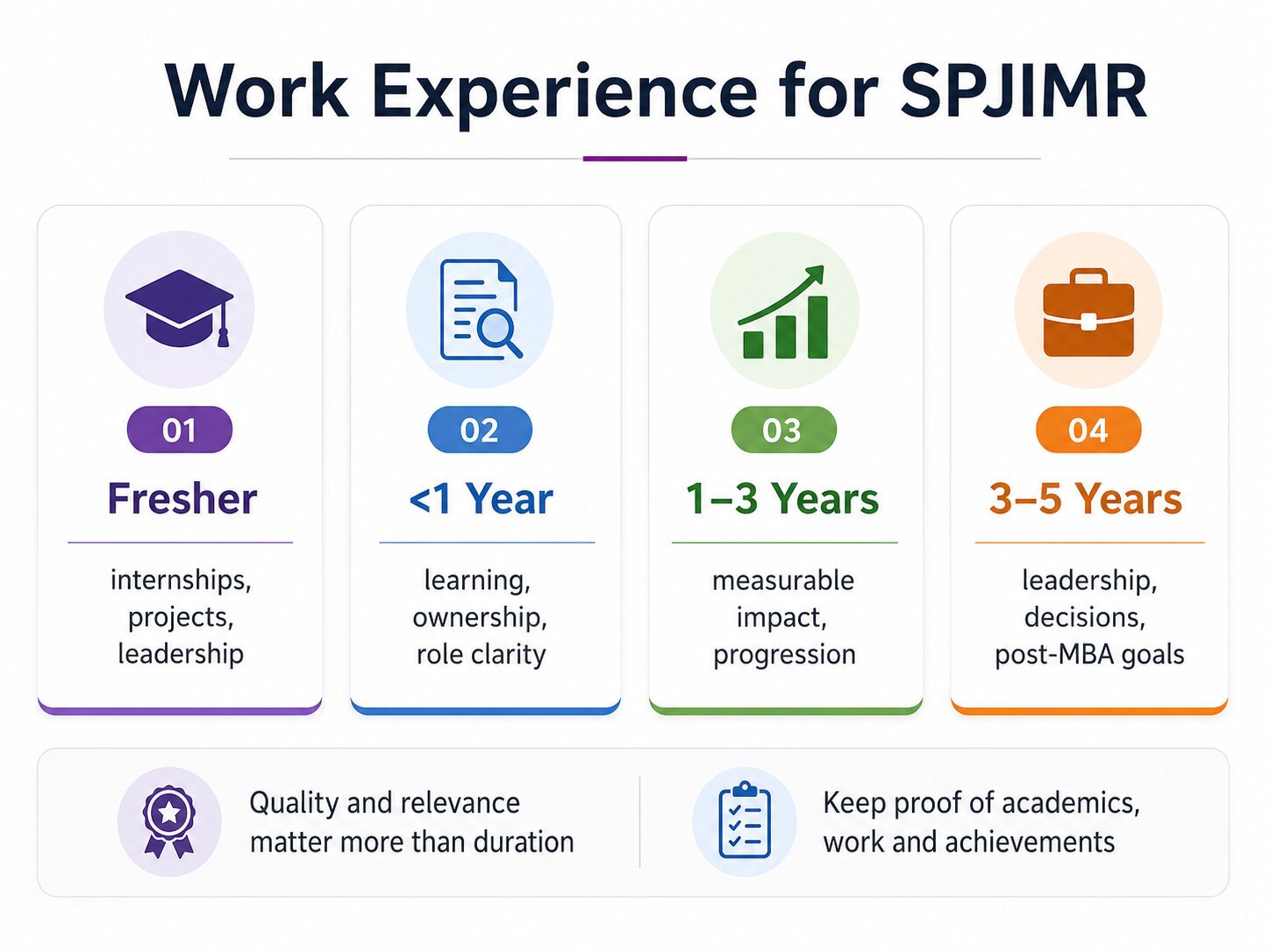
Work experience is not compulsory. SPJIMR welcomes freshers and candidates with up to five years of experience.
| Experience level | How to strengthen the application |
|---|---|
| Fresher | Highlight internships, projects, leadership and achievements |
| Less than one year | Show learning, ownership and role clarity |
| One to three years | Demonstrate measurable impact and progression |
| Three to five years | Explain leadership, decisions and post-MBA goals |
SPJIMR values the relevance and quality of experience more than job duration alone. Candidates must provide proof for academic, work and achievement claims during verification.
Specialisation Selection
The flagship PGDM offers major specialisations in Finance, Information Management, Marketing, and Operations and Supply Chain.
| Specialisation | Relevant profile indicators |
|---|---|
| Finance | Accounting, banking, markets, analytics or certifications |
| Marketing | Sales, consumer insight, communication or brand projects |
| Information Management | Technology, analytics, product or digital transformation |
| Operations and Supply Chain | Manufacturing, logistics, process improvement or engineering |
Applicants should not select a specialisation merely because it appears to have better placements. The application and interview should demonstrate genuine evidence of fit.
Important Dates
The exact schedule changes each year. For the 2026–28 cycle, applications closed on November 28, 2025, and interviews were generally conducted during January and February 2026. The programme begins in June.
| Admission activity | Typical period |
|---|---|
| Applications open | Mid-September |
| Applications close | End of November |
| Profile-based shortlist | Before or around CAT result period |
| Profile-cum-score shortlist | After entrance scores are available |
| Group interviews | January–February |
| Programme commencement | June |
Candidates applying for a later intake must follow the corresponding SPJIMR admission page rather than reusing old dates.
Section-Wise CAT Strategy
Because the institute requires candidates to clear every sectional cutoff, an extremely high overall percentile cannot compensate for a section below 75 percentile.
| CAT section | Preparation priority |
|---|---|
| VARC | Reading consistency, comprehension and elimination |
| DILR | Set selection and timed practice |
| QA | Concept accuracy and question selection |
| Overall | Balanced performance across all sections |
A practical target is to keep each sectional percentile comfortably above 80–85 rather than aiming only to cross 75.
Profile-Based Shortlist Strategy
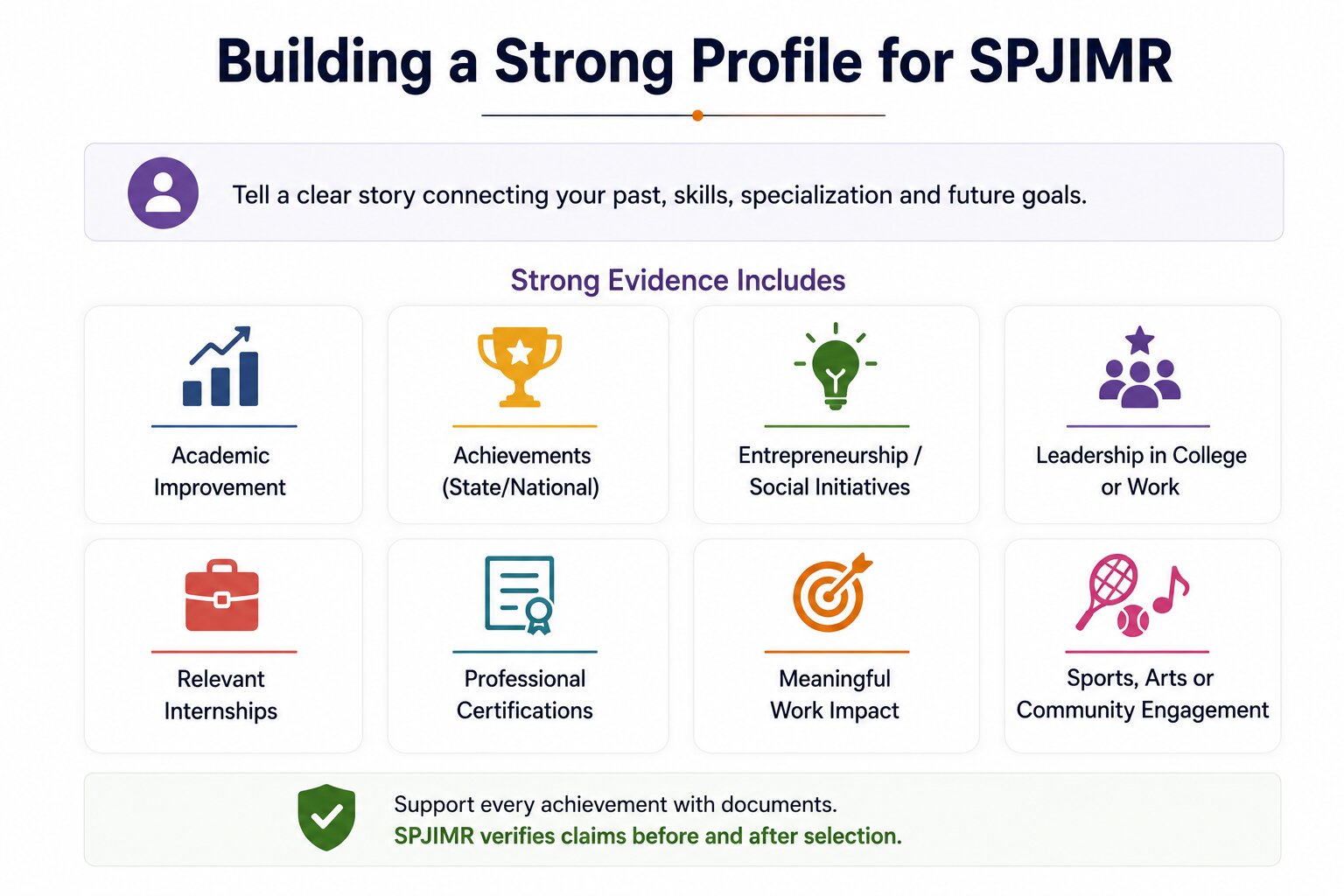
A profile-based application must tell a clear story. The candidate should connect past choices, current abilities, preferred specialisation and future career goals.
Strong evidence may include:
- Academic improvement
- National or state-level achievements
- Entrepreneurship or social initiatives
- Leadership in college or employment
- Relevant internships
- Professional certifications
- Meaningful work impact
- Sports, arts or community engagement
Every achievement mentioned should be supported by documents because SPJIMR verifies claims before and after selection.
Group Interview Preparation Strategy
Prepare a 60–90 second introduction covering education, experience, major achievement, MBA motivation and specialisation preference.
Revise:
- Graduation subjects
- Current-affairs themes
- Industry developments
- Employer and job function
- Application-form details
- Career goals
- Ethical dilemmas
- Strengths and limitations
During a group interview, listen actively, avoid repeating another candidate’s point and contribute with structure. Quality matters more than speaking frequency.
Common Mistakes
- Treating 85 percentile as a guaranteed interview-call cutoff
- Ignoring CAT sectional requirements
- Writing unsupported achievements
- Choosing a specialisation without profile alignment
- Giving generic “why MBA” answers
- Dominating the group interview
- Contradicting the application form
- Focusing only on CAT and neglecting profile development
- Assuming freshers are at a disadvantage
- Preparing for a conventional PI instead of a group-interview setting
Expert Tips
Target a CAT percentile higher than the minimum qualifying score. Candidates with average profiles should ideally aim for the upper-90s to improve competitiveness.
Keep the application evidence-based. Replace broad statements such as “I led an important project” with specific details about the task, team, decision and measurable result.
Do not exaggerate work experience. SPJIMR requires supporting documents, and misrepresentation can lead to disqualification.
Finally, practise interviews in small groups. This helps candidates learn how to enter a discussion, disagree professionally and remain composed while sharing interview time.
Why Aspirants Target SPJIMR
SPJIMR reported 100% final placements for the combined PGDM and PGDM (BM) Class of 2026. The institute reported an average CTC of ₹33.75 lakh, a median of ₹32.85 lakh and a highest CTC of ₹75 lakh; 46% of the batch received pre-placement offers. These outcomes were for the Class of 2026 and should not be treated as guaranteed future salaries.
| Placement indicator | Class of 2026 outcome |
|---|---|
| Placement rate | 100% |
| Average CTC | ₹33.75 LPA |
| Median CTC | ₹32.85 LPA |
| Highest CTC | ₹75 LPA |
| PPO share | 46% |
How Admittance Edutech Can Help
➡️ Get Personalized Guidance: College Predictor
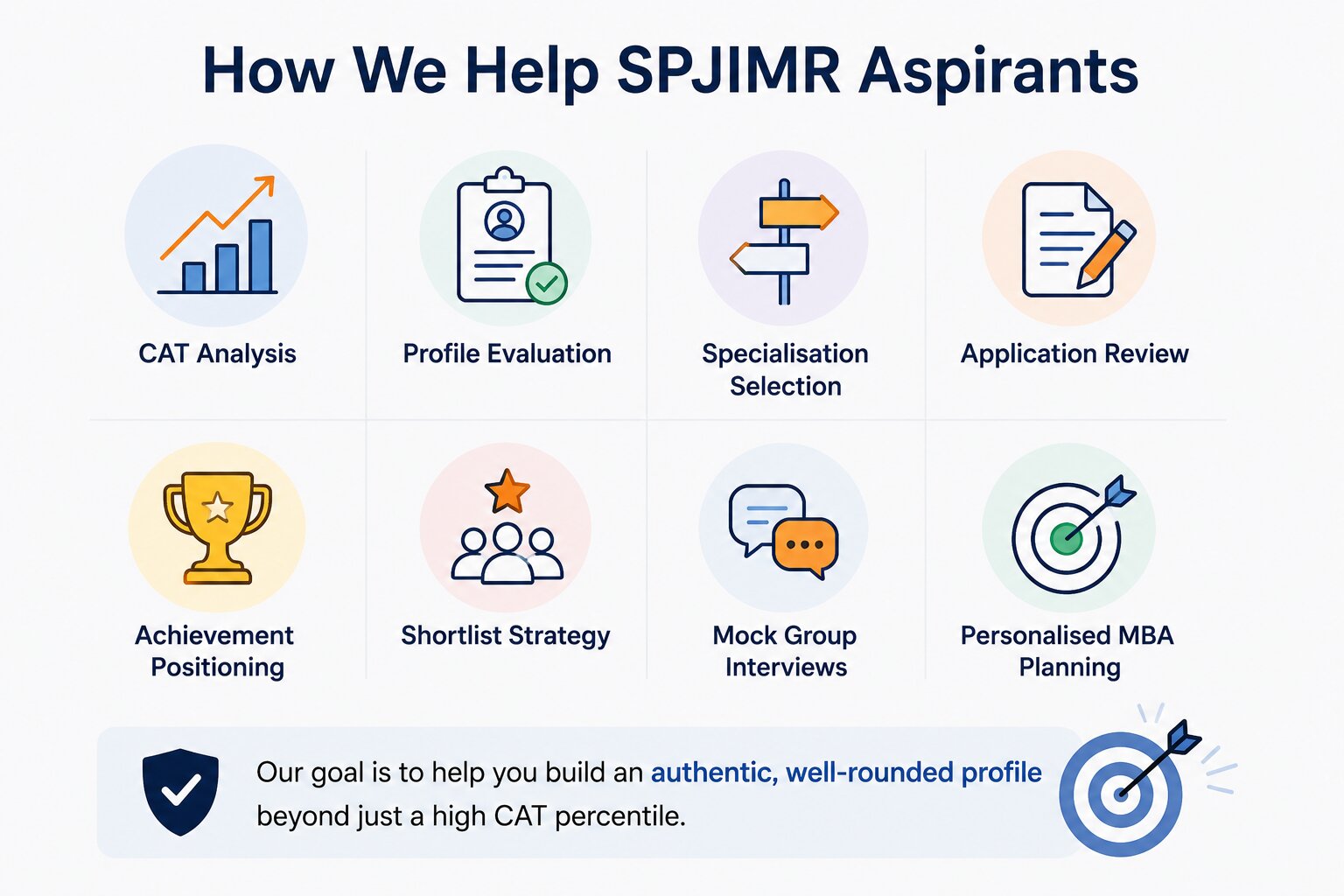
Admittance Edutech supports SPJIMR aspirants through:
- CAT percentile and sectional analysis
- Academic and professional profile evaluation
- PGDM specialisation selection
- Application-form review
- Achievement positioning
- Profile-based shortlist strategy
- Mock group interviews
- Personalised MBA admission planning
The objective is to help candidates present an authentic and coherent profile rather than relying only on a high CAT percentile.
Official Disclaimer
The published qualifying cutoffs discussed in this article relate to the SPJIMR 2026–28 admission cycle. SPJIMR may revise its eligibility criteria, test-score requirements, interview format, dates, intake or selection rules for subsequent cycles. Candidates must verify all information from the official SPJIMR admissions page and the applicable eligibility document before applying.
Conclusion
The SPJIMR Mumbai Cutoff 2026 cannot be understood through CAT percentile alone. Although the official qualifying requirement for the relevant admission cycle was 85 percentile overall and 75 percentile in every CAT section, these were only minimum eligibility thresholds. Actual interview shortlisting depended on the applicant’s academic consistency, work experience, achievements, versatility, specialisation fit and entrance-test performance.
SPJIMR follows two shortlisting routes: profile-based and profile-cum-score-based. Both lead to a distinctive selection process involving two rounds of group interviews. Candidates must therefore prepare not only for personal questions but also for listening, structured participation, professional disagreement and group behaviour.
Applicants with exceptional profiles may remain competitive at comparatively lower percentiles, while those with ordinary or inconsistent profiles should target a substantially higher CAT score. Freshers are fully eligible and can strengthen their candidature through internships, academic projects, leadership and meaningful extracurricular achievements.
The strongest strategy is to maintain balanced CAT sectionals, submit an evidence-backed application and prepare thoroughly for the group-interview format. Candidates who combine a competitive score with clarity, authenticity and profile alignment are best positioned to succeed.

Related Post |Admission Counselling vs Self Research: Which Saves More Time in 2026
FAQs
1. What is the official SPJIMR CAT cutoff for 2026 admission?
For the referenced 2026–28 PGDM (BM) cycle, the qualifying requirement was 85 percentile overall and 75 percentile in each CAT section.
2. Is 85 percentile enough for SPJIMR Mumbai?
It satisfies the published minimum requirement for the applicable cycle, but it does not guarantee shortlisting. Profile quality and competition determine the interview call.
3. Does SPJIMR conduct GD and PI?
SPJIMR officially conducts two rounds of group interviews. These may include individual questions and group interaction, so aspirants often refer to the stage informally as GEPI.
4. Can freshers receive an SPJIMR interview call?
Yes. Work experience is not mandatory. Freshers can be shortlisted based on academics, achievements, internships, profile quality and entrance scores.
5. What factors determine final selection at SPJIMR?
Final selection considers the candidate’s profile, academic record, CAT or GMAT score, work experience, achievements and performance in both group-interview rounds.
ALSO,