UPSC CDS 2 Admit Card 2026 has been officially released by the Union Public Service Commission on its official portal upsc.gov.in for candidates appearing in the Combined Defence Services Examination (II) 2026 scheduled on September 13, 2026 across nationwide examination centres. Candidates who have successfully registered for the recruitment of commissioned officers in the Indian Military Academy (IMA Dehradun), Indian Naval Academy (INA Ezhimala), Air Force Academy (AFA Hyderabad), and Officers Training Academy (OTA Chennai) can now download their e-Admit Card using their Registration ID or Roll Number along with their Date of Birth.
The Combined Defence Services (CDS) examination is one of India’s most prestigious defence entrance examinations conducted twice every year by the UPSC to select eligible candidates into the Indian Armed Forces as commissioned officers. With the national-level examination slated for Sunday, September 13, 2026, aspirants must verify every detail printed on their e-Hall Ticket, adhere strictly to the three-shift schedule, and familiarize themselves with the standardized examination day guidelines, mandatory documentation protocols, OMR black ballpoint pen instructions, and dress code directives issued by the Commission.
UPSC CDS 2 Admit Card 2026: Official Highlights and Overview
The Union Public Service Commission conducts the CDS 2 examination in pen-and-paper offline mode across major metropolitan cities and state capitals throughout India. Below is a comprehensive factual overview of the key examination parameters, conducting authority details, and critical download milestones.
| Exam Parameter | Official Specification / Schedule |
|---|---|
| Exam Conducting Body | Union Public Service Commission (UPSC) |
| Name of the Examination | Combined Defence Services Examination (II), 2026 [UPSC CDS 2 2026] |
| Recruitment Aim | Commissioned Officers in Indian Army (IMA/OTA), Indian Navy (INA), and Indian Air Force (AFA) |
| UPSC CDS 2 Admit Card 2026 Release Date | September 3, 2026 (Active and Live on Portal) |
| Official Exam Date | Sunday, September 13, 2026 |
| Mode of Examination | Offline (OMR Sheet Based Pen-and-Paper Test) |
| Question Paper Medium | Bilingual (Hindi and English) for GK and Mathematics; English only for English paper |
| Negative Marking Scheme | Penalty of 1/3rd (0.33) marks for every incorrect answer |
| Credential Requirements to Download | Registration ID or Roll Number + Date of Birth + Captcha |
| Official Web Portals | upsc.gov.in and upsconline.nic.in |
Official UPSC CDS 2 (2026) Shift Timings and Session Schedule
The CDS II examination follows a strict three-tier session structure throughout the exam day. While candidates seeking admission to the Indian Military Academy (IMA), Indian Naval Academy (INA), and Air Force Academy (AFA) must appear for all three test papers (English, General Knowledge, and Elementary Mathematics), candidates opting exclusively for the Officers Training Academy (OTA) are required to attempt only two papers: English and General Knowledge.
Candidates must report to their designated test centres at least 45 to 60 minutes prior to the commencement of each session. Entry into the examination venue closes precisely 10 minutes before the scheduled start of each paper. Under no circumstances will any candidate be permitted entry once the gates are closed.
| Exam Session / Paper | Applicable Academies | Exam Timings | Gate Closing Time | Total Marks / Duration |
|---|---|---|---|---|
| Paper 1: English | IMA, INA, AFA, and OTA | 09:00 AM to 11:00 AM | 08:50 AM Sharp | 100 Marks (2 Hours) |
| Paper 2: General Knowledge (GK) | IMA, INA, AFA, and OTA | 12:30 PM to 02:30 PM | 12:20 PM Sharp | 100 Marks (2 Hours) |
| Paper 3: Elementary Mathematics | IMA, INA, and AFA Only (Exempted for OTA) | 04:00 PM to 06:00 PM | 03:50 PM Sharp | 100 Marks (2 Hours) |
Step-by-Step Guide to Download UPSC CDS 2 Admit Card 2026
The Commission provides e-Admit Cards exclusively through its online portal. No physical paper hall tickets are dispatched via postal mail. Follow the structured step-by-step procedure below to download and print your official document without encountering server errors:
- Visit the Official Portal: Open your web browser and navigate to the official UPSC web portal at upsc.gov.in or direct application portal at upsconline.nic.in.
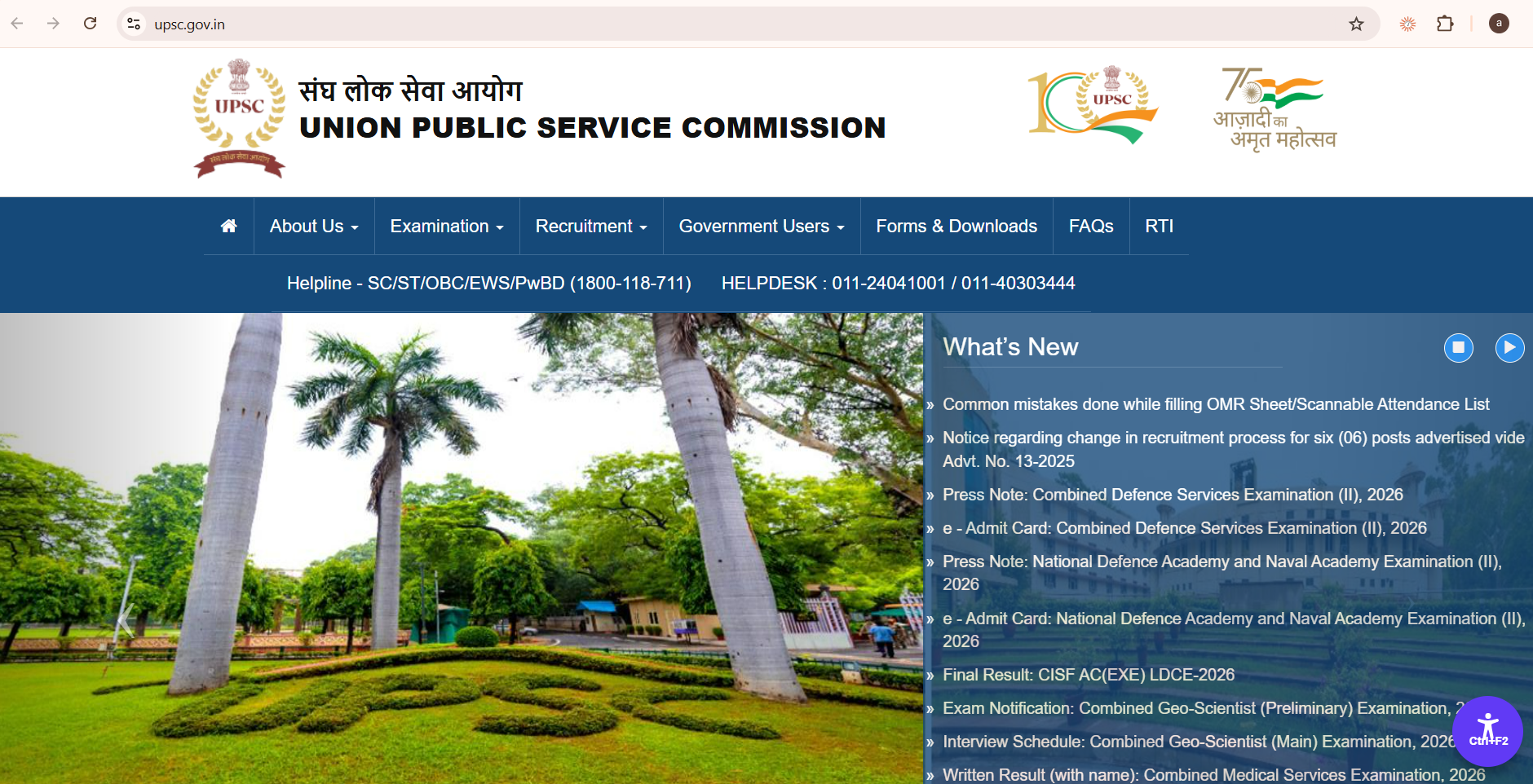
- Locate the Admit Card Section: On the home page, click on the “Admit Cards” tab located in the right-hand sidebar or under the “What’s New” marquee section.
- Select E-Admit Cards for Various Examinations: Click on the link titled “e-Admit Card: Combined Defence Services Examination (II), 2026”.
- Read Instructions and Agree: A mandatory instruction page detailing the Commission’s rules will appear. Read through the directives and click on the “Yes” button to acknowledge receipt.
- Select Verification Mode: Choose between “By Registration ID” (RID) or “By Roll Number”.
- Enter Required Credentials: Enter your 11-digit Registration ID or 7-digit Roll Number, select your Date of Birth (in DD/MM/YYYY format), and type the random Captcha code displayed on the screen.
- Generate and Download Admit Card: Click on “Submit”. Your UPSC CDS 2 Admit Card 2026 will appear on the screen in PDF format.
- Print Multiple Hard Copies: Save the PDF file securely on your device and take at least 2 to 3 clear printouts on clean white A4 paper. Ensure the barcode, photograph, roll number, and signature are distinctly legible.
Crucial Details to Verify on Your UPSC CDS 2 Admit Card 2026
Once you download your e-Admit Card, verify all printed data points meticulously. Any mismatch between your identity documents and your admit card can lead to disqualification at the examination venue or during the subsequent Services Selection Board (SSB) interview stage. Check the following elements:
- Candidate’s Full Name: Ensure spelling matches exactly with your Class 10 (Matriculation) certificate.
- Roll Number and Registration ID: Check that your unique identification numbers are clearly printed.
- Photograph and Signature: Verify that your uploaded photograph and scanned signature are crisp and clearly visible. If your photograph is blurred or missing, you must bring two passport-sized photographs along with a photo ID proof for each session.
- Examination Centre and Venue Address: Check the exact building name, road address, and city allocated for your examination. Plan your travel itinerary a day in advance.
- Academy Preferences (IMA / INA / AFA / OTA): Check the opted course codes and category tags reflected on the admit card.
- Time Table and Paper Codes: Ensure all allocated subject papers corresponding to your chosen wings are scheduled accurately.
UPSC CDS 2 Exam Pattern and Marking Structure (IMA, INA, AFA vs OTA)
Understanding the exact marking matrix and section distribution is essential for time management during the 2-hour duration of each paper. The table below provides the detailed comparison between the technical wings and the non-technical OTA cadre.
| Academy Track | Subjects Included | Total Number of Questions | Maximum Marks | Negative Marking per Wrong Answer |
|---|---|---|---|---|
| Indian Military Academy (IMA) | English (120 Qs) + GK (120 Qs) + Elementary Math (100 Qs) | 340 Objective Questions | 300 Marks (100 per paper) | -0.27 marks for English/GK; -0.33 marks for Math |
| Indian Naval Academy (INA) | English (120 Qs) + GK (120 Qs) + Elementary Math (100 Qs) | 340 Objective Questions | 300 Marks (100 per paper) | -0.27 marks for English/GK; -0.33 marks for Math |
| Air Force Academy (AFA) | English (120 Qs) + GK (120 Qs) + Elementary Math (100 Qs) | 340 Objective Questions | 300 Marks (100 per paper) | -0.27 marks for English/GK; -0.33 marks for Math |
| Officers Training Academy (OTA) | English (120 Qs) + GK (120 Qs) [Math Not Applicable] | 240 Objective Questions | 200 Marks (100 per paper) | -0.27 marks for English/GK per incorrect response |
Detailed Subject-Wise Syllabus Breakdown and Topic Weightage
To maximize your written score and ensure you comfortably exceed the 20% sectional qualifying barrier in every paper, review the subject-wise core syllabus and question distribution patterns outlined below:
1. Paper 1: English (100 Marks, 120 Questions)
The English paper tests candidates’ functional command over vocabulary, grammatical syntax, sentence formation, and analytical reading capabilities. Key high-scoring topic areas include:
- Reading Comprehension: 3 to 4 passages testing inferential logic, central themes, vocabulary in context, and author’s tone (15 to 20 questions).
- Spotting Errors: Subject-verb agreement, tense consistency, preposition usage, conjunctions, modifiers, and idiomatic errors (15 to 20 questions).
- Ordering of Words in a Sentence (PQRS) and Sentence Arrangement: Jumbled sentence reconstruction testing logical coherence (15 to 20 questions).
- Synonyms and Antonyms: Advanced contextual vocabulary testing word nuances, homonyms, and word association (20 questions).
- Idioms and Phrases: Identification of figurative meanings and usage in contemporary standard English (10 to 15 questions).
- Cloze Test and Fill in the Blanks: Paragraph completion testing grammatical precision and lexical choice (15 to 20 questions).
2. Paper 2: General Knowledge (100 Marks, 120 Questions)
The General Knowledge paper covers contemporary national and international events as well as foundational general science and social science disciplines:
- General Science (Physics, Chemistry, Biology): NCERT Class 9 and 10 conceptual foundations, including optics, mechanics, thermodynamics, chemical reactions, periodic table trends, human anatomy, diseases, and environmental ecology (30 to 35 questions).
- Indian Polity and Governance: Constitutional framework, Fundamental Rights, Directive Principles, Parliamentary procedures, President and Governor powers, Supreme Court landmark rulings, and local governance (18 to 22 questions).
- Indian and World Geography: Physiographic divisions of India, river drainage systems, climate patterns, soil profiles, mineral resources, ocean currents, and astronomical concepts (18 to 22 questions).
- Indian History and National Movement: Ancient Indian empires, medieval socio-religious developments, British colonial policies, freedom struggle, and prominent leaders (18 to 22 questions).
- Current Affairs and Defence Awareness: Joint military exercises, defence procurement, missile tests, international summits, bilateral agreements, sports, awards, and economic indices of the last 6 to 8 months (20 to 25 questions).
3. Paper 3: Elementary Mathematics (100 Marks, 100 Questions)
Applicable exclusively for IMA, INA, and AFA candidates, the Mathematics paper focuses on matriculation-level computational precision, algebraic techniques, and geometric theorems:
- Arithmetic and Number System: Number theory, divisibility rules, HCF and LCM, fractions, logarithms, percentages, profit and loss, simple and compound interest, time and work, time speed and distance (25 to 30 questions).
- Algebra: Linear equations, quadratic equations, polynomials, remainder theorem, inequalities, and simultaneous systems (15 to 20 questions).
- Trigonometry: Trigonometric ratios, standard identities, height and distance problems, and radian measure (12 to 15 questions).
- Geometry: Properties of triangles, congruence and similarity criteria, circles, chords, tangents, and parallelograms (15 to 18 questions).
- Mensuration: Surface areas and volumes of 2D and 3D figures (cubes, spheres, cones, cylinders, prisms, pyramids) (12 to 15 questions).
- Statistics: Graphical representation of data (bar charts, pie charts, histograms), measures of central tendency (mean, median, mode), and cumulative frequency distributions (8 to 10 questions).
Mandatory Documents to Carry to the UPSC CDS Examination Hall
Candidates must ensure they carry all mandatory verification articles to prevent denial of entry by security personnel and invigilators at the gate:
- Printed Copy of UPSC CDS 2 Admit Card 2026: A clear, physical printout of the e-Admit card on A4 sheet. Soft copies on mobile phones are strictly prohibited.
- Original Government-Issued Photo Identity Proof: The identical original photo identity card whose number was entered during online application registration (such as Aadhaar Card, Voter ID Card, PAN Card, Passport, Driving Licence, or any other photo ID issued by the Central/State Government).
- Black Ballpoint Pens (At least 2 to 3 pens): Candidates must use only Black Ballpoint Pens for marking answers on the OMR answer sheets and for encoding attendance registers. Pens with blue ink, gel pens, fountain pens, or pencils are strictly prohibited for OMR bubbling.
- Passport-Sized Photographs (2 Identical Copies): In case the photograph on the e-Admit card is faint, blurred, or missing, candidates must carry two identical passport-size photographs (with their name and roll number written on the back) along with an undertaking at the venue.
- Transparent Water Bottle and Simple Wristwatch: Analog watches with plain dials are allowed. Smartwatches, digital watches with calculators or memory functions, and fitness bands are completely banned.
Strictly Prohibited Items Inside the CDS Exam Centre
The Union Public Service Commission enforces a zero-tolerance policy regarding unauthorized communication devices and study material inside examination premises. Possession of any banned items—even if switched off—will lead to immediate cancellation of candidature and debarment from all future UPSC examinations for a specified period:
- Mobile phones, smartphones, pagers, Bluetooth devices, earphones, wireless microphones, or spy cameras.
- Smartwatches, digital fitness trackers, electronic calculative devices, and electronic timers.
- Bags, backpacks, books, reference sheets, notes, loose paper, clipboards, or pencil pouches (unless transparent).
- Metallic items, costly jewelry, or bulky electronic car keys with transmitters.
OMR Sheet Bubbling and Marking Best Practices
Minor technical errors while bubbling the OMR sheet can lead to automatic machine rejection of your test paper. Follow these proven mechanical rules to ensure flawless machine evaluation:
- Darken the Circles Completely: Ensure the black circle is completely darkened without leaving white spaces inside. Faint or partial marks may fail optical recognition scanners.
- Avoid Stray Marks: Do not make any unnecessary ticks, cross marks, or scribbles anywhere on the front or reverse side of the OMR response sheet.
- Careful Roll Number and Test Booklet Series Encoding: Double-check the 7-digit Roll Number and your Test Booklet Series (A, B, C, or D) before bubbling. Any incorrect encoding of the booklet series will cause your entire paper to be evaluated against the wrong answer key.
- Never Use Correction Fluids or Erasers: Use of white fluid (whitener), blade scratching, or eraser marks on OMR sheets is strictly forbidden and can cause rejection.
Expected UPSC CDS 2 Written Exam Cutoff Trends
Based on previous years’ official UPSC statistical archives and standard paper difficulty parameters, candidates can refer to the expected written qualifying cutoff thresholds below to calibrate their minimum safe attempt targets:
| Academy Wing | Total Written Marks | Minimum Sectional Cutoff (Each Paper) | Expected Overall Written Qualifying Score |
|---|---|---|---|
| Indian Military Academy (IMA) | 300 Marks | 20% (20 Marks per paper) | 125 to 135 Marks |
| Indian Naval Academy (INA) | 300 Marks | 20% (20 Marks per paper) | 118 to 128 Marks |
| Air Force Academy (AFA) | 300 Marks | 20% (20 Marks per paper) | 142 to 152 Marks |
| Officers Training Academy (OTA – Men) | 200 Marks | 20% (20 Marks per paper) | 98 to 108 Marks |
| Officers Training Academy (OTA – Women) | 200 Marks | 20% (20 Marks per paper) | 98 to 108 Marks |
Next Stages After the UPSC CDS 2 Written Examination
Candidates who secure qualifying marks above both the individual 20% sectional cutoff and the cumulative aggregate cutoff will be shortlisted for the next stages of the officer selection cycle:
- Stage 1: Services Selection Board (SSB) Interview: A comprehensive 5-day psychological assessment comprising the Officer Intelligence Rating (OIR) test, Picture Perception and Description Test (PPDT), Group Testing Officer (GTO) indoor/outdoor tasks, Personal Interview with the Interviewing Officer (IO), and Final Board Conference.
- Stage 2: Special Medical Board Examination (SMB): Comprehensive physical and clinical medical assessment at designated Military/Command Hospitals to verify vision standards (refraction limits, color perception CP-I/CP-II), surgical history, spinal health, anthropometric proportions, hearing, and systemic fitness.
- Stage 3: All India Merit List and Joining Letters: Final merit compilation combining written exam scores and SSB marks to allocate training academies according to verified vacancies, medical fitness, and candidate preference order.
Frequently Asked Questions (FAQs) Regarding UPSC CDS 2 Admit Card 2026
Q1: What is the official website to download the UPSC CDS 2 Admit Card 2026?
Answer: Candidates can download the official e-Admit Card directly from the Union Public Service Commission portals at upsc.gov.in or upsconline.nic.in.
Q2: When is the UPSC CDS 2 (2026) examination scheduled to take place?
Answer: The UPSC CDS 2 (2026) examination is officially scheduled to take place on Sunday, September 13, 2026, across designated examination centres nationwide.
Q3: What are the shift timings for the three papers in the CDS 2 examination?
Answer: The shift timings are: Paper 1 (English) from 09:00 AM to 11:00 AM, Paper 2 (General Knowledge) from 12:30 PM to 02:30 PM, and Paper 3 (Elementary Mathematics) from 04:00 PM to 06:00 PM.
Q4: Do OTA candidates need to appear for all three sessions?
Answer: No. Candidates applying exclusively for the Officers Training Academy (OTA) are required to appear only for Paper 1 (English) and Paper 2 (General Knowledge). They are completely exempted from Paper 3 (Elementary Mathematics).
Q5: What credentials are required to download the UPSC CDS 2 Admit Card 2026?
Answer: Candidates require either their 11-digit Registration ID (RID) or 7-digit Roll Number along with their Date of Birth and the security Captcha code to access and download the admit card.
Q6: Which pen is permissible for marking answers on the CDS OMR sheet?
Answer: Only a Black Ballpoint Pen is permissible for marking responses, attendance sheets, and roll numbers on the OMR answer sheets. Pens with blue ink, gel pens, and pencils are strictly banned.
Q7: What is the negative marking penalty in the UPSC CDS 2 exam?
Answer: There is a penalty of 1/3rd (0.33) of the marks assigned to that specific question for every incorrect answer. No marks are deducted for unattempted questions.
Q8: What should I do if my photograph or signature on the admit card is blurry or missing?
Answer: Candidates must carry two identical passport-sized photographs along with an original government photo ID proof for each examination session, and complete the prescribed undertaking form provided at the test centre.
Q9: What is the gate closure timing for each session of the examination?
Answer: The entry gates close strictly 10 minutes prior to the commencement of each session: at 08:50 AM for the morning session, 12:20 PM for the afternoon session, and 03:50 PM for the evening session.
Q10: What is the minimum qualifying mark required in each individual subject?
Answer: Candidates must secure a minimum of 20% marks in each individual paper (i.e. at least 20 marks out of 100 in English, GK, and Mathematics) in addition to clearing the overall aggregate cutoff score.
Q11: Are wristwatches allowed inside the CDS examination hall?
Answer: Only simple, basic analog wristwatches with plain mechanical dials are allowed. Smartwatches, digital watches with multiple displays, and fitness bands are strictly prohibited.
Q12: Will UPSC send a physical copy of the CDS admit card by post?
Answer: No. UPSC does not send physical admit cards by post. All candidates must download and print their e-Admit cards online from the official website.