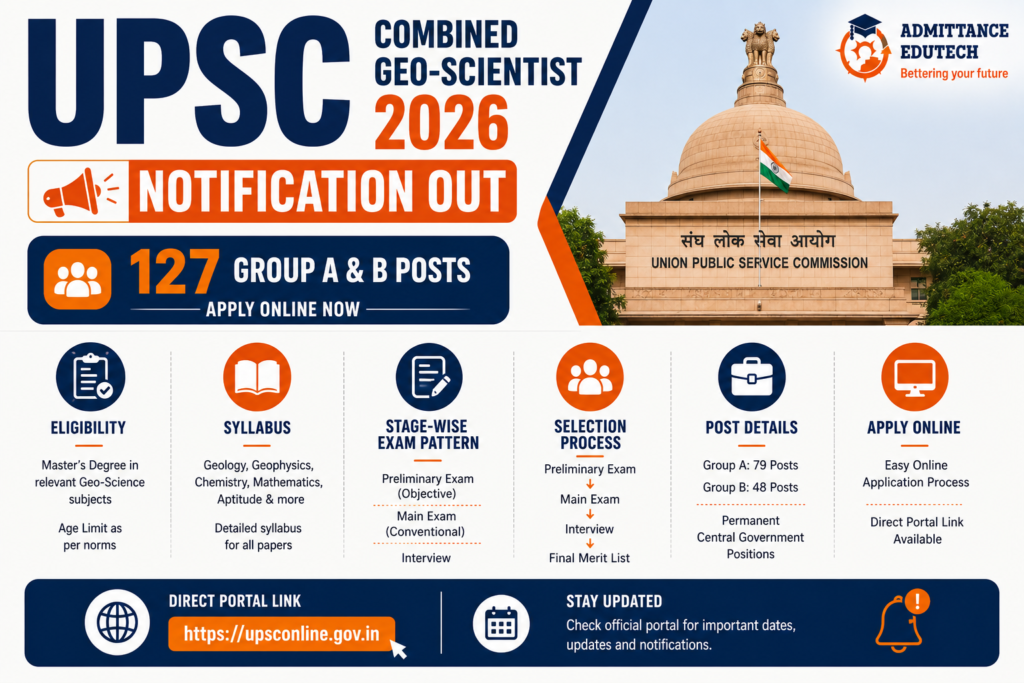
UPSC Combined Geo-Scientist 2026 Notification and Syllabus has officially been released by the Union Public Service Commission (UPSC) under Examination Notice No. 01/2027-GEOL on the apex recruitment portal (upsc.gov.in). The Commission has invited online applications from qualified postgraduates and master’s degree holders for 127 tentative vacancies across prestigious Group ‘A’ and Group ‘B’ scientific positions in the Geological Survey of India (GSI) under the Ministry of Mines, and the Central Ground Water Board (CGWB) under the Ministry of Jal Shakti. The online application submission process began on September 2, 2026, and the registration window on the UPSC One Time Registration (OTR) platform (upsconline.nic.in) will remain open until September 22, 2026 (up to 6:00 PM).
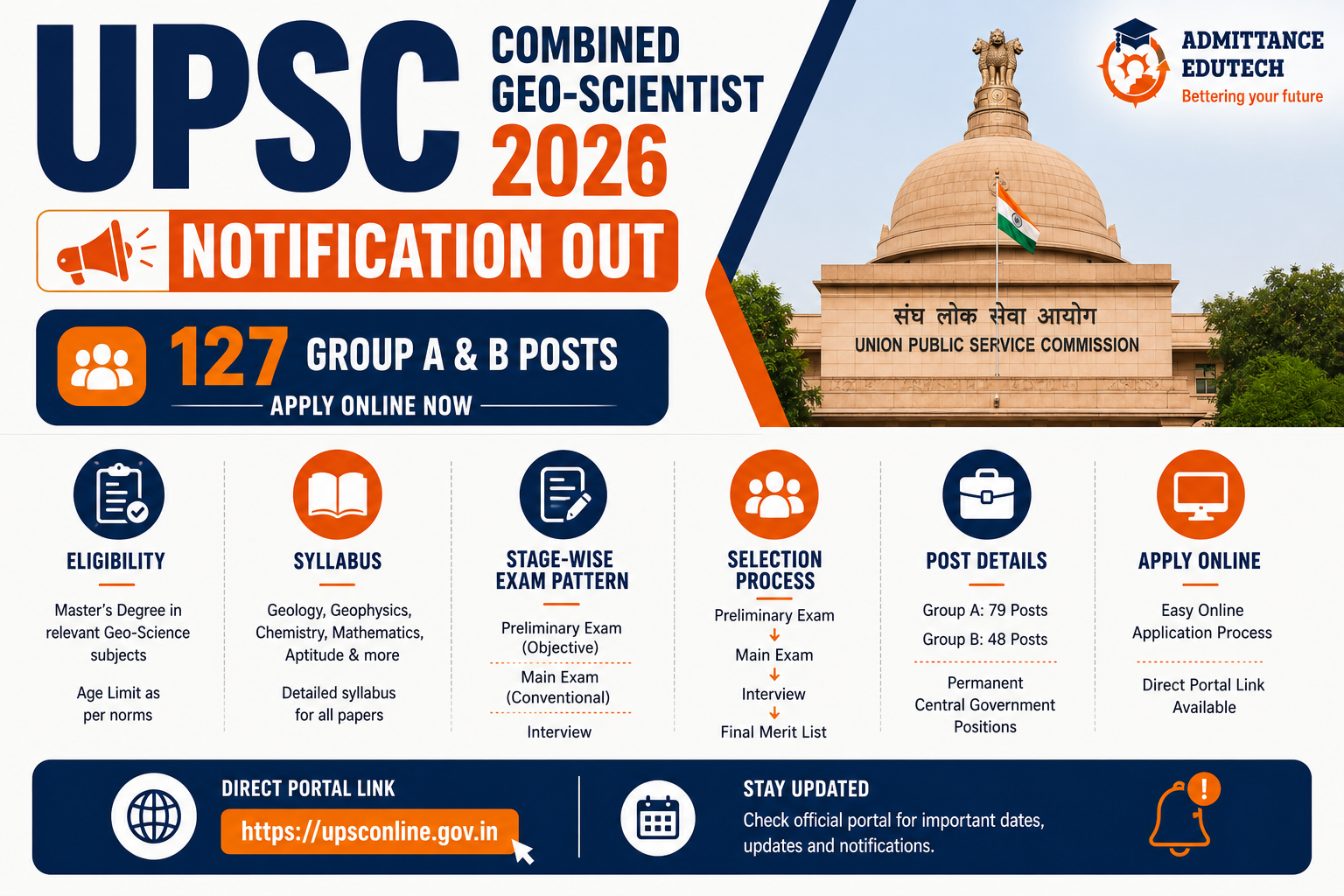
The Combined Geo-Scientist Examination serves as the premier national-level gateway for aspiring geologists, geophysicists, chemists, and hydrogeologists aiming to build a distinguished career in India’s apex mineral exploration, groundwater governance, and geoscientific research organizations. The recruitment process follows a stringent three-stage selection architecture: Stage-I Preliminary Examination (Computer-Based Objective Test) scheduled for January 10, 2027, followed by Stage-II Main Examination (Descriptive Test) scheduled for June 19 and June 20, 2027, and concluding with the Stage-III Personality Test / Interview. This comprehensive guide provides an exhaustive breakdown of the official vacancy distribution, age limits, educational qualifications, stage-wise exam patterns, syllabus modules, marking schemes, and step-by-step application instructions.
UPSC Combined Geo-Scientist 2026 Notification and Syllabus Key Highlights and Summary
Below is the structured overview of all fundamental institutional parameters and recruitment details as notified in the official UPSC Combined Geo-Scientist Examination gazette notification:
| Recruitment Parameter | Official Notification Details |
|---|---|
| Exam Conducting Authority | Union Public Service Commission (UPSC) |
| Examination Name | Combined Geo-Scientist Examination (CGSE) |
| Official Notice Number | Notice No. 01/2027-GEOL |
| Participating Organizations | Geological Survey of India (GSI) and Central Ground Water Board (CGWB) |
| Total Tentative Vacancies | 127 Posts (Group ‘A’ and Group ‘B’ Scientific Cadres) |
| Notification Release Date | September 2, 2026 |
| Online Application Window | September 2, 2026 to September 22, 2026 (up to 6:00 PM) |
| Application Correction Window | September 23, 2026 to September 29, 2026 (7 Days) |
| Stage-I Preliminary Exam Date | January 10, 2027 (Sunday) |
| Stage-II Main Exam Dates | June 19, 2027 and June 20, 2027 |
| Official Websites | upsc.gov.in | upsconline.nic.in |
Official Vacancy Distribution Across GSI and CGWB
The 127 vacancies announced under the UPSC Combined Geo-Scientist 2026 Notification and Syllabus are bifurcated between the Geological Survey of India and the Central Ground Water Board across multiple specialized scientific streams. The cadre-wise and department-wise distribution is detailed in the table below:
| Cadre / Department | Designation of Post | Service Classification | Tentative Vacancies |
|---|---|---|---|
| Geological Survey of India (GSI) | Geologist | Group ‘A’ (Gazetted) | 68 Posts |
| Geological Survey of India (GSI) | Geophysicist | Group ‘A’ (Gazetted) | 14 Posts |
| Geological Survey of India (GSI) | Chemist | Group ‘A’ (Gazetted) | 22 Posts |
| Central Ground Water Board (CGWB) | Scientist ‘B’ (Hydrogeology) | Group ‘A’ (Junior Time Scale) | 13 Posts |
| Central Ground Water Board (CGWB) | Scientist ‘B’ (Chemical) | Group ‘A’ (Junior Time Scale) | 06 Posts |
| Central Ground Water Board (CGWB) | Scientist ‘B’ (Geophysics) | Group ‘A’ (Junior Time Scale) | 04 Posts |
| Total Vacancies | Combined Geo-Scientist 2026-27 | Group ‘A’ Scientific Posts | 127 Vacancies |
Note: Vacancies are tentative and subject to alteration as per administrative requisitions received by UPSC prior to the declaration of final results. Vertical reservation for SC, ST, OBC, and EWS candidates, as well as horizontal reservation for Persons with Benchmark Disabilities (PwBD), will be maintained strictly in accordance with Government of India roster rules.
Eligibility Criteria: Nationality, Age Limit, and Educational Qualifications
Candidates aspiring to apply for the Combined Geo-Scientist Examination must verify their compliance with all eligibility parameters prescribed by the Union Public Service Commission as of the crucial reference dates:
1. Nationality Standards
A candidate must be either:
- A Citizen of India, or
- A Subject of Nepal, or
- A Subject of Bhutan, or
- A Tibetan refugee who came over to India before January 1, 1962, with the intention of permanently settling in India, or
- A person of Indian origin who has migrated from Pakistan, Burma, Sri Lanka, or East African countries of Kenya, Uganda, the United Republic of Tanzania, Zambia, Malawi, Zaire, and Ethiopia or Vietnam with the intention of permanently settling in India (subject to possessing an eligibility certificate issued by the Government of India).
2. Age Limit (As on January 1, 2027)
Candidates applying for posts in the Geological Survey of India and the Central Ground Water Board must satisfy the following age thresholds:
- Minimum Age: A candidate must have attained the age of 21 years on January 1, 2027.
- Maximum Age: A candidate must not have attained the age of 32 years on January 1, 2027 (i.e., candidates must have been born not earlier than January 2, 1995, and not later than January 1, 2006).
- Age Relaxation Provisions:
- Scheduled Castes (SC) / Scheduled Tribes (ST): Up to a maximum of 5 years.
- Other Backward Classes (OBC – Non-Creamy Layer): Up to a maximum of 3 years.
- Defence Services Personnel disabled in operations: Up to a maximum of 3 years.
- Ex-Servicemen including Commissioned Officers / ECOs / SSCOs: Up to a maximum of 5 years.
- Persons with Benchmark Disabilities (PwBD – Blindness/Low Vision, Deaf/Hard of Hearing, Locomotor): Up to a maximum of 10 years.
- Cumulative relaxation is applicable for SC/ST and OBC candidates under PwBD categories (up to 15 years and 13 years respectively).
3. Minimum Educational Qualifications Discipline-Wise
Candidates must possess the requisite postgraduate academic credentials from a recognized university incorporated by an Act of the Central or State Legislature in India or other educational institutions established by an Act of Parliament:
| Post Name and Department | Mandatory Master’s Degree / Academic Qualification |
|---|---|
| Geologist (Group ‘A’) in GSI | Master’s Degree in Geological Science / Geology / Applied Geology / Geo-Exploration / Mineral Exploration / Engineering Geology / Marine Geology / Earth Science and Resource Management / Oceanography and Coastal Areas Studies / Petroleum Geosciences / Geochemistry from a recognized University. |
| Geophysicist (Group ‘A’) in GSI & Scientist ‘B’ (Geophysics) in CGWB | M.Sc. in Physics / Applied Physics / M.Sc. (Geophysics) / Integrated M.Sc. (Exploration Geophysics) / M.Sc. (Applied Geophysics) / M.Sc. (Marine Geophysics) / M.Sc. (Tech.) (Applied Geophysics) from a recognized University. |
| Chemist (Group ‘A’) in GSI & Scientist ‘B’ (Chemical) in CGWB | M.Sc. in Chemistry / Applied Chemistry / Analytical Chemistry from a recognized University or Institute. |
| Scientist ‘B’ (Hydrogeology) in CGWB | Master’s Degree in Geology / Applied Geology / Marine Geology / Hydrogeology from a recognized University. |
Candidates appearing in their final qualifying examination are also eligible to apply provisionally for the Stage-I Preliminary Examination, provided they submit documentary proof of passing the qualifying examination at the time of Stage-II Main Examination application (Detailed Application Form – DAF).
Stage-Wise Examination Architecture and Selection Process
The selection mechanism for the UPSC Combined Geo-Scientist 2026 Notification and Syllabus is structured into three progressive evaluation stages:
| Examination Stage | Mode and Question Type | Total Papers | Maximum Marks | Role in Final Merit Selection |
|---|---|---|---|---|
| Stage-I: Preliminary Examination | Computer-Based Objective (MCQ) | 2 Papers | 400 Marks | Marks counted for Stage-II shortlisting and Final Merit |
| Stage-II: Main Examination | Conventional Descriptive (Pen and Paper) | 3 Papers | 600 Marks | Marks counted for Final Merit List |
| Stage-III: Personality Test / Interview | In-person Viva-Voce Board | 1 Interview | 200 Marks | Marks counted for Final Merit List |
| Grand Total for Merit | All Three Stages Combined | 5 Papers + Interview | 1,200 Marks | Final Recommendation Order |
Stage-I Preliminary Examination Pattern and Marking Scheme
The Stage-I Preliminary Examination will be conducted across designated computer test centers nationwide on January 10, 2027. It consists of two objective multiple-choice papers for all streams:
| Paper Code and Stream | Subject / Discipline | Exam Duration | Maximum Marks |
|---|---|---|---|
| Paper-I (Common for All Streams) | General Studies | 2 Hours | 100 Marks |
| Paper-II (Stream-Specific) |
|
2 Hours | 300 Marks |
| Total for Stage-I | General Studies + Stream Discipline | 4 Hours | 400 Marks |
Negative Marking Rules in Stage-I Preliminary Examination:
- For every incorrect answer, one-third (0.33) of the marks assigned to that specific question will be deducted as penalty.
- If a candidate gives more than one answer to a question, it will be treated as an incorrect answer even if one of the options is correct, and 1/3rd penalty will apply.
- No deduction of marks will occur if a question is left unattempted (blank).
Stage-II Main Examination Pattern (Descriptive Papers)
Candidates who qualify in the Preliminary Examination based on stream-specific cutoff benchmarks will be invited to appear for the Stage-II Main Examination on June 19 and June 20, 2027. The Main Examination comprises three conventional descriptive papers of 3 hours duration each, carrying 200 marks per paper (Total: 600 Marks):
| Stream / Discipline | Paper-I (200 Marks / 3 Hrs) | Paper-II (200 Marks / 3 Hrs) | Paper-III (200 Marks / 3 Hrs) |
|---|---|---|---|
| Geologist Stream | Geology Paper I | Geology Paper II | Geology Paper III |
| Geophysicist Stream | Geophysics Paper I | Geophysics Paper II | Geophysics Paper III |
| Chemist Stream | Chemistry Paper I | Chemistry Paper II | Chemistry Paper III |
| Scientist ‘B’ (Hydrogeology) Stream | Geology Paper I | Geology Paper II | Hydrogeology (Paper III) |
Candidates competing simultaneously for the post of Geologist in GSI and Scientist ‘B’ (Hydrogeology) in CGWB are required to appear for Geology Paper I, Geology Paper II, Geology Paper III, and Hydrogeology Paper III during the Main Examination.
Detailed Official Syllabus Breakdown: Prelims and Mains
The syllabus prescribed under the UPSC Combined Geo-Scientist 2026 Notification and Syllabus is structured comprehensively to assess both broad general awareness and deep academic command over advanced earth and chemical sciences:
1. Paper-I: General Studies (Common for All Streams in Prelims – 100 Marks)
- Current Events of National and International Importance: Major scientific breakthroughs, geopolitics, national developmental projects, environmental treaties, and bilateral agreements.
- History of India and Indian National Movement: Ancient and medieval history, cultural heritage, 1857 revolt, socio-religious reform movements, freedom struggle, and post-independence consolidation.
- Indian and World Geography: Physical, social, and economic geography of India and the world; geological formations, river drainage basins, climate zones, natural hazards, and mineral resources.
- Indian Polity and Governance: Constitution of India, political system, Panchayati Raj, public policy, fundamental rights, judicial review, and statutory bodies.
- Economic and Social Development: Sustainable development, poverty eradication, demographic trends, social sector initiatives, budgeting, fiscal policies, and industrial growth.
- Environmental Ecology, Biodiversity, and Climate Change: Ecosystem dynamics, forest conservation policies, carbon credits, endangered flora and fauna, and disaster risk reduction.
- General Science: Basic principles of physics, chemistry, biology, space exploration, and nuclear technology.
2. Geology / Hydrogeology Stream Syllabus
- Physical Geology and Geomorphology: Origin and interior of the Earth, plate tectonics, seismic waves, weathering, fluvial, aeolian, glacial, and karst landforms, morphometric analysis, and remote sensing applications.
- Structural Geology: Principles of stress and strain, fold mechanics, fault kinematics, joints, shear zones, petrofabric analysis, and stereographic projections.
- Mineralogy and Crystallography: Symmetry elements, 32 crystal classes, optical mineralogy, crystal chemistry, silicates, carbonates, and optical properties under petrological microscope.
- Igneous and Metamorphic Petrology: Magma generation, phase equilibria (binary and ternary systems), Bowen’s reaction series, metamorphic facies, isograds, and metasomatism.
- Sedimentology and Stratigraphy: Sedimentary structures, depositional environments, provenance analysis, litho-, bio-, and chrono-stratigraphy, Precambrian crustal evolution of India (Dharwar, Bastar, Singhbhum cratons), Phanerozoic stratigraphy of India, and Gondwana basins.
- Paleontology: Evolution of invertebrates, microfossils, foraminifera, vertebrate evolution (Siwalik fauna), and Gondwana flora.
- Economic Geology: Magmatic, hydrothermal, sedimentary, and metamorphic ore deposits; metallogenic epochs and provinces in India; coal, petroleum, and atomic minerals.
- Hydrogeology: Hydrological cycle, Darcy’s law, aquifer hydraulics, groundwater flow equations, well hydraulics, hydrogeochemistry, pumping tests, seawater intrusion, and artificial recharge techniques.
3. Geophysics Stream Syllabus
- Solid Earth Geophysics: Earth’s gravitational field, geoid and spheroid, isostasy, geomagnetism, paleomagnetism, continental drift, and earthquake seismology.
- Mathematical Methods in Geophysics: Vector calculus, Laplace and Fourier transforms, boundary value problems, matrices, and partial differential equations.
- Electromagnetic and Electrical Methods: Self-potential, electrical resistivity methods (Wenner, Schlumberger configurations), induced polarization, and magnetotellurics.
- Seismic Exploration Methods: Seismic wave propagation, reflection and refraction surveying, data acquisition, seismic processing, NMO correction, velocity analysis, and seismic migration.
- Gravity and Magnetic Methods: Gravimeters and magnetometers, bouguer and free-air anomalies, regional-residual separation, upward and downward continuation, and magnetic field modeling.
- Well Logging and Radioactive Methods: SP log, resistivity log, gamma ray log, neutron log, sonic log, radioactive decay laws, and borehole geophysics.
4. Chemistry Stream Syllabus
- Inorganic Chemistry: Chemical periodicity, bonding in main group compounds, coordination chemistry, crystal field theory, Jahn-Teller effect, bioinorganic chemistry, organometallics, and f-block element chemistry.
- Organic Chemistry: Reaction mechanisms, nucleophilic and electrophilic substitutions, reactive intermediates (carbocations, carbenes), pericyclic reactions, stereochemistry, spectroscopic identification of organic molecules (NMR, IR, UV-Vis, Mass spectrometry).
- Physical Chemistry: Quantum mechanics, chemical thermodynamics, electrochemistry, kinetics of reactions, surface chemistry, catalysis, and statistical thermodynamics.
- Analytical Chemistry: Titrimetric analysis, gravimetry, spectrophotometry, atomic absorption spectroscopy (AAS), inductively coupled plasma mass spectrometry (ICP-MS), chromatography (HPLC, GC), and thermal analysis (TGA, DSC).
Step-by-Step Online Application Process on UPSC OTR Portal
Candidates must submit their online applications exclusively via the UPSC One Time Registration (OTR) platform. Follow the step-by-step procedure detailed below:
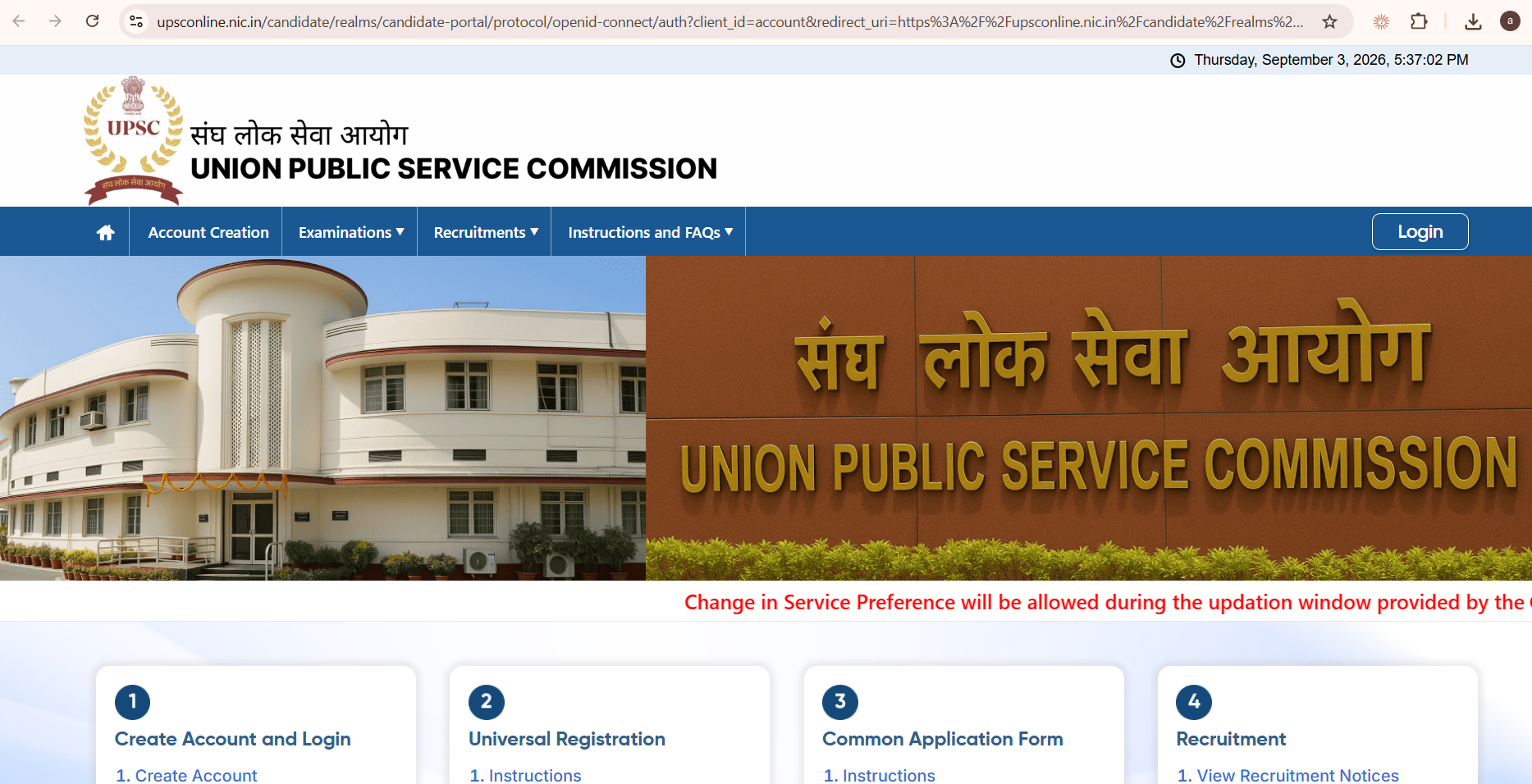
- One Time Registration (OTR): Visit upsconline.nic.in. If you have not registered on OTR previously, click on “New Registration” and enter your basic demographic details (Name, Gender, Date of Birth, Father’s Name, Mother’s Name, Mobile Number, Email ID, and Security Questions). If already registered, log in directly using your registered Email ID / Mobile Number / OTR ID and OTP.
- Access Active Examination Section: Once logged in, navigate to the “Latest Notifications” dashboard. Locate the link for Combined Geo-Scientist Examination 2027 (Notice No. 01/2027-GEOL).
- Fill Part-I Application Form: Verify personal details, select examination centers for Preliminary Examination, choose your specific academic stream (Geologist / Geophysicist / Chemist / Hydrogeology), and provide academic qualification details.
- Payment of Application Fee:
- General / OBC / EWS Male Candidates: Rs. 200/- (Payable online via Net Banking, Debit/Credit Card, UPI, or cash payment at SBI branches).
- Female Candidates, SC, ST, and PwBD Candidates: Exempted from fee payment (Rs. 0/-).
- Upload Photographs, Signature, and Photo ID: Upload clear scanned images of your recent passport-sized photograph (with name and date as per UPSC photo guidelines), signature, and a valid photo identity card (Aadhaar Card / Voter ID / PAN Card / Passport / Driving Licence) in JPG/PDF format.
- Select Stage-I Exam Center and Final Submit: Choose your preferred examination city from the list of available test centers. Review the entire application draft carefully, accept the declaration, and click on “Final Submit”. Download and print the confirmation page and application form for future reference.
UPSC Geo-Scientist Salary, Perks, and Career Growth
Selected candidates are inducted into prestigious central scientific services under the Central Civil Services (Revised Pay) Rules, 2016:
- Pay Scale: Level-10 in the Pay Matrix (Rs. 56,100 to Rs. 1,77,500) corresponding to Grade Pay Rs. 5,400 (pre-revised).
- Starting Emoluments: The gross monthly salary at entry level ranges between Rs. 85,000 and Rs. 1,05,000 per month (including Dearness Allowance, House Rent Allowance / Government Accommodation, Transport Allowance, and Field Special Allowances).
- Career Hierarchy in GSI: Geologist (Level-10) → Senior Geologist (Level-11) → Superintending Geologist (Level-12) → Director (Level-13) → Deputy Director General (Level-14) → Additional Director General → Director General, Geological Survey of India (Level-17 / Apex Scale).
- Career Hierarchy in CGWB: Scientist ‘B’ (Level-10) → Scientist ‘C’ (Level-11) → Scientist ‘D’ (Level-12) → Scientist ‘E’ / Superintending Hydrogeologist (Level-13) → Member, Central Ground Water Board (Level-14) → Chairman, CGWB.
Frequently Asked Questions (FAQs) on UPSC Combined Geo-Scientist 2026 Notification and Syllabus
Q1: What is the last date to apply online for the UPSC Combined Geo-Scientist Examination 2026-27?
Answer: The online application window on upsconline.nic.in will close strictly at 6:00 PM on September 22, 2026.
Q2: How many total vacancies are announced under the UPSC Combined Geo-Scientist 2026 Notification?
Answer: A total of 127 tentative vacancies have been announced across Group ‘A’ and Group ‘B’ scientific positions in the Geological Survey of India (GSI) and Central Ground Water Board (CGWB).
Q3: What is the age limit for the UPSC Combined Geo-Scientist Examination?
Answer: Candidates must be between 21 and 32 years of age as on January 1, 2027. Age relaxations of 5 years for SC/ST and 3 years for OBC candidates apply as per central government norms.
Q4: What is the date for the Stage-I Preliminary Examination?
Answer: The Stage-I Computer-Based Preliminary Examination will be conducted nationwide on January 10, 2027.
Q5: When will the Stage-II Main Examination be held?
Answer: The Stage-II Conventional Descriptive Main Examination is scheduled to be conducted on June 19 and June 20, 2027.
Q6: Are marks obtained in the Preliminary Examination counted in the final merit list?
Answer: Yes. Unlike the Civil Services Examination, the marks obtained in Stage-I Preliminary Examination (400 Marks), Stage-II Main Examination (600 Marks), and Stage-III Personality Test (200 Marks) are all combined (Total: 1,200 Marks) to determine the final merit rank.
Q7: Is there negative marking in the UPSC Combined Geo-Scientist Preliminary Examination?
Answer: Yes, there is a penalty of one-third (0.33) marks deducted for every incorrect objective response in Paper-I and Paper-II of the Preliminary Examination.
Q8: What is the application fee for UPSC Combined Geo-Scientist Examination?
Answer: General, OBC, and EWS male candidates must pay an application fee of Rs. 200/-. All female candidates and candidates belonging to SC, ST, and PwBD categories are completely exempted from payment of fees.
Q9: Can final year Master’s degree students apply for this recruitment?
Answer: Yes, candidates appearing for their final qualifying Master’s degree examination can apply provisionally, provided they produce proof of having passed the examination before the Stage-II Main Examination.
Q10: What is the entry-level salary for Geologists and Geophysicists in GSI?
Answer: Selected candidates are appointed at Pay Level-10 (Rs. 56,100 to Rs. 1,77,500) under the 7th CPC, with an initial gross salary of approximately Rs. 85,000 to Rs. 1,05,000 per month including DA, HRA, and field allowances.
Q11: Can a candidate apply for both Geologist (GSI) and Scientist ‘B’ (Hydrogeology) in CGWB?
Answer: Yes, candidates possessing an eligible Master’s degree in Geology / Applied Geology can apply for both posts simultaneously. They must appear for the common papers and the specific Hydrogeology paper in the Main Examination.
Q12: Where can candidates access the official UPSC Combined Geo-Scientist notification PDF and online application portal?
Answer: Candidates can download the official notification from upsc.gov.in and complete the online application process on upsconline.nic.in.